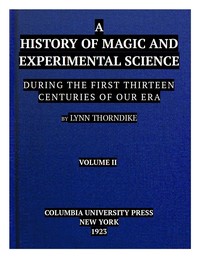
A History of Magic and Experimental Science, Volume 2 (of 2) by Lynn Thorndike

(5 User reviews)   945
By Donna Ferrari Posted on Jan 12, 2026
In Category - Money Basics
Thorndike, Lynn, 1882-1965 Thorndike, Lynn, 1882-1965
English
Ever wondered where science ends and magic begins? Lynn Thorndike's second volume tackles this question head-on. Forget the wizards and wands – this book explores the real, messy history of how people tried to understand their world. Thorndike takes us through the 16th and 17th centuries, a time when brilliant minds were doing serious experiments with one hand and consulting ancient magical texts with the other. The book’s main question is fascinating: Why did smart, educated people believe in alchemy, astrology, and natural magic for so long? It’s a story of failed ideas, stubborn beliefs, and the slow, confusing birth of the modern scientific mindset. If you think the history of science is a straight line from ignorance to truth, this book will make you think again.
Share

Read "A History of Magic and Experimental Science, Volume 2 (of 2) by Lynn Thorndike" Online

This book is available in the public domain. Start reading the digital edition below.

START READING FULL BOOK
Instant Access    Mobile Friendly

Book Preview

A short preview of the book’s content is shown below to give you an idea of its style and themes.

magic--Five sub-divisions of magic--_De bestiis et aliis rebus_. [Sidenote: Relation of scholastic theology to our theme.] The names of Peter Abelard, 1079-1142, and Hugh or Hugo of St. Victor, 1096-1141, have been coupled as those of the two men who perhaps more than any others were the founders of scholastic theology. Our investigation is not very closely or directly concerned with scholastic theology, which I hope to show did not so exclusively absorb the intellectual energy of the twelfth and thirteenth centuries as has sometimes been asserted. Our attention will be mainly devoted as heretofore to the pursuit of natural science during that period and the prominence both of experimental method and of magic in the same. But our investigation deals not only with magic and experimental science, but with their relation to Christian thought. It is therefore with interest that we turn to the works of these two early representatives of scholastic theology, and inquire what cognizance, if any, they take of the subjects in which we are especially interested. As we proceed into the later twelfth and thirteenth centuries in subsequent chapters, we shall also take occasion to note the utterances of other leading men of learning who speak largely from the theological standpoint, like John of Salisbury and Thomas Aquinas. Let us hasten to admit also that the scholastic method of instruction and writing made itself felt in natural science and medicine as well as in theology, as a number of our subsequent chapters will illustrate. In the present chapter we shall furthermore be brought again into contact with the topic of the _Physiologus_ and Latin Bestiaries, owing to the fact that a treatise of this sort has been ascribed, although probably incorrectly, to Hugh of St. Victor. [Sidenote: Character of Abelard’s learning.] There is no more familiar, and possibly no more important, figure in the history of Latin learning during the twelfth century than Peter Abelard who flourished at its beginning. His career, as set forth in his own words, illustrates educational conditions in Gaul at that time. His brilliant success as a lecturer on logic and theology at Paris reveals the great medieval university of that city in embryo. His pioneer work, _Sic et Non_, set the fashion for the standard method of presentation employed in scholasticism. He was not, however, the only daring and original spirit of his time; his learned writings were almost entirely in those fields known as patristic and scholastic; and, as in the case of _Sic et Non_, consist chiefly in a repetition of the utterances of the fathers. This is especially true of his statements concerning astrology, the _magi_, and demons. To natural science he gave little or no attention. Nevertheless his intellectual prominence and future influence make it advisable to note what position he took upon these points. [Sidenote: Incorrect statements of his views.] Although not original, his views concerning the stars and their influences are the more essential to expose, because writers upon Abelard have misunderstood and consequently misinterpreted them. Joseph McCabe in his Life of Abelard,[1] for instance, asserts that Abelard calls mathematics diabolical in one of his works. And Charles Jourdain in his in some ways excellent[2] _Dissertation sur l’état de la philosophie naturelle en occident et principalement en France pendant la première moitié du XIIe siècle_, praises Abelard for what he regards as an admirable attack upon and criticism of astrology in his _Expositio in Hexameron_, saying, “It will be hard to find in the writers of a later age anything more discriminating on the errors of astrology.”[3] Jourdain apparently did not realize the...

This is a limited preview. Download the book to read the full content.

This isn't a story in the traditional sense. It's a deep, detailed look at a pivotal 200-year period. Thorndike tracks the intellectual journey from the late Middle Ages into the early modern era. He introduces us to dozens of thinkers, from famous names like Paracelsus and Francis Bacon to lesser-known scholars and natural philosophers.

The Story

The book follows the slow, often contradictory, evolution of thought. It shows how magical ideas about the universe—like astrology's influence or alchemy's promise—were deeply woven into the fabric of early science. You'll see how experiments were conducted to prove magical theories, and how the tools of science (observation, recording) were often used in the service of magic. The 'conflict' is the internal struggle of an era trying to separate useful knowledge from superstition, a battle that was far from clear-cut.

Why You Should Read It

What I love is how it humanizes the past. These weren't fools; they were people using the best tools and ideas they had. Thorndike doesn't judge them by modern standards. Instead, he lays out their beliefs and practices, letting you see the logic (however flawed) for yourself. It makes you appreciate how hard it is to change a whole way of thinking. You start to see our own scientific certainties in a new, more humble light.

Final Verdict

This is a serious book for curious minds. It's perfect for readers who love history, especially the history of ideas, and for anyone who's ever been fascinated by the 'weird' side of science's past. It's dense and packed with information, so it's not a light read. But if you're willing to put in the time, it offers a truly unique and eye-opening perspective on how we learned to study the world.


ℹ️ Legal Disclaimer

This work has been identified as being free of known copyright restrictions. Preserving history for future generations.

Liam Hernandez
1 month ago

After looking for this everywhere, the technical accuracy of the content is spot on. Don't hesitate to download this.

Carol Thomas
1 month ago

From a technical perspective, the presentation of ideas feels natural and engaging. An unexpectedly enjoyable experience.

Carol Thomas
4 months ago

Given the topic, the storytelling feels authentic and emotionally grounded. This made complex ideas feel approachable.

Christopher Lopez
4 months ago

At first glance, the plot twists are genuinely surprising without feeling cheap or forced. It exceeded all my expectations.

Patricia Torres
4 months ago

From a casual reader’s perspective, the formatting of this PDF is flawless and easy to read on any device. This left a lasting impression on me.
4.5
4.5 out of 5 (5 User reviews )

Add a Review

Your Rating *
There are no comments for this eBook.
You must log in to post a comment.
Log in

Related eBooks