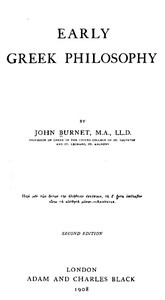
Early Greek philosophy by John Burnet

(4 User reviews)   891
By Donna Ferrari Posted on Jan 12, 2026
In Category - Money Basics
Burnet, John, 1863-1928 Burnet, John, 1863-1928
English
Ever wondered where Western thinking really started? Forget Socrates and Plato for a moment. John Burnet's 'Early Greek Philosophy' takes you back to the real beginning, to a wild bunch of thinkers who asked the first big questions about everything from atoms to the soul. They didn't have labs or libraries—just their own minds. Burnet makes these ancient ideas feel fresh and surprisingly urgent. If you're curious about why we think the way we do, this book is the fascinating origin story you didn't know you needed.
Share

Read "Early Greek philosophy by John Burnet" Online

This book is available in the public domain. Start reading the digital edition below.

START READING FULL BOOK
Instant Access    Mobile Friendly

Book Preview

A short preview of the book’s content is shown below to give you an idea of its style and themes.

This version of the text cannot represent certain typographical effects. Italics are delimited with the ‘_’ character as _italic_. The single instance of a superscript is given as ‘Z^5’. In the original text, footnote references were numbered, beginning with ‘1’ on each page. They have been renumbered consecutively for uniqueness and have been moved to follow the paragraphs in which they are referenced. References to notes in the index and elsewhere have been changed to reflect the revised numbers. Minor errors, attributable to the printer, have been corrected. Please see the transcriber’s note at the end of this text for details regarding the handling of any textual issues encountered during its preparation. EARLY GREEK PHILOSOPHY BY JOHN BURNET, M.A., LL.D. PROFESSOR OF GREEK IN THE UNITED COLLEGE OF ST. SALVATOR AND ST. LEONARD, ST. ANDREWS Περὶ μὲν τῶν ὄντων τὴν ἀλήθειαν ἐσκόπουν, τὰ δ’ ὄντα ὑπέλαβον εἶναι τὰ αἰσθητὰ μόνον.—ARISTOTLE. _SECOND EDITION_ LONDON ADAM AND CHARLES BLACK 1908 _First Edition published April 1892._ PREFACE TO THE SECOND EDITION It has been no easy task to revise this volume in such a way as to make it more worthy of the favour with which it has been received. Most of it has had to be rewritten in the light of certain discoveries made since the publication of the first edition, above all, that of the extracts from Menon’s Ἰατρικά, which have furnished, as I believe, a clue to the history of Pythagoreanism. I trust that all other obligations are duly acknowledged in the proper place. It did not seem worth while to eliminate all traces of a certain youthful assurance which marked the first edition. I should not write now as I wrote at the age of twenty-five; but I still feel that the main contentions of the book were sound, so I have not tried to amend the style. The references to Zeller and “Ritter and Preller” are adapted throughout to the latest editions. The Aristotelian commentators are referred to by the pages and verses of the Berlin Academy edition, and Stobaeus by those of Wachsmuth. J. B. ST. ANDREWS, 1908. PREFACE TO THE FIRST EDITION No apology is needed for the appearance of a work dealing with Early Greek Philosophy. The want of one has long been felt; for there are few branches of philology in which more progress has been made in the last twenty years, and the results of that progress have not yet been made accessible to the English reader. My original intention was simply to report these results; but I soon found that I was obliged to dissent from some of them, and it seemed best to say so distinctly. Very likely I am wrong in most of these cases, but my mistakes may be of use in calling attention to unobserved points. In any case, I hope no one will think I have been wanting in the respect due to the great authority of Zeller, who was the first to recall the history of philosophy from the extravagances into which it had wandered earlier in the century. I am glad to find that all my divergences from his account have only led me a little further in the path that he struck out. I am very sensible of the imperfect execution of some parts of this work; but the subject has become so large, and the number of authorities whose testimony must be weighed is so great, that it is not easy for any one writer to be equally at home in all parts of the field. I have consulted the student’s convenience by...

This is a limited preview. Download the book to read the full content.

This isn't a story in the traditional sense, but it's a detective story of the mind. John Burnet pieces together the fragments of thought left by philosophers who lived before Socrates, like Thales, Heraclitus, and Parmenides. These guys were trying to figure out the basic rules of the universe with almost no tools except observation and logic. What is everything made of? How does change happen? Can we trust our senses? Burnet acts as your guide, explaining their often strange-sounding ideas in clear terms and showing how they argued with each other, building the very foundation of science and philosophy.

Why You Should Read It

I loved how this book connects the dots. You suddenly see how a question from 2,500 years ago about 'water being the first principle' is part of the same human drive that leads to modern physics. Burnet has a real passion for his subject, and it's contagious. He treats these thinkers with respect, not as primitive guesses, but as brilliant, logical minds working with what they had. It makes you appreciate how radical and brave it was to look at the world and try to explain it without referring to gods or myths.

Final Verdict

Perfect for curious minds who enjoy big ideas and a bit of intellectual history. You don't need a philosophy degree; you just need to be the kind of person who asks 'why?' or 'how?'. If you've ever enjoyed a popular science book about the universe's origins, you'll find the philosophical version of that journey here. It's a rewarding read that stretches your brain and gives you a deep appreciation for where our whole tradition of questioning began.


🟢 License Information

This is a copyright-free edition. It is available for public use and education.

Steven Hill
4 months ago

After finishing this book, the structure supports both quick reading and deep study. Time very well spent.

Elizabeth Jones
1 month ago

I didn’t think I would enjoy this, but the author's voice is distinct, making the complex topics easy to digest. Simply brilliant.

Anthony Jones
3 months ago

After years of reading similar books, the insights offered are both practical and thought-provoking. Don't hesitate to download this.

Steven Wilson
1 week ago

After years of reading similar books, the style is confident yet approachable. I will be reading more from this author.
4
4 out of 5 (4 User reviews )

Add a Review

Your Rating *
There are no comments for this eBook.
You must log in to post a comment.
Log in

Related eBooks