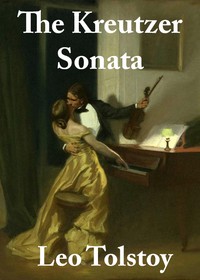
The Kreutzer Sonata and Other Stories by graf Leo Tolstoy

(5 User reviews)   987
By Donna Ferrari Posted on Jan 12, 2026
In Category - Money Basics
Tolstoy, Leo, graf, 1828-1910 Tolstoy, Leo, graf, 1828-1910
English
Ever read a book that makes you sit up and say, 'Wait, what just happened?' That's Tolstoy's 'The Kreutzer Sonata.' It's not your typical historical drama—it's a raw, uncomfortable confession from a man on a train, telling strangers why he murdered his wife. The story spins around jealousy, marriage, and whether love can survive when society tells us to own each other. It's short, brutal, and will stick with you long after you finish. If you're tired of neat endings and want something that feels painfully real, grab this one.
Share

Read "The Kreutzer Sonata and Other Stories by graf Leo Tolstoy" Online

This book is available in the public domain. Start reading the digital edition below.

START READING FULL BOOK
Instant Access    Mobile Friendly

Book Preview

A short preview of the book’s content is shown below to give you an idea of its style and themes.

which evinces a deep study of the subject on the part of the writer. Tolstoy has drawn many of the peculiar customs of the Russian peasant in a masterly manner, and I doubt if he has given a more comprehensive description of this feature of Russian life in any of his other works. In this story also he has presented many traits which are common to human nature throughout the world, and this gives an added interest to the book. The language is simple and picturesque, and the characters are drawn with remarkable fidelity to nature. The moral of this tale points out how the hero Ivan might have avoided the terrible consequences of a quarrel with his neighbor (which grew out of nothing) if he had lived in accordance with the scriptural injunction to forgive his brother’s sins and seek not for revenge. The story of “Polikushka” is a very graphic description of the life led by a servant of the court household of a certain nobleman, in which the author portrays the different conditions and surroundings enjoyed by these servants from those of the ordinary or common peasants. It is a true and powerful reproduction of an element in Russian life but little written about heretofore. Like the other stories of this great writer, “Polikushka” has a moral to which we all might profitably give heed. He illustrates the awful consequences of intemperance, and concludes that only kind treatment can reform the victims of alcohol. For much valuable assistance in the work of these translations, I am deeply indebted to the bright English scholarship of my devoted wife. THE KREUTZER SONATA. CHAPTER I. Travellers left and entered our car at every stopping of the train. Three persons, however, remained, bound, like myself, for the farthest station: a lady neither young nor pretty, smoking cigarettes, with a thin face, a cap on her head, and wearing a semi-masculine outer garment; then her companion, a very loquacious gentleman of about forty years, with baggage entirely new and arranged in an orderly manner; then a gentleman who held himself entirely aloof, short in stature, very nervous, of uncertain age, with bright eyes, not pronounced in color, but extremely attractive,—eyes that darted with rapidity from one object to another. This gentleman, during almost all the journey thus far, had entered into conversation with no fellow-traveller, as if he carefully avoided all acquaintance. When spoken to, he answered curtly and decisively, and began to look out of the car window obstinately. Yet it seemed to me that the solitude weighed upon him. He seemed to perceive that I understood this, and when our eyes met, as happened frequently, since we were sitting almost opposite each other, he turned away his head, and avoided conversation with me as much as with the others. At nightfall, during a stop at a large station, the gentleman with the fine baggage—a lawyer, as I have since learned—got out with his companion to drink some tea at the restaurant. During their absence several new travellers entered the car, among whom was a tall old man, shaven and wrinkled, evidently a merchant, wearing a large heavily-lined cloak and a big cap. This merchant sat down opposite the empty seats of the lawyer and his companion, and straightway entered into conversation with a young man who seemed like an employee in some commercial house, and who had likewise just boarded the train. At first the clerk had remarked that the seat opposite was occupied, and the old man had answered that he should get out at the first station. Thus...

This is a limited preview. Download the book to read the full content.

This collection brings together some of Tolstoy's later, shorter works. The title story, 'The Kreutzer Sonata,' is the main event.

The Story

On a long train ride, a man named Pozdnyshev overhears passengers debating love and marriage. He interrupts them and launches into a shocking monologue. He confesses he killed his wife in a fit of jealous rage. He then walks us through their entire marriage—the initial passion, the slow decay into resentment, and the arrival of a charming violinist. When his wife and the violinist play Beethoven's passionate 'Kreutzer Sonata' together, Pozdnyshev becomes convinced they are having an affair. His jealousy consumes him, leading to a tragic and violent end.

Why You Should Read It

This isn't a cozy read. It's a punch to the gut. Tolstoy throws away any romantic ideas about marriage and shows us the dark side: possession, boredom, and rage. Pozdnyshev is a terrible, unreliable narrator, but you can't stop listening. You're trapped in his head, seeing his twisted logic. It’s a masterclass in building tension through conversation alone. The other stories in the book explore similar heavy themes, like faith and morality, but 'Kreutzer' is the one that will haunt you.

Final Verdict

Perfect for readers who love psychological deep-dives and don't mind an unlikable narrator. If you enjoyed the intense, claustrophobic feel of 'Crime and Punishment' or just want to see a classic author completely dismantle societal norms, this is for you. It's a challenging, thought-provoking book that asks tough questions about love we still struggle to answer.


ℹ️ Copyright Free

This work has been identified as being free of known copyright restrictions. Knowledge should be free and accessible.

Anthony Green
4 months ago

Honestly, the organization of topics is intuitive and reader-friendly. This felt rewarding to read.

Aiden Sanchez
3 weeks ago

At first glance, the progression of ideas feels natural and coherent. I appreciate the effort put into this.

Mason Nelson
3 months ago

It’s rare that I write reviews, but the diagrams and footnotes included in this version are very helpful. It is definitely a 5-star read from me.

Charles Rodriguez
1 month ago

For a digital edition, it creates a vivid world that you simply do not want to leave. An unexpectedly enjoyable experience.

Betty Harris
2 months ago

Make no mistake, the organization of topics is intuitive and reader-friendly. I will be reading more from this author.
5
5 out of 5 (5 User reviews )

Add a Review

Your Rating *
There are no comments for this eBook.
You must log in to post a comment.
Log in

Related eBooks