1

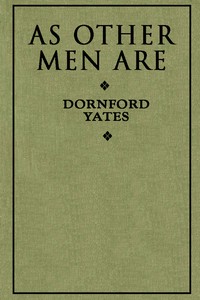
As Other Men Are — Edition Insights
(0 User reviews)
712
Project Gutenberg
2021
Not confirmed
Man-woman relationships -- Fiction; Short stories, English; English fiction -- 20th century; Husband and wife -- Fiction
Readers of public-domain and historical texts
Project Gutenberg digital edition
en
Edition facts
Words
85,605
Reading time
373 min
Text sections
12
For As Other Men Are — Edition Insights, the stored edition analysis reports 85,605 words, 6 hr 13 min estimated reading time, and 12 detected text sections.
The text analysis averages about 10.4 words per sentence, while the detected sections provide another way to judge how the source is divided.
Project Gutenberg metadata also associates the work with “Man-woman relationships -- Fiction,” connecting these edition facts with the source record’s subject description.
Source:
Project Gutenberg record #65387
A collection of twelve stories, each named after a male protagonist, exploring romantic entanglements and social comedy through witty dialogue and sharp observations of early 20th-century manners.
Read the complete public-domain text at its original source.
Read on Project GutenbergThe opening story, 'Jeremy,' introduces readers to the collection's characteristic blend of banter and romantic tension. Jeremy Broke and Eve Malory Carew debate the merits of her cutting her hair, with Jeremy likening it to 'a sort of national treasure.' Their repartee is light but pointed, revealing a dynamic where affection is expressed through teasing. The excerpt ends with a silence that suggests unspoken feelings, hinting at deeper currents beneath the polished surface.
Dialogue as a Window
Yates relies heavily on dialogue to advance character and conflict. In 'Jeremy,' the conversation about Eve's hair occupies nearly the entire excerpt, with each line revealing their personalities: Jeremy's playful hyperbole ('blasphemous') and Eve's pragmatic frustration ('I go through such hell'). The banter is symmetrical, each volley matched, until Jeremy's quiet 'No' breaks the pattern. This shift signals a moment of genuine emotion, a technique Yates uses to punctuate comedy with sincerity.
In 'Ivan,' letters and telegrams replace direct conversation, yet the same verbal sparring persists. Belinda's curt notes and Ivan's increasingly frantic replies build a comedy of miscommunication. The clipped, formal tone of her correspondence contrasts with his emotional outbursts, creating a rhythm that propels the narrative.
The Comedy of Misunderstanding
Miscommunication drives the plot in 'Ivan.' Belinda's letter proposing to visit Les Iles d'Or is met with Ivan's eager reply, but subsequent messages reveal crossed purposes: she delays, he assumes she is already there, and a series of letters and telegrams escalate into farce. The comedy lies in the gap between intention and interpretation—Belinda's casual 'clear out' versus Ivan's frantic 'assisted out of the vestibule.'
Yates heightens the absurdity through contrast: the idyllic setting of Biarritz ('the monarch of a glorious week') versus Ivan's domestic chaos (his servant 'unshaven and travel-stained' on a pile of luggage). The reader is positioned to see the humor in Ivan's suffering, a pattern that recurs across the collection.
Setting as Emotional Barometer
Yates uses weather and landscape to mirror characters' inner states. In 'Ivan,' the English weather is 'consistently vile' while Biarritz is 'bathed in sunshine,' emphasizing Ivan's frustration and longing. When he finally arrives, the description is lush: 'The sky was cloudless, and the sun, a beneficent giant.' This idyllic scene is immediately undercut by the discovery that his villa is occupied, creating a sharp contrast between expectation and reality.
This technique appears in 'Jeremy' more subtly: the conversation takes place in an unspecified but presumably elegant setting, with the 'leisurely disintegration' of something (likely a cigarette or ash) suggesting a languid, upper-class milieu. The physical environment is less detailed, but the social setting—Bond Street, balls, titled names—establishes a world of privilege where romantic dilemmas are the primary concern.
Narrative Structure and Reader Expectations
Each story is named after a male character, yet the excerpts show that women often drive the action. In 'Jeremy,' Eve initiates the conflict; in 'Ivan,' Belinda's letters control the timing of events. This asymmetry creates a dynamic where the titular hero is reactive, a pattern that may hold across the collection.
The stories are self-contained, but the consistent tone—witty, slightly cynical, with a undercurrent of genuine feeling—suggests a unified vision. Readers should expect each tale to revolve around a romantic complication resolved through dialogue and misadventure rather than dramatic action. The excerpts offer no endings, so the resolution of Ivan's villa predicament or Jeremy's unspoken feelings remains open, inviting speculation.
Approach each story as a self-contained vignette, paying attention to how Yates balances humor with pathos. The dialogue rewards close reading: what characters say—and what they leave unsaid—carries the weight of the narrative. The collection's title, As Other Men Are, hints at a theme of ordinary human folly, but the excerpts suggest that these men are anything but ordinary in their romantic predicaments.
There’s a particular ache in those twelve men, each so sure of his own story. I keep thinking about how their quiet failures of understanding echo the larger themes in The Big Idea — Background and Themes, that deeper current beneath the witty surface. Reading them together, I felt less alone in my own confusions.
There are no reviews for this eBook.
There are no comments for this eBook.
Reader reflection
Your personal reading reflection
Build a private reading journal entry for this title.
Your progress
0
/
10
2
How much did you enjoy the reading experience?
3
Is this a title you would suggest to others?
4
How easy was the book to follow?
5
Was the book what you thought it would be?
6
How clear did the writing feel?
7
Did the book give you something worth debating?
8
Could you see yourself revisiting this book?
9
In one sentence, what did you learn?
10