1

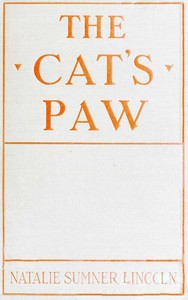
The Cat's Paw — Reading Notes
(0 User reviews)
459
Project Gutenberg
2021
Not confirmed
Detective and mystery stories; Family secrets -- Fiction; Murder -- Investigation -- Fiction; Washington (D.C.) -- Fiction
Readers of public-domain and historical texts
Project Gutenberg digital edition
en
Edition facts
Words
65,167
Reading time
284 min
Text sections
27
For The Cat's Paw — Reading Notes, the stored edition analysis reports 65,167 words, 4 hr 44 min estimated reading time, and 27 detected text sections.
The text analysis averages about 12.6 words per sentence, while the detected sections provide another way to judge how the source is divided.
Project Gutenberg metadata also associates the work with “Detective and mystery stories,” connecting these edition facts with the source record’s subject description.
Source:
Project Gutenberg record #66627
Natalie Sumner Lincoln's 1922 mystery set in Washington, D.C., where Kitty Baird's inheritance and a suspicious death entangle her with a cast of guarded characters. The narrative shifts between tense dialogue and brisk action, with a cat named Mouchette as a recurring motif.
Read the complete public-domain text at its original source.
Read on Project GutenbergThe Cat's Paw opens with a confrontation that establishes its central dynamic: Miss Susan Baird, a seventy-year-old guardian, ridicules a suitor who wishes to marry her niece, Kitty. The scene is built on sharp dialogue—Miss Baird's 'talonlike fingers' and 'shrill laughter' contrast with the suitor's 'stubborn determination.' This early exchange sets a pattern of verbal sparring and withheld information that persists throughout the excerpts.
Lincoln's prose moves between clipped, tense exchanges and moments of observational detail, such as Kitty noting a waiter slipping a note to a companion. The setting—Washington, D.C., with references to the Shoreham hotel, Fort Myer, and 'Rose Hill'—grounds the mystery in a specific, recognizable geography.
Voice and Verbal Dueling
The excerpts reveal a narrative voice that favors dialogue as the primary engine of conflict and revelation. Characters rarely speak directly; instead, they parry, deflect, and probe. Miss Baird's opening line—'So you wish to marry my niece, Kitty'—is immediately undercut by her laughter, weaponizing tone against content. Later, Kitty responds to a question about her fortune with dry evasion: 'It depends on how you compute wealth. And how much faith you put in newspapers.'
This verbal fencing extends to the narration itself, which often reports a character's expression or gesture rather than their inner state. When Wallace flushes and speaks 'with unconcealed bitterness,' the reader infers emotion from external cues. The effect is a story told through surfaces—what is said, what is seen—leaving motives and feelings ambiguous.
Pacing and the Interruption of Action
Lincoln controls pace by alternating sustained dialogue with sudden interruptions. In the opening chapter, the suitor's declaration is cut off by Miss Baird's 'Wait.' Later, a street collision halts a tense conversation between Kitty and Wallace: 'There's no fun in being jostled about by idiots!' The pattern recurs when a mutual acquaintance 'swooped down upon them' just as Wallace is about to answer a crucial question.
These interruptions serve multiple functions: they delay revelation, heighten frustration, and mimic the unpredictability of real life. They also shift the scene's rhythm, forcing characters to reset their emotional tone. The effect is a narrative that feels constantly on the verge of disclosure, only to be pulled back.
Recurring Details and the Cat Motif
The title The Cat's Paw finds its echo in a chapter heading: 'Mouchette, the Seven-Toed.' While the excerpts do not reveal the cat's role, the animal's name—French for 'little fly' or a type of cat—and the specific detail 'seven-toed' suggest a distinctive physical trait that may carry symbolic or plot weight. The cat appears only in the table of contents, but its presence as a chapter title implies it is a recurring element, possibly linked to the family secrets and murder investigation cataloged in the subjects.
Other recurring details include the silver sugar bowl Miss Baird fumbles with, the taxi ride that bundles Kitty away, and the repeated motif of notes being passed—all small, tangible objects that accumulate significance across scenes.
Readers attentive to language will find Lincoln's dialogue-driven style rewards careful attention to what is left unsaid. The excerpts offer no resolution to the mystery of Kitty's inheritance or the death that prompts investigation; instead, they establish a world where every conversation is a negotiation and every gesture may conceal a clue. Approach the text as a puzzle of voices and silences.
That old D.C. mystery, with its guarded rooms and that cat always underfoot, left a particular quiet ache in me—the way a house can hold secrets without ever saying so. It reminded me of something softer I found later, tracing those same shadows into woodlands and memory. Out of the Woods — Background and Themes felt like sitting beside that feeling, just breathing.
There are no reviews for this eBook.
There are no comments for this eBook.
Reader reflection
Before you leave, reflect on the book
Use these questions to collect your thoughts before moving on.
Your progress
0
/
10
2
What was your overall reaction to the book?
3
How likely are you to recommend this book?
4
What was the reading difficulty like?
5
Did the book offer a fresh perspective?
6
Did any part of the book feel personally relevant?
7
How much did the book move you?
8
How useful were the ideas in this book?
9
In one sentence, what did you learn?
10