1

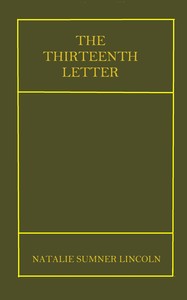
The Thirteenth Letter — A Closer Reading
(0 User reviews)
1506
Project Gutenberg
2022
Not confirmed
Detective and mystery stories; Murder -- Investigation -- Fiction; Nurses -- Fiction; Washington (D.C.) Region -- Fiction
Readers of public-domain and historical texts
Project Gutenberg digital edition
en
Edition facts
Words
66,557
Reading time
290 min
Text sections
28
The Thirteenth Letter — A Closer Reading can be approached with a clearer sense of reading commitment from its source measurements: 66,557 words, 4 hr 50 min estimated reading time, and 28 detected text sections.
The text analysis averages about 12.9 words per sentence, while the detected sections provide another way to judge how the source is divided.
Project Gutenberg metadata also associates the work with “Detective and mystery stories,” connecting these edition facts with the source record’s subject description.
Source:
Project Gutenberg record #67890
A 1923 mystery set in Washington, D.C., involving a nurse, a clergyman's wife, and a missing letter. The excerpts reveal tense bedside conversations, a snowstorm, and a stamp code, but the catalog subjects oversimplify the narrative's focus on domestic suspicion and hidden knowledge.
Read the complete public-domain text at its original source.
Read on Project GutenbergThe opening chapter of The Thirteenth Letter immediately establishes a claustrophobic atmosphere: a white-capped nurse draws curtains against a whirling snowstorm, and the lamplight inside reveals a physician, Doctor Roberts, taking a patient's pulse. The patient, Abbott, is too weak to eat, and the nurse, Miriam Ward, is soon drawn into tense exchanges with Mrs. Nash, a sharp-eyed woman recovering from illness. The catalog lists this as a murder investigation story, but the excerpts so far show no corpse—only suspicion, evasive answers, and a missing young woman named Betty Carter who has been visiting a cemetery at night.
A Nurse's Perspective on Domestic Tension
The excerpts center on Miriam Ward, a trained nurse whose professional observations anchor the narrative. She notes Doctor Roberts's negative shake of the head as he checks Abbott's pulse, and later watches Mrs. Nash's 'sharp, black eyes' detect her husband's constrained manner. The story's voice is filtered through Miriam's silent judgments: she sees the clergyman Nash squirm under his wife's unswerving gaze, and she deliberately turns her back on him when he enters the sickroom. This limited viewpoint keeps the reader inside the house, reliant on what Miriam sees and hears—a structural choice that builds mystery from ordinary domestic interactions rather than from police procedures or forensic clues.
The Stamp Code and the Thirteenth Letter
The author's note acknowledges a 'cleverly devised stamp code' contributed by Alain Campbell White, which is utilized in the novel. This code is likely central to the title's 'Thirteenth Letter'—possibly a cipher or a hidden message within a series of stamps. The excerpts do not reveal the code in action, but the table of contents includes chapters titled 'The Folded Note,' 'The Human Eye,' and 'The Thirteenth Letter,' suggesting that written or printed documents are key evidence. Readers should watch for any mention of stamps, envelopes, or unusual markings in the text, as these may carry encoded information that the characters must decipher.
Setting as a Character: Washington, D.C., and a Snowstorm
The story is set in the Washington, D.C., region, but the excerpts focus on interior spaces: a lamp-lit sickroom, a hall alcove, and a clergyman's home. The snowstorm outside is described as 'whirling' and 'outer darkness,' isolating the characters and heightening the tension of late-night conversations. The cemetery visit mentioned by Mrs. Nash—Betty Carter went there at night—and the reference to Sheriff Trenholm's house two miles away suggest a rural or suburban setting rather than a city center. This combination of a storm, a sickbed, and a missing young woman creates a closed-circle atmosphere where every character's movements are scrutinized.
Because the excerpts cover only the first chapter and the author's note, the full plot—including the murder mentioned in the catalog—remains unseen. Readers should pay attention to how the stamp code is introduced and whether the 'thirteenth letter' refers to a physical object, a cipher key, or a chapter number. The nurse's perspective may shift as the story progresses, so note any changes in Miriam Ward's role from observer to participant.
That rainy afternoon, I kept returning to the nurse’s wary glances in The Thirteenth Letter, the way a snowstorm could bury a secret so quietly. It made me think of how little we truly know of the women in those rooms. Later, almost by chance, I found Jenny: A Novel — Key Ideas to Explore, and the same hush lingered there, only softer.
There are no reviews for this eBook.
There are no comments for this eBook.
Reader reflection
Record your reading impressions
A brief reflection can help important ideas stay with you longer.
Your progress
0
/
10
2
Was reading this book enjoyable?
3
How likely are you to recommend this book?
4
Did the language feel accessible?
5
Did you gain anything practical from the text?
6
Was the book what you thought it would be?
7
Did you relate to its people, ideas, or situations?
8
Could you see yourself revisiting this book?
9
What did this book teach you most?
10