1

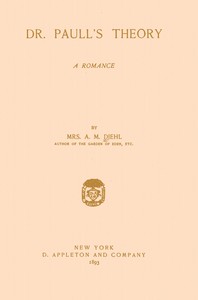
Dr. Paull's Theory: A Romance — Edition Insights
(0 User reviews)
755
Project Gutenberg
2022
Not confirmed
England -- Fiction; Physicians -- Fiction; Man-woman relationships -- Fiction; Reincarnation -- Fiction
Readers of public-domain and historical texts
Project Gutenberg digital edition
en
Edition facts
Words
77,572
Reading time
338 min
Text sections
18
The catalog record for Dr. Paull's Theory: A Romance — Edition Insights provides practical reading context through 77,572 words, 5 hr 38 min estimated reading time, and 18 detected text sections.
The text analysis averages about 14.0 words per sentence, while the detected sections provide another way to judge how the source is divided.
Project Gutenberg metadata also associates the work with “England -- Fiction,” connecting these edition facts with the source record’s subject description.
Source:
Project Gutenberg record #67437
Alice M. Diehl's 1893 novel uses diary entries, letters, and notebook extracts to explore a physician's theory of reincarnation and the strain it places on his marriage, with dialogue and description revealing character through voice and gesture.
Read the complete public-domain text at its original source.
Read on Project GutenbergThe novel opens with house-surgeon Hugh Paull interrupted at his writing-desk by a porter announcing an accident: an old gentleman thrown from a carriage. The scene establishes Paull’s professional composure—he dismisses the screen for the dying, feels the pulse, listens at the heart, and orders the patient undressed. Diehl’s narration moves briskly between clinical observation and the subdued drama of a hospital ward, where a “grand face” lies “still as death.” This early moment signals the book’s interest in the boundary between life and death, and in the authority of medical judgment.
Diction of the Consulting Room
Diehl’s prose is notably precise when rendering medical procedure. In the accident ward, Paull “felt the patient’s pulse, listened at his heart, opened the closed eyelids, placed his hand lightly on his brow.” The sequence of verbs—felt, listened, opened, placed—mirrors a diagnostic routine, each action deliberate and unadorned. The dialogue of the porter is similarly functional: “Wanted, sir. Accident just brought in.” No exclamation, no emotion. The dresser’s flushed face and request for a screen contrast with Paull’s curt “Take it away.” Diehl uses these small verbal choices to differentiate characters: the dresser anticipates death; Paull resists it. Later, when Paull speaks of his wife Lilia, his language shifts to frustration: “I thought I had married a woman who would bravely face life at my side, not shrink and cower at shadows like a nervous horse.” The simile is clinical, almost diagnostic, comparing her to a skittish animal. Such diction keeps the reader inside Paull’s professional mindset, even in domestic scenes.
Voice Through Diary and Letter
The novel’s structure relies on multiple first-person documents: Hugh Paull’s diary, an initial letter, and an old notebook of Lilia Pym. Each voice carries distinct rhythms. Paull’s diary entries are dated and reflective, often interrupted—as when he writes “I was interrupted after that last word” by Lilia’s frightened entrance. The diary form allows Diehl to show Paull’s private irritation and his effort to rationalize his wife’s behavior. In contrast, the letter from Daisy (Paull’s sister) uses a more colloquial, exasperated tone: “the poor people we go to see are beginning to think that you beat her, or something.” Daisy’s voice is direct, even blunt, and her report of Dame Ashwell’s “disgusted” look provides an external perspective on Lilia’s misery. The notebook of Lilia Pym, mentioned in the table of contents, suggests a third voice—likely more intimate or confessional. Diehl thus builds a polyphonic narrative where the same events are refracted through different speakers, each with their own vocabulary and emotional register.
Recurring Gestures and Physical Detail
Diehl repeatedly uses physical gestures to convey inner states. When Lilia appears in her dressing-gown, “her heart was beating, she was trembling.” Paull responds by taking her on his knee and shutting his book into a drawer—a small but telling action that separates his work from her need. Earlier, the old gentleman’s face is described as “a model for a painter,” a phrase that aestheticizes the patient even as Paull works to save him. In the diary, Paull notes that Dr. Hildyard, after visiting, called Lilia “a perfect baby.” The metaphor recurs: Lilia is compared to a child, a nervous horse, a non-entity when away from her husband. These repeated images build a portrait of dependency that the novel examines without resolving. The physical details—the trembling, the beating heart, the closed drawer—anchor the psychological drama in observable behavior, allowing Diehl to suggest tension without explicit commentary.
Setting as Psychological Mirror
The settings in the excerpts are few but carefully chosen. The hospital room is quiet because “the thoroughfares near to the hospital were blocked” by a public event; the external disturbance creates an internal calm that is then broken by the accident. The Pinewood, where Paull and Lilia live, is evoked through Daisy’s mention of “the thatched cottage at the end of Swain’s Lane” and “the wood picking up fir-cones.” These details suggest a rural retreat, but one where neighbors observe and gossip. The contrast between the city hospital—a place of ordered emergency—and the country home, where Lilia’s moods are scrutinized by Dame Ashwell, underscores the novel’s central conflict: Paull’s professional world demands rationality and control, while his domestic life is marked by emotional volatility. Diehl does not elaborate the settings; she uses them as backdrops that amplify character. The blocked streets, the quiet room, the fir-cone wood—each functions as a stage for a specific kind of encounter, medical or marital.
Readers attentive to Diehl’s craft will notice how she withholds judgment, letting the diary and letters speak for themselves. The novel does not declare whether Paull’s theory is valid or his treatment of Lilia just; instead, it presents conflicting testimonies. Pay attention to who gets the last word in each section, and to the small physical details—a closed drawer, a trembling hand—that carry more weight than any explicit statement. The romance promised in the subtitle may lie less in conventional love than in the fraught negotiation between two people trying to inhabit the same story.
That grey afternoon, Dr. Paull’s Theory lingered in my hands—the quiet ache of a marriage strained by abstract belief, the rain ticking like a clock. I set it down and reached for something else, almost without thinking, and found myself in The Curse of Eve — Inside the Classic. Same restless beat, different body. The stories seemed to whisper to each other across the shelf.
There are no reviews for this eBook.
There are no comments for this eBook.
Reader reflection
Take a moment to reflect on this book
Create a short personal record of your experience with this book.
Your progress
0
/
10
2
What was your overall reaction to the book?
3
Would you pass this book on to a friend?
4
How demanding did the text feel?
5
How strongly did the book affect you emotionally?
6
Did the book give you something worth debating?
7
Did you relate to its people, ideas, or situations?
8
What was the strongest part of the book?
9
What is the main idea you are taking away?
10