1

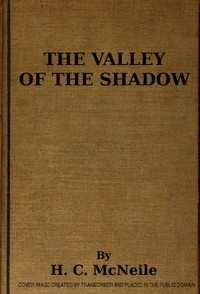
The Valley of the Shadow — Background and Themes
(0 User reviews)
694
Project Gutenberg
2020
Not confirmed
Short stories; Triangles (Interpersonal relations) -- Fiction; Attempted murder -- Fiction; Husband and wife -- Fiction
Readers of public-domain and historical texts
Project Gutenberg digital edition
en
Edition facts
Words
9,870
Reading time
43 min
Text sections
2
For The Valley of the Shadow — Background and Themes, the stored edition analysis reports 9,870 words, 43 min estimated reading time, and 2 detected text sections.
The text analysis averages about 15.3 words per sentence, while the detected sections provide another way to judge how the source is divided.
Project Gutenberg metadata also associates the work with “Short stories,” connecting these edition facts with the source record’s subject description.
Source:
Project Gutenberg record #61669
H. C. McNeile's 1924 short story opens with Hilda Garling's repeated question about why her husband invited Jack Denver to stay, establishing a tense marital triangle. The narrative shifts to a trapped-in-a-glass-tower climax, where Jack and Hilda struggle for survival against Hubert Garling's maniacal surveillance.
Read the complete public-domain text at its original source.
Read on Project GutenbergThe story begins with Hilda Garling's internal repetition of a single question—'Why had her husband asked Jack Denver to stay?'—a device that immediately signals obsessive unease. The opening paragraphs establish a marriage defined by seclusion: Hubert Garling has become a recluse, shutting himself away for days, and the house feels like a prison. Hilda's attempts to host guests fail because her husband's indifference drives them away. The doctor's diagnosis of heart trouble adds a layer of medical constraint, yet the narrative withholds Hubert's motives, leaving the reader to wonder whether his invitation to Jack is a rare social gesture or something more calculated.
A Marriage Built on Duty, Not Love
The early excerpts reveal Hilda's self-awareness: 'It was hypocrisy to pretend to herself that she loved him.' She married Hubert, fourteen years her senior, as a schoolgirl captivated by a 'brilliantly clever and handsome man.' Her parents approved his social and financial status. Now, five years in, she feels trapped. The doctor's warning about Hubert's heart condition becomes her excuse to stay—she 'had the instinct of playing the game very fully developed.' This sense of obligation, not affection, governs her actions. The narrative does not show Hubert's perspective, so readers must infer his reasons for the invitation from his later behavior.
The Trap: A Room of Glass and Cement
The middle excerpt shifts to a confined space: a room with a door that 'fits as tight as a safe door,' no keyhole, and walls of smooth cement. The ceiling is 'flawless glass, immensely thick.' Jack Denver systematically searches for an exit—tearing down silk panels, examining the roof—but finds nothing. The room is 'diabolically efficient,' designed for suffocation. The details are precise: the shoe thrown at the glass, the shouting for help, the growing stuffiness. The narrative emphasizes Jack's calm assurance, then his realization that 'the full gravity of the situation had come home to him.' The trap is not just physical but psychological, as the victims become aware of their dwindling oxygen.
The Watcher Above: Hubert's Maniacal Glee
The climax introduces Hubert Garling as a visible tormentor. He crawls over the glass ceiling 'like some loathsome insect,' pressing his face against it, 'gloating as he watched them.' When Jack hurls a shoe, Hubert starts back, then returns 'shaking with maniacal laughter.' The power dynamic is inverted: the recluse husband becomes an active predator. Hilda's plea to 'turn off the light' plunges the room into darkness, but Hubert's silhouette remains visible against the sky, 'beating furiously against the glass with his fists.' The scene relies on visual horror—the face at the glass, the laughter—rather than explanation. The narrative does not clarify Hubert's motives or his madness; it simply presents his actions as a terrifying spectacle.
A Desperate Ruse: Acting for Survival
Jack devises a plan: pretend to be dead to lure Hubert into opening the door. He instructs Hilda to 'sprawl forward on the floor—face downwards' while he staggers and falls. The dialogue is terse and urgent: 'Act, my beloved, act as you have never acted before.' The excerpt breaks off before the ruse's outcome, leaving the reader in suspense. The plan hinges on Hubert's desire to witness their deaths—a gamble that exploits his sadism. The narrative's structure, shifting from Hilda's domestic anxiety to this life-or-death performance, underscores the story's compression: a marriage crisis escalates into a survival thriller within a few thousand words.
Readers should note how McNeile withholds Hubert's interiority, making him a figure of menace rather than a developed character. The story's brevity—under 10,000 words—means every detail, from the doctor's diagnosis to the glass ceiling, serves the escalating tension. The excerpts do not reveal the ending, so the final pages will determine whether Jack's ruse succeeds and what becomes of the marriage. Pay attention to how the narrative shifts from Hilda's point of view to a more omniscient perspective during the trap scene, and consider whether the story resolves the triangle or leaves it suspended.
That rainy afternoon, the glass tower’s claustrophobia stayed with me long after I closed McNeile’s book, the weight of Hubert’s silent watcher’s gaze. I found myself drifting, half-aimlessly, toward shelves I rarely touch. There, the quiet steadiness of Ronald and I; or, Studies from Life — Text and Context felt like breathing out. A gentler mirror of that same fascination with why people watch each other.
There are no reviews for this eBook.
There are no comments for this eBook.
Reader reflection
What was your reading experience?
Capture what you thought, learned, and would like to remember.
Your progress
0
/
10
2
What was your overall reaction to the book?
3
Would you encourage someone else to read it?
4
How easy was the book to follow?
5
Which aspect of the book did you value most?
6
How strongly did the book affect you emotionally?
7
Did the book give you something worth debating?
8
How strong was your personal connection to the text?
9
What changed or sharpened your thinking?
10