1

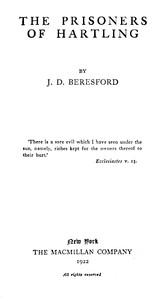
The Prisoners of Hartling — Background and Themes
(0 User reviews)
63
Project Gutenberg
2020
Not confirmed
Inheritance and succession -- Fiction; Country homes -- Fiction; Children of the rich -- Fiction; England -- Social life and customs -- 20th century -- Fiction; Families -- Fiction
Readers of public-domain and historical texts
Project Gutenberg digital edition
en
Edition facts
Words
72,405
Reading time
315 min
Text sections
7
The source record for The Prisoners of Hartling — Background and Themes measures this digital text at 72,405 words, 5 hr 15 min estimated reading time, and 7 detected text sections.
The text analysis averages about 14.8 words per sentence, while the detected sections provide another way to judge how the source is divided.
Project Gutenberg metadata also associates the work with “Inheritance and succession -- Fiction,” connecting these edition facts with the source record’s subject description.
Source:
Project Gutenberg record #61246
An editorial note on how the opening, middle, and later excerpts of J. D. Beresford's 'The Prisoners of Hartling' guide a first reading, focusing on the contrast between freedom and confinement, the dynamics of inheritance, and the shifting power relations within the Kenyon family.
Read the complete public-domain text at its original source.
Read on Project GutenbergThe novel opens with a brisk, colloquial exchange between Arthur Woodroffe and his employer, Dr. Somers, in which Arthur sums up his discontent with the phrase "Dog's life, old man, a dog's life." The dialogue immediately establishes a contrast between Arthur's yearning for "more space" and "more beauty" and the confined, dutiful existence of a general practitioner. This tension between aspiration and limitation recurs throughout the excerpts, often linked to the physical and social constraints of the country house Hartling. The epigraph from Ecclesiastes—"riches kept for the owners thereof to their hurt"—signals that wealth itself will be a source of entrapment, not liberation.
Opening: A Dialogue of Discontent
The first excerpt introduces Arthur Woodroffe as a man caught between two worlds. He is a paid assistant to Dr. Somers, yet his ambitions reach beyond the Peckham surgery. Somers chides him for "hankering after the intoxication of saving wounded under fire," linking Arthur's restlessness to the recent war. The conversation circles around the idea of an "independent income" as a means to freedom, but Arthur insists he would not become a slacker—he would "go in for research or something." This exchange sets up a key question: can financial independence truly satisfy a desire for purpose? The setting—a "little room"—and Arthur's critical look around it reinforce the theme of confinement. The dialogue is natural, even playful, but beneath it lies a serious meditation on vocation and the good life.
Middle: The Weight of Inheritance
In the second excerpt, Arthur confronts Mr. Kenyon, the elderly patriarch of Hartling. The scene is charged with unspoken tensions. Arthur has just quarreled with Eleanor Kenyon, and he suspects the old man may have overheard. Mr. Kenyon's opening remark—"What a wonderful girl she is, isn't she?"—feels pointed, and Arthur is "slightly taken aback." The power dynamics shift rapidly: Arthur initially feels dismissed, then resolves to speak his mind, realizing that his "fear and respect of the old man" were based on "nothing but the longing for comfort and luxury." Mr. Kenyon's pale blue eyes become "the eyes of a hunting animal" when Arthur raises the subject of Hubert. The scene reveals how the promise of inheritance can warp relationships, turning family members into prisoners of expectation. Arthur's decision to speak freely marks a turning point in his own sense of agency.
Later: The Struggle for Freedom
The later excerpt continues Arthur's conversation with Mr. Kenyon, now focused on Hubert, who has "fallen in love." Arthur argues that Hubert's life at Hartling is "dreadfully confined and limited," a judgment that echoes his own earlier complaints. Mr. Kenyon listens without displeasure, but his silence is ambiguous. The scene underscores the novel's central conflict: the desire for personal freedom versus the gravitational pull of family obligation and wealth. Arthur's role as an outsider—neither fully a servant nor a family member—allows him to articulate criticisms that those born into the Kenyon world might suppress. The excerpt leaves the outcome uncertain, but it clarifies that the "prisoners" of the title are not only the Kenyons but also those drawn into their orbit. The dialogue is taut, each word carrying weight.
Structure and Voice: A Novel of Talk and Tension
Across the excerpts, Beresford relies heavily on dialogue and interior reflection to advance the narrative. The opening is almost entirely conversation; the middle and later scenes blend speech with Arthur's thoughts. This technique gives the reader direct access to the characters' motivations and doubts. The voice is measured, even clinical at times, but capable of sharp observation—as when Arthur notes that Mr. Kenyon "had an amazing gift of detaching his interest from his surroundings." The setting of Hartling itself is sketched only in fragments: a room, a hearthrug, a copy of the Times. The focus is on psychological rather than physical space. For a first-time reader, attending to who speaks and who remains silent is essential; the power struggles often play out in what is left unsaid.
These excerpts suggest that The Prisoners of Hartling is a novel best read for its dialogue and its quiet, cumulative revelations about character. The epigraph warns that riches can harm their owners, and the opening scenes bear that out: wealth here is less a comfort than a cage. As you read, note how each character's relationship to money and freedom shapes their choices. The novel rewards attention to small gestures—a frown, a hesitation, a shift in tone—that signal larger conflicts beneath the surface of Edwardian country-house life.
Reading about the Kenyons’ quiet struggles with what they inherit—walls, duty, unspoken rules—left me thinking about how we’re often shaped by things we never chose. That same ache of unexpressed years lives in The Old Maid (The 'Fifties) — Key Ideas to Explore, where time feels less like a passage and more like a room that slowly narrows. Such loneliness, simply held.
There are no reviews for this eBook.
There are no comments for this eBook.
Reader reflection
Before you leave, reflect on the book
Use these questions to collect your thoughts before moving on.
Your progress
0
/
10
2
How much did you enjoy the reading experience?
3
Would you encourage someone else to read it?
4
How much effort did this book require?
5
What was the strongest part of the book?
6
How did the reading compare with what you expected?
7
How useful did the reading feel?
8
How closely did the book connect with your experience?
9
Which lesson or insight stayed with you?
10