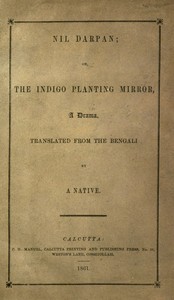
Nil Darpan; or, The Indigo Planting Mirror, A Drama. by Dinabandhu Mitra

(4 User reviews)   324
Mitra, Dinabandhu, 1829-1874 Mitra, Dinabandhu, 1829-1874
English
Imagine being forced to grow a crop that destroys your land and life, all because a foreign company demands it. That's the brutal reality in 'Nil Darpan,' a play that ripped the lid off colonial exploitation in 19th-century Bengal. It's not a dry history lesson—it's a raw, angry drama about Bengali peasants pushed to their absolute limit by British indigo planters. The tension is so thick you can feel it, and the characters' desperation leaps off the page. This is the story that helped fuel a real-life revolution, and it still hits hard today.
Share

Read "Nil Darpan; or, The Indigo Planting Mirror, A Drama. by Dinabandhu Mitra" Online

This book is available in the public domain. Start reading the digital edition below.

START READING FULL BOOK
Instant Access    Mobile Friendly

Book Preview

A short preview of the book’s content is shown below to give you an idea of its style and themes.

This version of the text cannot represent certain typographical effects. Italics are delimited with the ‘_’ character as _italic_. Footnotes have been moved to follow the Scene in which they are referenced. Minor errors, attributable to the printer, have been corrected. Please see the transcriber’s note at the end of this text for details regarding the handling of any textual issues encountered during its preparation. ------------------------------------------------------------------------ NIL DARPAN, OR THE INDIGO PLANTING MIRROR, =A Drama.= TRANSLATED FROM THE BENGALI BY A NATIVE. ------------------ _CALCUTTA_: C. H. MANUEL, CALCUTTA PRINTING AND PUBLISHING PRESS, No. 10, WESTON’S LANE, COSSITOLLAH. --- 1861. ------------------------------------------------------------------------ INTRODUCTION. ---------- The original Bengali of this Drama—the NIL DARPAN, OR INDIGO PLANTING MIRROR—having excited considerable interest, a wish was expressed by various Europeans to see a translation of it. This has been made by a Native; both the original and translation are _bonâ fide_ Native productions and depict the Indigo Planting System as viewed by Natives at large. The Drama is the favourite mode with the Hindus for describing certain states of society, manners, customs. Since the days of Sir W. Jones, by scholars at Paris, St. Petersburgh, and London, the Sanskrit Drama has, in this point of view, been highly appreciated. The Bengali Drama imitates in this respect its Sanskrit parent. The evils of Kulin Brahminism, widow marriage prohibition, quackery, fanaticism, have been depicted by it with great effect. Nor has the system of Indigo planting escaped notice: hence the origin of this work, the NIL DARPAN, which, though exhibiting no marvellous or very tragic scenes, yet, in simple homely language, gives the “annals of the poor;” pleads the cause of those who are the feeble; it describes a respectable ryot, a peasant proprietor, happy with his family in the enjoyment of his land till the Indigo System compelled him to take advances, to neglect his own land, to cultivate crops which beggared him, reducing him to the condition of a serf and a vagabond; the effect of this on his home, children, and relatives are pointed out in language, plain but true; it shows how arbitrary power debases the lord as well as the peasant; reference is also made to the partiality of various Magistrates in favor of Planters and to the Act of last year penally enforcing Indigo contracts. Attention has of late years been directed by Christian Philanthropists to the condition of the ryots of Bengal, their teachers, and the oppression which they suffer, and the conclusion arrived at is, that there is little prospect or possibility of ameliorating the mental, moral, or spiritual condition of the ryot without giving him security of landed-tenure. If the Bengal ryot is to be treated as a serf, or a mere squatter or day-labourer, the missionary, the school-master, even the Developer of the resources of India, will find their work like that of Sisyphus—vain and useless. Statistics have proved that in France, Switzerland, Holland, Belgium, Sweden, Denmark, Saxony, the education of the peasant, along with the security of tenure he enjoys on his small farms, has encouraged industrious, temperate, virtuous, and cleanly habits, fostered a respect for property, increased social comforts, cherished a spirit of healthy and active independence, improved the cultivation of the land, lessened pauperism, and has rendered the people averse to revolution, and friends of order. Even Russia is carrying out a grand scheme of serf-emancipation in this spirit. It is the earnest wish of the writer of these lines that harmony may be speedily established between the Planter and the Ryot, that mutual interests may bind the two classes together, and that the European...

This is a limited preview. Download the book to read the full content.

Published in 1860, Nil Darpan (The Indigo Mirror) holds up a stark reflection of a brutal colonial system. It's a play, but it reads like a frontline report from a war zone—the war being waged on Bengali farmers by British indigo planters.

The Story

The plot follows the lives of Bengali peasants, especially the decent farmer Torap, who are trapped in a vicious cycle. British planters, backed by the law, force them to grow indigo (a blue dye) on their best land instead of food. The system is rigged: the planters provide loans the farmers can never repay, and then use violence and legal threats to keep them enslaved to the crop. We watch as their livelihoods are destroyed, their families humiliated, and their protests met with ruthless force. The drama builds to a powerful, heartbreaking climax of rebellion and tragedy.

Why You Should Read It

This isn't just a historical artifact; it's a shockingly immediate piece of storytelling. Dinabandhu Mitra wrote with fire, creating characters who feel real in their fear, anger, and helplessness. You don't just learn about exploitation; you feel the weight of it through Torap's struggle. Reading it, you understand exactly why this play caused such an uproar—it gave a voice to the voiceless and exposed an ugly truth the authorities wanted buried. It’s the raw, emotional core of a major political movement.

Final Verdict

Perfect for anyone interested in the human stories behind colonial history, or for readers who love socially charged literature. If you've ever wondered how art can change the world, start here. It's a challenging, often painful read, but an essential one that proves a powerful story can be a weapon for justice.


🟢 Usage Rights

This book is widely considered to be in the public domain. Distribute this work to help spread literacy.

Paul Rodriguez
2 months ago

I have to admit, the structure allows easy navigation and quick referencing. This turned out to be a great decision.

Jessica Walker
1 month ago

I have to admit, the examples used throughout the text are practical and relevant. Absolutely essential reading.

Jennifer Mitchell
4 months ago

I needed a solid reference and the narrative structure is incredibly compelling and well-thought-out. This felt rewarding to read.

John Hill
2 months ago

It’s rare that I write reviews, but the style is confident yet approachable. This was both informative and enjoyable.

5
5 out of 5 (4 User reviews )

Add a Review

Your Rating *
There are no comments for this eBook.
You must log in to post a comment.
Log in

Related eBooks