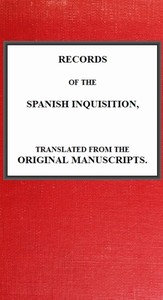
Records of the Spanish Inquisition, Translated from the Original Manuscripts

(4 User reviews)   773
White, Andrew Dickson, 1832-1918 White, Andrew Dickson, 1832-1918
English
Hey, I just finished reading this book about the Spanish Inquisition, and it's not what I expected at all. It's not just a dusty history book—it's like reading a secret file that was never supposed to see the light of day. The translated records show you exactly how the Inquisition worked, in its own words. You get the rules, the interrogations, the justifications. It's chilling because there's no narrator telling you what to think; the documents speak for themselves. The main thing that sticks with you is the sheer, cold bureaucracy of fear. It's a tough but important read that makes you think about power, belief, and what happens when systems stop seeing people.
Share

Read "Records of the Spanish Inquisition, Translated from the Original Manuscripts" Online

This book is available in the public domain. Start reading the digital edition below.

START READING FULL BOOK
Instant Access    Mobile Friendly

Book Preview

A short preview of the book’s content is shown below to give you an idea of its style and themes.

[Every attempt has been made to replicate the original book as printed. Some typographical errors have been corrected. {A list follows the text} No attempt has been made to correct or normalize the printed accentuation or spelling of spanish names or words. (etext transcriber’s note) RECORDS OF THE SPANISH INQUISITION, TRANSLATED FROM THE ORIGINAL MANUSCRIPTS. BOSTON: SAMUEL G. GOODRICH, 141 WASHINGTON STREET. MDCCCXXVIII. DISTRICT OF MASSACHUSETTS, _to wit_: _District Clerk’s Office._ BE IT REMEMBERED, That on the twentysixth day of May, A. D. 1828, in the fiftysecond year of the Independence of the UNITED STATES OF AMERICA, _Samuel G. Goodrich_, of the said district, has deposited in this office, the title of a book, the right whereof he claims as proprietor, in the words following, _to wit_; ‘Records of the Spanish Inquisition, translated from the Original Manuscripts.’ In conformity to the act of the Congress of the United States, entitled ‘An act for the encouragement of learning, by securing the copies of maps, charts, and books, to the authors and proprietors of such copies, during the time therein mentioned;’ and also to an act entitled ‘An act supplementary to an act, entitled, an act for the encouragement of learning, by securing the copies of maps, charts, and books to the authors and proprietors of such copies during the times therein mentioned; and extending the benefits thereof to the arts of designing, engraving and etching historical and other prints.’ JNO. W. DAVIS, _Clerk of the District of Massachusetts_. EXAMINER PRESS. Hiram Tupper, Printer--Bromfield Lane. PREFACE. The manner in which the originals of the following work came into the hands of the translator may be described in a few words. These papers are a part of the Records of the Inquisition of Barcelona, and were obtained during the revolution which broke out at Cadiz in 1819. The province of Catalonia, of which Barcelona is the capital, was one of the most forward and zealous to embrace the cause of freedom. Its inhabitants have, in all times, been distinguished for their daring and determined spirit, and their ardent love of liberty. The revolution moved with rapid strides from the Isle of Leon to the Ebro. On the twentyeighth of February, 1820, the governor of Tarragona received a summons to repair immediately to Madrid, and in a few days the insurrection burst out in the former place. On the fourteenth of March, two days after this, it exploded at Barcelona. The first movement of the revolutionary party was to depose the Captain General of the province. This office was then held by Castañas, a royalist. His predecessor was General Villacampa, an officer of some distinction, who had been deprived of the captain-generalship, and banished to Mataró, a small town on the coast, for his attachment to liberal principles. Castañas was forced to resign, and Villacampa was conducted in triumph from his place of banishment to Barcelona, and reinstated in his dignity by the populace. The government of the city being revolutionized, their next thoughts were directed to the Inquisition, the great engine of priestly oppression, and the object of dread and detestation to the friends of liberty, both political and religious. The vast and gloomy piles of this tribunal, which covered a spot of more than ten times the extent of the Massachusetts State Prison, had been too long the terror of the oppressed and restless Catalonians to escape distinguished notice on this occasion. The populace demanded, with loud cries, of the Captain General, that the Inquisitorial Palace should be thrown open. What answer was given by Villacampa to this demand, does not appear....

This is a limited preview. Download the book to read the full content.

This book isn't a traditional story with a plot. Instead, Andrew Dickson White acts as a translator and compiler, pulling back the curtain on one of history's most infamous institutions. He presents official records—the manuals, trial transcripts, and decrees—that governed the Spanish Inquisition. You're reading the actual instructions on how to identify heretics, conduct an interrogation, and carry out punishments. It's the operational playbook, presented without sugar-coating.

Why You Should Read It

You should read this because it's raw history. There's no fictional drama added. The power comes from seeing how a system of absolute control was built on paper. The language in these documents is often dry and legalistic, which makes it even more disturbing. It shows how cruelty can be packaged as procedure and dogma. Reading it feels like holding a piece of the past that explains so much about fear, authority, and the human capacity for justifying terrible acts in the name of a higher cause.

Final Verdict

This book is perfect for readers who want to go beyond simplified historical summaries and see the primary sources for themselves. It's for anyone interested in the mechanics of power, religious history, or the dark corners of human institutions. Be warned: it's not an easy, breezy read. It's dense and sometimes heavy going. But if you're willing to sit with it, you'll come away with a much deeper, and more unsettling, understanding of this period. It's a book that stays with you.


⚖️ Community Domain

This publication is available for unrestricted use. Thank you for supporting open literature.

Donna Allen
5 months ago

This exceeded my expectations because the style is confident yet approachable. An impressive piece of work.

Mark Clark
4 months ago

Initially overlooked, this book the technical accuracy of the content is spot on. This deserves far more attention.

Edward King
2 months ago

I stumbled upon this by accident and the emotional weight of the story is balanced perfectly with moments of levity. Time very well spent.

William Harris
5 months ago

After years of reading similar books, it manages to explain difficult concepts in plain English. I would gladly recommend this to others.
4.5
4.5 out of 5 (4 User reviews )

Add a Review

Your Rating *
There are no comments for this eBook.
You must log in to post a comment.
Log in

Related eBooks