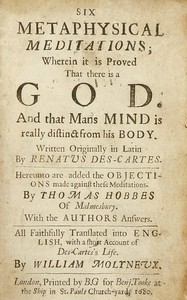
Six metaphysical meditations by René Descartes

(5 User reviews)   593
By Donna Ferrari Posted on Jan 12, 2026
In Category - Budgeting
Descartes, René, 1596-1650 Descartes, René, 1596-1650
English
Hey, have you ever stared at your ceiling at 3 AM wondering what you can actually know for sure? Descartes did that for us 400 years ago. In 'Six Metaphysical Meditations,' he basically hits the reset button on everything he thought was true. He starts by doubting EVERYTHING—his senses, the physical world, even whether he's awake or dreaming. It's a wild mental workout. The payoff is his famous conclusion, 'I think, therefore I am,' which becomes the one solid rock he can build all other knowledge on. It's short, sometimes frustrating, but it completely changed how we think about thinking.
Share

Read "Six metaphysical meditations by René Descartes" Online

This book is available in the public domain. Start reading the digital edition below.

START READING FULL BOOK
Instant Access    Mobile Friendly

Book Preview

A short preview of the book’s content is shown below to give you an idea of its style and themes.

_Renatus Des-Cartes was born on the last day of ~March~ in the year 1596. at ~Tours~, or at ~Castrum Eraldum~ a Town near ~Tours~ in ~France~; He came of an Antient and Noble Family, being by Descent ~Lord~ of ~Perron~, His Father was a Senator of his Country, and a Man of no mean estate, leaving to this his only Son by a second Wife between six and seven thousand pounds a year._ _He was Educated in his younger years according to the manner of his Country (and as he himself recommends in one of his Epistles, ~viz. Epist. 90. partis secundæ~ to One for the Instruction of his Son) in the Aristotelian principles of Philosophy, a whole course whereof he had run through at the Age of seventeen in the Schools of ~Flexia~, or ~La Flesche~ a Town in the Province of ~Anjou~, famous for the Colledge of Jesuites there establish’d by ~Henry~ the ~4th~._ _But to this he did not Continue long devoted, giving early testimonies of his dislike to the unsatisfactory Notions, and verbose emptiness of the Peripatetick Philosophy; He used therefore his utmost endeavours (as he himself testifies in his ~Dissertatio de Methodo~) to get loose from those Chains and Fetters of Mind to which the weakness of his tender years had subjected him._ _To this end he betook himself to a long course of Travel, that by the variety of Objects, which he was likely to meet with in his journeys, the memory of his past Notions might be blotted out; In his travel he applied himself much to the study of the Art Military, and Mathematicks; In the latter he has left the World large testimonies of his Excellence in his ~Book of Geometry~; and in the former we have reason to believe him most expert, for He was personally present at some Sieges and Battles both in ~France~ and ~Germany~, as particularly at the Siege of ~Rochel~, of ~Gava~ near ~Genoa~, of ~Breda~, at the Battle of ~Prague~, ~&c.~ so that we may conclude that he had a Genius fitted (according to the Motto of the noble ~Sir W. Raliegh~) ~Tam Marti, quam Mercurio~, For the Pike as well as Pen. And as the Glorious Roman Emperour became a ~Cæsar~ by his Book as well as Sword, by the Conquests of his mind as well as those of his arm; so our Famous Author was ~Ex Utroque Clarus~._ _In his Travels he spent many years, in all which time he was not Idle, but highly improved himself by his converse with the ~Beaux Esprits~, which he met with in several Regions he visited; The first Place he betook himself to, was ~Italy~, then he went into ~Denmark, Germany, Hungary, &c.~ And after a Long but advantagious Peregrination he return’d to ~Amsterdam~, where he intended to take up his Rest, had he not been called by the French King upon very Honourable terms to ~Paris~; During his Continuance there he so order’d his annual Revenue, that he might be supplied by the hands of a Friend wherever he was. He staid at ~Paris~ three years, and then retired Himself to a solitary village in ~Holland~ called ~Egmond~, where he lived twenty five years, during which time he apply’d himself wholly to the Restauration of true Philosophy, wherein he gave the World such mighty testimonies of his Excellence, that in a short time he became celebrated in the mouths of all Learned Men. Neither were the Courts of Princes silent in his deserved Praises; for after a Retirement of twenty five years he was Invited...

This is a limited preview. Download the book to read the full content.

The Story

There isn't a plot with characters in the usual sense. Instead, the 'story' is the journey of Descartes's own mind. He invites you to follow along as he tries to find absolute certainty. He starts by throwing out all his old beliefs, treating them as if they might be false. What if an evil genius is tricking him? What if he's just a brain in a vat (long before that was a sci-fi trope)? After this radical doubt, he finds his famous anchor point: the fact that he is thinking proves he must exist. From there, he carefully rebuilds his worldview, arguing for the existence of God and the separation of the mind from the physical body.

Why You Should Read It

This book is the birthplace of modern philosophy. It's incredible to watch someone build a system of knowledge from the ground up using pure logic. It feels personal, like you're inside a very smart, very skeptical friend's head as he works through his biggest questions. While you might not agree with all his steps (especially his arguments for God), the method is brilliant. It teaches you to question your assumptions in a fundamental way. It's less about the answers he lands on and more about the fearless process of getting there.

Final Verdict

Perfect for curious thinkers, science fans, or anyone who's ever questioned reality. It's not a light read—you have to go slow and really chew on the ideas. But it's surprisingly short and direct. If you've ever wondered where the idea of 'mind vs. body' came from, or why we say 'I think, therefore I am,' this is the source. Just be ready for your brain to feel a bit sore afterwards, in the best way possible.


🔖 No Rights Reserved

The copyright for this book has expired, making it public property. Distribute this work to help spread literacy.

Matthew Johnson
1 month ago

In my opinion, the presentation feels refined and carefully planned. Well worth recommending.

Deborah Flores
5 months ago

Once I started reading, the tone remains consistent and professional throughout. An unexpectedly enjoyable experience.

Kenneth Taylor
2 weeks ago

I was pleasantly surprised because the author avoids unnecessary jargon, which is refreshing. This made complex ideas feel approachable.

Patricia Torres
3 months ago

I didn’t realize how engaging this would be until the structure supports both quick reading and deep study. This deserves far more attention.

Kenneth Green
3 months ago

I didn’t think I would enjoy this, but it challenges the reader's perspective in the most intellectual way. This was both informative and enjoyable.

5
5 out of 5 (5 User reviews )

Add a Review

Your Rating *
There are no comments for this eBook.
You must log in to post a comment.
Log in

Related eBooks