
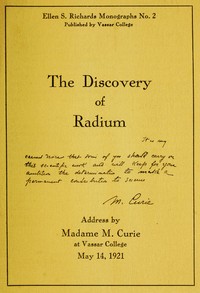
The Discovery of Radium by Marie Curie
Read "The Discovery of Radium by Marie Curie" Online
This book is available in the public domain. Start reading the digital edition below.
Book Preview
A short preview of the book’s content is shown below to give you an idea of its style and themes.
Okay, let's get real: most historical book promotions make old scientists sound like boring museum wax figures. But when you actually read Marie Curie's The Discovery of Radium, you're grabbed by her energy. She doesn't write like I expect a Nobel Prize–winner to—like some grand lecturer giving a speech. Instead, she tells things straight, like you're just grabbing coffee with her and she cannot stop talking because she's so geeked about the problem.
The Story
It all started weird. Back in the 1890s, some guy named Becquerel just discovered that uranium rocks fogged up photo plates without any sunlight. Everyone was confused but moved on. Marie, a broke grad student, took the bait. Her first task didn't sound fancy—she was told to 'Weigh things. Measure radiations.' So she started measuring other thousand pounds of super, super weird radioactive barium—like the most poisonous dirt on Earth mixed with glitter. This was for days at a crack inside a feverish leaky storage shed.
The entire book tells the gory details of her isolating radium. Every time she removed one gross chemical fraction from pitchblende soup, a stronger ray shone. Finally, she got her prize: the gram of shimmering pure radium salt took over FOUR wasted years. It was, she wrote, 'like seeing light written in stone.'
Why You Should Read It
Look, this isn't about memorizing atomic abbreviations. It's a book about real crazy risk versus obsessive weirdness. Curie willingly inhaled toxic particles (and yes, her notebook is still radioactive). That's scary, but also revealing—it tells me science isn't just careful. I personally came away being like—happiness sometimes looks very insane to normal neighbors watching from outside. Curie handled toxic sludge with bare determination because the mystery kept knocking.
Themes of extreme sacrifice and passion echo her point: literally everyone called Big Visions plain stupid until she won a Nobel from it. Later, she brushed off public harassment to—somehow—do triple the amount of work before the irradiation could ruin her spine. Authors often defend these folks as models; Curie shows her indecision, rotten days, and distrust of hangers-on better than novels can.
Final Verdict
Perfect for history-light science readers who hate dense numbers but enjoy shadow whispers, dusty rebellions, and rootable willpower. It reads smoothly—like Grade 8 smooth but legit interesting—very limited. If you loved watching hidden things yell for credit to quiet suspicion (like Dorothy's Culpa plots but real), Curie's chronicle bites. For midtellers after immersive extremes at normal jobs: get nourished. Note: the tiny size (about 92 raw inside pages no wasted wording) carries a charge long after lights off. Four out of five stars: short as a sudden knock—ear piercing deeper than learned nonsense.
This text is dedicated to the public domain. It serves as a testament to our shared literary heritage.
Matthew Jackson
1 month agoUnlike many other resources I've purchased before, the narrative arc keeps the reader engaged while delivering factual content. Highly recommended for those seeking credible information.

Nancy Moore
10 months agoI was skeptical about the depth of this book at first, but the bibliography and references suggest a high level of research and authority. It’s hard to find this much value in a single source these days.