1

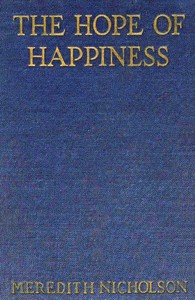
The hope of happiness — Inside the Classic
(0 User reviews)
2714
Project Gutenberg
2022
Not confirmed
City and town life -- Fiction; Fathers and sons -- Fiction; Love stories; Architects -- Fiction; Middle West -- Fiction
Readers of public-domain and historical texts
Project Gutenberg digital edition
en
Edition facts
Words
105,649
Reading time
460 min
Text sections
26
The source record for The hope of happiness — Inside the Classic measures this digital text at 105,649 words, 7 hr 40 min estimated reading time, and 26 detected text sections.
The text analysis averages about 14.5 words per sentence, while the detected sections provide another way to judge how the source is divided.
Project Gutenberg metadata also associates the work with “City and town life -- Fiction,” connecting these edition facts with the source record’s subject description.
Source:
Project Gutenberg record #68399
Meredith Nicholson's 1923 novel follows architect Bruce Storrs as he navigates identity, inheritance, and a tense dinner with Franklin Mills, a man who may be his father. The narrative moves between Midwestern river reverie and New York opulence, using physical action and domestic detail to probe hidden histories.
Read the complete public-domain text at its original source.
Read on Project GutenbergThe novel opens with Bruce Storrs diving into a river from a fallen sycamore, an image that establishes both his physical confidence and a pattern of movement between natural and social worlds. Nicholson devotes careful attention to Bruce's body—his tan, his swimming stroke, the way he tears bark from the log—before shifting to the urban interiors of New York. This early scene, set in late August in the corn belt, introduces a protagonist who measures himself against landscapes and objects as much as against people.
The excerpts reveal a story built around a charged dinner between Bruce and Franklin Mills, a wealthy connoisseur who may be his father. The narrative voice lingers on material details: Mills's old English china, the water glasses, the billiard room's mounted animal heads. These objects become evidence of character and class, while the conversation circles around Laconia, a small town that holds a shared, unspoken past.
Bodies and Rivers
The opening chapter establishes Bruce through physical action: he stands on a log, plunges into water, swims with confident strokes, then tears bark and tosses it into the current. Nicholson describes his body as “perfectly fashioned” and notes his “deeply-tanned hands.” This attention to the protagonist's physique is not merely descriptive; it signals a man who uses his body to test himself. The river scene recurs as a touchstone—Bruce returns to the water after the dinner with Mills, as if to wash away the tension. The narrative treats swimming as a form of self-mastery, a ritual of reassurance.
Later, in Mills's billiard room, the mounted animal heads and photographs of famous horses echo this focus on physical prowess, but in a domesticated, trophy-collecting mode. Bruce's athleticism contrasts with Mills's sedentary connoisseurship. The novel seems to set up a binary between natural vitality and cultivated refinement, though the excerpts do not reveal how this tension resolves.
Objects as Evidence
Nicholson invests objects with psychological weight. Bruce carries a flat canvas bag containing a towel and toilet articles; his shoes bear “the imprint of a metropolitan maker.” At Mills's dinner, the water glasses are described as “a recent acquisition,” and the food is served unhurriedly. These details are not mere set dressing; they reveal character. Mills is a man who “enjoyed the contemplation of precious silver and crystal,” and Bruce, as an architect, is presumably attuned to design.
The dinner scene becomes a duel of observation. Bruce notes Mills's “finely formed head” and calculates whether he has matched his host's composure. The objects on the table—the china, the glasses—serve as neutral ground for a conversation that skirts the real subject: whether Mills is Bruce's father. The narrative uses material culture to mediate emotional confrontation, a technique that gives the novel a restrained, almost forensic tone.
The Weight of Laconia
Laconia, Bruce's hometown, functions as a gravitational center. It is described as settled by Revolutionary soldiers, a “patriotic community.” Mills recalls it with selective nostalgia—Gardner's Grove, the oak trees, the dances. But Bruce knows that Mills's stay there was tied to business for his father, and that Mills knew Bruce's mother, Marian Storrs. The conversation about Laconia is a minefield of implication.
Bruce states his father was John Storrs, a lawyer, and that both parents are dead. Mills murmurs sympathy, but the narrative notes that Bruce wonders whether Mills is an “incomparable actor.” The town becomes a repository of secrets. The novel's structure, moving between Laconia's past and New York's present, suggests that place itself holds the key to identity. The excerpts do not reveal what happened in Laconia, but the town's name recurs like a refrain, each mention tightening the suspense.
Movement Between Worlds
The novel's structure depends on shifts in setting: from the sycamore-lined river to Mills's opulent dining room, from the billiard room to the street. Each transition carries emotional weight. Bruce's dive into the river is an escape; his arrival at Mills's house is an ordeal. The narrative moves with deliberate pacing, lingering on sensory details—the “lazy ripple” of the water, the “graceful lines” of the glasses—before cutting to dialogue that crackles with subtext.
This movement is not merely scenic. It mirrors Bruce's internal journey between two possible fathers: the absent John Storrs and the present, wealthy Franklin Mills. The excerpts show Bruce testing himself in each environment, measuring his own composure. The novel seems to ask whether a man can choose his own story, or whether he is bound by the places and people that shaped him. The answer, based on these fragments, remains suspended.
Readers attentive to gesture and object will find Nicholson's method rewarding: a lifted eyebrow, a water glass, a remembered oak grove all carry narrative weight. The novel rewards patience, as its revelations are earned through accumulation rather than dramatic disclosure. Approach this as a study in withheld emotion and the architecture of restraint.
There’s something about Bruce’s wary dinner with Franklin Mills that lingers—the way a quiet meal can hold an entire unspoken history. That same ache of near-recognition lives in His Official Fiancée — Text and Context, where pretense and longing tangle. Sometimes I think we read these old books just to sit with that feeling a little longer.
There are no reviews for this eBook.
There are no comments for this eBook.
Reader reflection
What was your reading experience?
Capture what you thought, learned, and would like to remember.
Your progress
0
/
10
2
What was your overall reaction to the book?
3
Is this a title you would suggest to others?
4
How easy was the book to follow?
5
What was the strongest part of the book?
6
Would you read this book again?
7
How strong was your personal connection to the text?
8
How clear did the writing feel?
9
What is the main idea you are taking away?
10