1

So Big — Inside the Classic
(0 User reviews)
1215
Project Gutenberg
2020
Not confirmed
Domestic fiction; Fathers and daughters -- Fiction; Bildungsromans; Chicago (Ill.) -- Fiction; Gamblers -- Family relationships -- Fiction
Readers of public-domain and historical texts
Project Gutenberg digital edition
en
Edition facts
Words
96,978
Reading time
422 min
Text sections
11
The catalog record for So Big — Inside the Classic provides practical reading context through 96,978 words, 7 hr 2 min estimated reading time, and 11 detected text sections.
The text analysis averages about 13.3 words per sentence, while the detected sections provide another way to judge how the source is divided.
Project Gutenberg metadata also associates the work with “Domestic fiction,” connecting these edition facts with the source record’s subject description.
Source:
Project Gutenberg record #61686
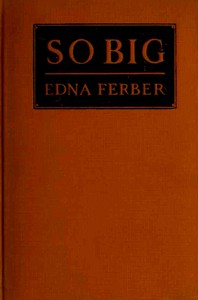
Edna Ferber's So Big follows Selina DeJong, a Dutch-American widow turned truck farmer, and her son Dirk, whose childhood nickname 'So Big' shapes his early identity. The novel's diction and dialogue reveal class tensions, immigrant labor, and the clash between rural grit and urban ambition in early 20th-century Chicago.
Read the complete public-domain text at its original source.
Read on Project GutenbergThe opening pages of So Big introduce a nickname that functions as both a burden and a badge. Dirk DeJong, nearly ten, has fought to shed 'So Big'—a name his mother Selina coined in the idiotic question put to babies. Ferber’s diction here is precise: the nickname is 'condensed' from infantile endearment to 'Sobig,' a word whose 'consonantal disharmony' mirrors the boy’s discomfort. The mother’s lapse into the old name provokes sulking, not schoolyard tactics, a small but telling detail about their relationship.
The Weight of a Name
Ferber anchors the novel’s emotional logic in a single word. Dirk’s struggle to be called by his real name—Dirk DeJong—is a fight waged with 'fists, teeth, copper-toed boots, and temper.' The nickname, however, persists as a private language between mother and son. When Selina uses it, her tone 'would have melted the heart of any but that natural savage, a boy of ten.' The phrase 'natural savage' is striking: it suggests a primal resistance to sentiment, a quality that will define Dirk’s later ambitions. Ferber does not explain this dynamic; she lets the physicality of the fight—the boots, the teeth—speak for the boy’s need to carve an identity separate from his mother’s world of labor.
Selina’s Driven Posture
Selina DeJong is introduced through a series of urgent, repetitive gestures. She wipes sweat 'with a quick duck of her head in the crook of her bent arm,' a motion so habitual it becomes a signature. Her hair is 'skewered into a utilitarian knob,' and between her eyes is 'a driven look as of one who walks always a little ahead of herself in her haste.' Ferber’s prose mirrors this haste: sentences are packed with tasks—'from washtub to baking board, from stove to table'—and the fields are described as 'close-set rows' that demand a 'numbed back.' The effect is a portrait of a woman whose body is perpetually in motion, yet whose mind occasionally pauses to regard her child with 'great fine dark eyes.' The contrast between her physical exhaustion and her capacity for tenderness is rendered without sentimentality.
The Vocabulary of the Truck Farm
Ferber’s descriptions of the truck farm are dense with specific, unglamorous nouns: 'carrots, turnips, spinach, or beets,' 'potato sacks,' 'black loam.' The soil is 'rich warm' but also 'earth-grimed' on Selina’s calico dress. When she sells vegetables in Chicago, the language shifts to the marketplace: 'Jew pedlers,' 'chicken men,' 'empty coops.' A grocer named Talcott notes that her produce is 'bunched kind of extry, and all of a size'—a detail that reveals Selina’s aesthetic impulse in a world that values utility. Ferber does not romanticize this; the two dollars Selina earns are hard-won, and the narrative records the exact sum she owes—four hundred dollars—with the bluntness of a ledger.
Urban Disorientation and Rural Grit
When Selina and Dirk drive into Chicago, Ferber’s prose becomes cacophonous. The 'L trains thunder overhead,' horses 'step high and swerve stiffly,' and the wagon is 'absurdly out of place in this canyon of cobblestones, shops, street-cars, drays, carriages, bicycles, pedestrians.' The list of conveyances is deliberately excessive, emphasizing the chaos of the city. Yet Selina’s response is practical: she tells Dirk, 'Pretty soon,' and thinks of the quiet house, the 'squares of the kitchen tablecloth,' the 'sofa in the parlour with the ruffled calico cover.' These domestic details—the tablecloth, the sagging cane seat—are rendered with a specificity that makes them feel like anchors. Ferber uses them to suggest that Selina’s resilience is rooted not in grand ideals but in the comfort of familiar, worn objects.
Ferber’s prose in So Big is notable for its economy and physicality. She builds character through gesture—the duck of a head, the grip of a rein—and through the precise naming of things: vegetables, fabrics, debts. Readers attuned to these details will find a novel that earns its emotional weight not through declaration but through accumulation. The excerpts suggest a story grounded in the textures of daily work, where a nickname can carry the force of a life.
That book—So Big—stayed with me because of how quietly Selina holds onto her own worth amid all that dirt and striving. It made me think of another story where someone's inner life brushes against expectation, almost by accident. I keep recalling passages from Dr. Paull's Theory: A Romance — Edition Insights lately, the same way certain scenes from the farm linger without permission.
There are no reviews for this eBook.
There are no comments for this eBook.
Reader reflection
Record your reading impressions
A brief reflection can help important ideas stay with you longer.
Your progress
0
/
10
2
What was your overall reaction to the book?
3
Would you recommend this book to another reader?
4
What was the reading difficulty like?
5
Could you see yourself revisiting this book?
6
Which aspect of the book did you value most?
7
Did the book meet your expectations?
8
Could you apply anything you learned?
9
Which lesson or insight stayed with you?
10