1

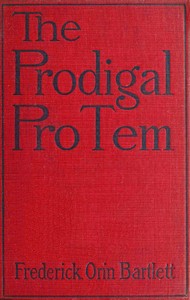
The Prodigal Pro Tem — Text and Context
(0 User reviews)
1742
Project Gutenberg
2022
Not confirmed
Love stories; United States -- Social life and customs -- 20th century -- Fiction; Interpersonal relations -- Fiction; Impersonation -- Fiction; Families -- Fiction
Readers of public-domain and historical texts
Project Gutenberg digital edition
en
Edition facts
Words
64,381
Reading time
280 min
Text sections
33
For The Prodigal Pro Tem — Text and Context, the stored edition analysis reports 64,381 words, 4 hr 40 min estimated reading time, and 33 detected text sections.
The text analysis averages about 11.8 words per sentence, while the detected sections provide another way to judge how the source is divided.
Project Gutenberg metadata also associates the work with “Love stories,” connecting these edition facts with the source record’s subject description.
Source:
Project Gutenberg record #67997
Frederick Orin Bartlett's 1910 novel follows Barnes, an artist who assumes a false identity, navigating love, family, and self-discovery. The narrative is shaped by vivid natural imagery, a recurring Dutch door, and a tension between wandering and belonging.
Read the complete public-domain text at its original source.
Read on Project GutenbergThe novel opens with Barnes, an artist, gazing at a landscape that feels incomplete without a woman. This sets up a pattern: the natural world is constantly compared to art and emotion. The prose is lush, with clouds described as "Spanish galleons" and the dawn as a woman entering a room. The story quickly introduces a central device—the little Dutch door—which becomes a threshold for key moments. Barnes's initial restlessness and his artist's eye for beauty establish a character driven by aesthetic and emotional longing.
The Artist's Eye and the Natural World
From the first chapter, Bartlett uses elaborate nature descriptions to mirror Barnes's inner state. The opening scene presents a "golden-moted silence" and clouds that "cut no churning path." This painterly attention to light and color recurs throughout the excerpts. Later, the dawn is explicitly linked to Eleanor: "The dawn was Eleanor." The landscape is not just backdrop but a character in Barnes's emotional drama. The road itself shifts from a "glad highway" to a "ghost road" as his circumstances change. Readers should watch how weather and time of day—especially dawn and dusk—signal shifts in mood and plot.
The Dutch Door as a Symbolic Threshold
A small architectural detail becomes a recurring motif. The Dutch door is mentioned multiple times: it first attracts Barnes to the house, he leads Eleanor through it to the hilltop, and later it provides "a temporary means of escape." The narrator notes "how important a part, first and last, this inanimate object had played in his life." This door marks transitions—between inside and outside, between identities, between solitude and connection. Its repeated appearance suggests that Barnes's journey is about crossing thresholds, both literal and figurative.
Voices in Conflict: Barnes and Langdon
The excerpts introduce a tense dynamic between Barnes and Langdon, a musician. On the hilltop at dawn, Langdon describes a symphony inspired by Eleanor, while Barnes feels a "fierce desire for his paints." Their rivalry is artistic and personal. Barnes experiences a "primeval" urge to grapple with Langdon, but he suppresses it. This moment of near-violence contrasts with the earlier lyrical tone. The two men interpret Eleanor through their respective arts—music and painting—suggesting a competition not just for her affection but for the right to represent her. Their conflict hints at deeper themes of possession and expression.
The Prodigal Pattern: Wandering and Return
The title and chapter headings (e.g., "What makes a Prodigal," "An Old Prodigal comes Home") frame the story as a variation on the prodigal son parable. Barnes's impulse to wander is strong: he feels the road calls him, and he considers returning to his mother. Yet he stays because the old man (likely his father) will need him. The excerpts show a man torn between escape and duty. The road is no longer "a glad highway" but a path that leads "away." This tension between freedom and responsibility drives the narrative. Readers should note how the prodigal theme applies to multiple characters, not just Barnes.
Bartlett's novel rewards attention to its sensory details—the weight of a door, the color of dawn, the texture of a cloud. The excerpts suggest a story that moves between interior reflection and dramatic confrontation. As you read, track how the natural world reflects Barnes's emotional arc, and how the Dutch door marks each turning point. The prodigal motif is not simply religious but psychological: the question is not just who returns, but what they return to.
That rainy afternoon, The Prodigal Pro Tem stayed with me—Barnes’s Dutch door kept opening onto the same question of where home truly lives. Later, apropos of nothing, I reached for Advisory Ben: A Story — Story, Setting & Ideas, and found that same quiet tension between wandering and belonging, only softer, more patient. One book simply led to the other, the way rain finds the gutter.
There are no reviews for this eBook.
There are no comments for this eBook.
Reader reflection
Take a moment to reflect on this book
Create a short personal record of your experience with this book.
Your progress
0
/
10
2
How did the book work for you overall?
3
How likely are you to recommend this book?
4
How easy was the book to follow?
5
How useful were the ideas in this book?
6
Did you relate to its people, ideas, or situations?
7
What did you think about the pace?
8
Did this book create an emotional response?
9
Which lesson or insight stayed with you?
10