1

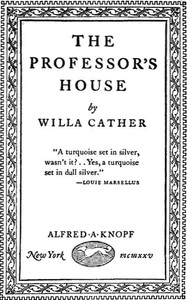
The Professor's House — Background and Themes
(0 User reviews)
21
Project Gutenberg
2021
Not confirmed
Psychological fiction; Frame stories; College teachers -- Fiction; Middle-aged men -- Fiction; Midlife crisis -- Fiction; Teacher-student relationships -- Fiction
Readers of public-domain and historical texts
Project Gutenberg digital edition
en
Edition facts
Words
66,246
Reading time
289 min
Text sections
31
This digital edition of The Professor's House — Background and Themes is described by source-level measurements including 66,246 words, 4 hr 49 min estimated reading time, and 31 detected text sections.
The text analysis averages about 16.2 words per sentence, while the detected sections provide another way to judge how the source is divided.
Project Gutenberg metadata also associates the work with “Psychological fiction,” connecting these edition facts with the source record’s subject description.
Source:
Project Gutenberg record #65465
In Willa Cather's novel, Professor St. Peter confronts the physical decay of his old house and the emotional distance from his family, while a framed story of a lost Native American city offers a counterpoint to modern acquisitiveness.
Read the complete public-domain text at its original source.
Read on Project GutenbergThe novel opens with Professor St. Peter alone in his dismantled house, a structure he describes as “almost as ugly as it is possible for a house to be.” The building’s flaws—steep stairs, creaky boards, a dripping tub—are catalogued with the precision of long familiarity. St. Peter has lived there since his marriage, raised his daughters, and written his historical work. Now the family is moving to a new, more comfortable house, and the Professor’s attachment to the old one becomes a measure of his resistance to change. The house is not merely a setting but a physical record of compromises and neglected repairs, mirroring the professor’s own deferred adjustments.
The Weight of Domestic Details
The excerpt dwells on the house’s inconveniences with a specificity that suggests more than mere complaint. St. Peter notes the “wobbly stair treads” and “creaky boards” he has winced at for twenty-odd years, yet he never fixed them. He had “a deft hand with tools,” but there was “not time enough to go round.” This tension between capability and inaction recurs in his family life. His wife Lillian’s remark that “if your country has contributed one thing, at least, to civilization, why not have it?”—referring to a modern bathroom—highlights a generational and philosophical divide. The professor’s youth in a Versailles house with no bath at all shapes his indifference to domestic upgrades, while his wife and daughters see them as necessities. The narrative voice, closely aligned with St. Peter’s perspective, renders these domestic frictions with dry humor and a sense of accumulated weariness.
Acquisition and Its Discontents
A shopping expedition to Chicago reveals another layer of tension. St. Peter accompanies his daughter Rosamond and her husband Louie, who is enthusiastic about buying. The professor finds the experience exhausting: “Too much is certainly worse than too little—of anything,” he tells his wife, calling it “an orgy of acquisition.” His son-in-law Scott McGregor later observes St. Peter looking “absolutely flattened out and listless,” and reflects that “the Marselluses have no mercy.” The professor’s discomfort with consumption contrasts sharply with Louie’s exuberance and Rosamond’s “faultless purchasing manner.” Even as St. Peter admits feeling a “distinct sense of loss” when Louie departs, the episode underscores his alienation from the values of the younger generation. The novel’s critique of materialism is embedded in these small, concrete observations rather than stated abstractly.
A Body Marked by History
St. Peter’s physical description is woven into the narrative with unusual attention. He is “built upon extremely good bones, with the slender hips and springy shoulders of a tireless swimmer.” His face is long and brown, with a “close-trimmed Van Dyke, like a tuft of shiny black fur.” The narrator notes that “for looks, the fewer clothes he had on, the better.” This emphasis on his physique—athletic, Spanish-seeming, aging but still vital—creates a counterpoint to his mental fatigue. In the Chicago scene, his body betrays him: he arrives home on foot in a light coat, chilled and silent, having forgotten to take a taxi. His wife reads his exhaustion in “his walk and the set of his shoulders.” The professor’s body, once a source of pride, now registers the strain of accommodating others. The novel uses physical detail to suggest an inner life that words alone cannot express.
The excerpts offer a portrait of a man caught between the house he cannot leave and the family he cannot fully join. Cather’s prose moves from the creak of a stair to the silence of a train ride, building a world where every object and gesture carries weight. Readers attentive to the novel’s structure will find that the opening domestic scenes establish tensions that reverberate through the later sections, including the embedded narrative of Tom Outland. The professor’s house is more than a setting; it is a character in its own right, and its dismantling signals a deeper unraveling.
St. Peter’s hollowed house reminds me of the summer I packed my grandfather’s study, each dust-sheet a small goodbye. That ache of rooms losing their voices—something in What Maisie Knew touched it, too, but quietly. Later I found that same hush again in the Stern — Reading Companion, where a man watches his own life recede, and I simply sat with it, not wanting to finish.
There are no reviews for this eBook.
There are no comments for this eBook.
Reader reflection
Your personal reading reflection
Build a private reading journal entry for this title.
Your progress
0
/
10
2
Did this book hold your interest?
3
Is this a title you would suggest to others?
4
How demanding did the text feel?
5
Did the book meet your expectations?
6
Which aspect of the book did you value most?
7
How did the pace of the book feel?
8
Could you follow the author’s main argument?
9
What changed or sharpened your thinking?
10