1

The Thing Beyond Reason — Background and Themes
(0 User reviews)
671
Project Gutenberg
2022
Not confirmed
Young women -- Fiction; Missing persons -- Fiction; Man-woman relationships -- Fiction; Mystery fiction
Readers of public-domain and historical texts
Project Gutenberg digital edition
en
Edition facts
Words
48,833
Reading time
213 min
Text sections
25
The source record for The Thing Beyond Reason — Background and Themes measures this digital text at 48,833 words, 3 hr 33 min estimated reading time, and 25 detected text sections.
The text analysis averages about 11.6 words per sentence, while the detected sections provide another way to judge how the source is divided.
Project Gutenberg metadata also associates the work with “Young women -- Fiction,” connecting these edition facts with the source record’s subject description.
Source:
Project Gutenberg record #67429
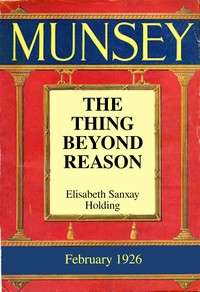
Elisabeth Sanxay Holding's 1926 novel follows Lexy Moran, a young woman solving a crossword puzzle when a frantic phone call draws her into a suburban mystery. The narrative shifts from brisk, witty domestic scenes to disorienting, sensory-driven terror, with prose that mirrors Lexy's changing mental state.
Read the complete public-domain text at its original source.
Read on Project GutenbergThe novel opens with Lexy Moran scowling over a crossword puzzle, chewing a badly damaged pencil. This small, stubborn scene establishes her character through action rather than description: she is careful, intelligent, and obstinate. The telephone rings, and a man's urgent voice asks for Miss Enderby. Lexy's cheerful reply contrasts sharply with the caller's desperation, introducing a tension that will define the story. Holding uses these early moments to build a world of ordinary details—a ticking clock, a shaded lamp—that will soon give way to something far less stable.
A Voice That Shifts
Holding's narrative voice is not static. In the opening pages, it is brisk and slightly ironic, matching Lexy's self-possession. The prose moves in short, declarative sentences: “She was a young little thing, only twenty-three, and quite alone in the world, but not at all dismayed by that.” The tone is almost conversational, with phrases like “by jiminy” and “snug little fortune” that suggest a narrator comfortable with colloquialism. Later, as Lexy's situation grows stranger, the voice becomes more fragmented and sensory. The sentences lengthen, then break into staccato questions: “What was it that rustled like that? What were these black, tall things that were standing motionless about her on every side?” This shift is not abrupt but gradual, mirroring Lexy's own descent from puzzle-solving confidence to disoriented fear.
Pace as a Psychological Tool
The novel's pace is carefully calibrated to Lexy's emotional state. Early scenes move at a steady, unhurried rhythm, with time for crossword clues and telephone conversations. As the mystery deepens, the pace accelerates into a breathless rush of action and perception. In the dreamlike sequence where Lexy finds herself in a dark wood, the prose becomes a series of urgent, short paragraphs: “I’m here,” she said. “I’m in a wood somewhere. These are trees.” The repetition of “I’m” and the staccato rhythm convey her struggle to anchor herself. Later, when she regains composure, the pace slows again, allowing for reflection. Holding uses these changes not as arbitrary shifts but as a direct expression of Lexy's psychological journey from control to chaos and back.
Recurring Sensory Details
Certain sensory motifs recur, binding the narrative together. The scent of roses appears in the dark room where Lexy tries to sleep: “a wonderful fragrance. It was wonderful, but almost too strong. It was too strong. It troubled her.” This detail, seemingly minor, becomes a marker of unease. The sound of rustling leaves recurs in the wood, where Lexy hears “patter, patter, patter, like little feet running behind her.” Holding uses these sensory anchors to create continuity between waking and dreamlike states. The wind, too, is a constant presence—first stirring curtains in the quiet library, then blowing through the dark room, and finally sweeping through the forest. These repeated elements give the novel a cohesive texture, even as the setting and mood shift dramatically.
Readers should attend to the way Holding builds atmosphere through small, concrete details rather than grand declarations. The crossword puzzle that opens the novel is not a gimmick; it is a key to Lexy's methodical mind. Notice how the prose contracts and expands with her confidence. The novel rewards attention to its sensory world—the scent of roses, the sound of leaves—as much as to its plot. Holding's craft lies in making the ordinary feel precarious.
There’s a strange quiet that lingers after reading Holding’s novel, that shift from ordinary talk into something unnameable. It reminded me of how The Crowded Street — Key Ideas to Explore holds that same tension, the way a familiar room can suddenly feel hollow. I keep thinking about Lexy’s unraveling, the crossword forgotten. It felt less like a story and more like a memory I walked into.
There are no reviews for this eBook.
There are no comments for this eBook.
Reader reflection
Take a moment to reflect on this book
Create a short personal record of your experience with this book.
Your progress
0
/
10
2
How did the book work for you overall?
3
Is this a title you would suggest to others?
4
How easy was the book to follow?
5
How useful did the reading feel?
6
How closely did the book connect with your experience?
7
Would a second reading be valuable?
8
How would you describe its reading pace?
9
What changed or sharpened your thinking?
10