1

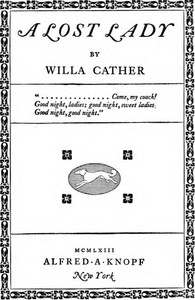
A Lost Lady — Background and Themes
(0 User reviews)
25
Project Gutenberg
2021
Not confirmed
Nebraska -- Fiction; Psychological fiction; Domestic fiction; Married women -- Fiction; Frontier and pioneer life -- Fiction
Readers of public-domain and historical texts
Project Gutenberg digital edition
en
Edition facts
Words
37,365
Reading time
163 min
Text sections
4
The source record for A Lost Lady — Background and Themes measures this digital text at 37,365 words, 2 hr 43 min estimated reading time, and 4 detected text sections.
The text analysis averages about 14.8 words per sentence, while the detected sections provide another way to judge how the source is divided.
Project Gutenberg metadata also associates the work with “Nebraska -- Fiction,” connecting these edition facts with the source record’s subject description.
Source:
Project Gutenberg record #65636
An editorial note on Willa Cather's A Lost Lady, focusing on shifts in narrative pace and voice as the novel moves from a collective, nostalgic opening to a more intimate, psychologically acute portrait of Marian Forrester's decline.
Read the complete public-domain text at its original source.
Read on Project GutenbergThe novel opens with a collective, almost mythologizing voice: “Thirty or forty years ago, in one of those grey towns along the Burlington railroad…” The narrator speaks for a community, recalling a house “well known from Omaha to Denver for its hospitality.” This initial sweep is broad, gesturing at a lost era of railroad aristocracy. Yet within the first pages, the prose narrows to the physical details of the Forrester place—the “fussy, fragile pillars,” the “bristling grove”—and to the precise social strata of homesteaders versus investors. This contraction from panorama to particular sets the pattern for the entire work: a gradual retreat from public legend into private, often painful, observation.
From Collective Memory to Individual Witness
The early chapters employ a choric “we” that recalls the town’s shared memory of Captain Forrester and his wife. The narrator reports what “everyone called” the place, what “was enough to say of a man.” This voice is unhurried, almost anecdotal, as if telling a story already known. But as the novel progresses, the narrative lens shifts to Niel Herbert, a young neighbor. His perspective becomes the filter through which Marian Forrester is seen. The language grows more immediate: we watch him “waiting by the door for the letters,” noticing the “flash” of her earrings. The collective “we” recedes; the story becomes his private record. This change in narrative distance is not abrupt but gradual, mirroring the erosion of the Forresters’ social world.
Pace and the Rhythm of Decline
Cather controls tempo through the length and density of scenes. Early passages are expansive, lingering on the house’s setting, the poplar lane, the “wide meadows.” Dialogue is sparse; description dominates. Later, after Captain Forrester’s stroke, the prose contracts. Sentences become shorter, more clipped. The doctor’s prognosis is delivered in flat, medical terms: “unless another brain lesion occurred.” The visit from Cyrus Dalzell, though warm, is compressed into a few pages of brisk dialogue and gesture. The pace quickens as the Captain’s speech thickens and Niel’s departure looms. This acceleration reflects the narrowing of possibilities for Marian Forrester, whose earlier brightness—her “light and fluttery” fingers—gives way to a more constrained presence.
Voice and the Weight of Unspoken Things
The narrator’s tone is restrained, often reporting what is not said. When Dalzell calls Marian “Lady Forrester,” the phrase carries an ironic weight that the text does not underline. The Captain’s stroke leaves him “avoiding talking even more than was his habit”; his wife’s reply to an invitation—“Oh, that, I’m afraid, is a pretty dream”—is followed by a silence the narrator fills only with the observation that “tears flashed into her eyes.” Cather trusts the reader to hear the gap between what is spoken and what is felt. This indirection is central to the novel’s voice: it never explains Marian’s motivations, but lets her gestures—the straightened tie, the murmured phrase—accumulate into a portrait of a woman managing loss.
Readers attentive to shifts in narrative distance will find that A Lost Lady rewards close attention to its pacing. The novel moves from a communal, almost elegiac opening to a tighter, more intimate focus on Niel’s observations. Cather’s prose, spare and precise, leaves much unsaid; the silences between lines are as telling as the dialogue. This edition preserves the original text, allowing the reader to trace the subtle modulations in voice that make the novel a study in the erosion of both a woman’s reputation and a way of life.
Years among these shelves taught me how A Lost Lady begins as a collective memory, then narrows to one woman’s fading heart—that quiet shift from crowd to solitude. It reminds me of a companion volume, The Thing Beyond Reason — Background and Themes, where the same patient withdrawal happens, a story turning inward until only the essential remains. They sit apart, yet breathe alike.
There are no reviews for this eBook.
There are no comments for this eBook.
Reader reflection
What did you think of this book?
Answer a few questions and save a private reflection on this device.
Your progress
0
/
10
2
How did the book work for you overall?
3
How likely are you to recommend this book?
4
Did the language feel accessible?
5
Was the book easy to understand?
6
Could you see yourself revisiting this book?
7
Which part made the strongest impression?
8
Would you start a conversation about this book?
9
What is the main idea you are taking away?
10