1

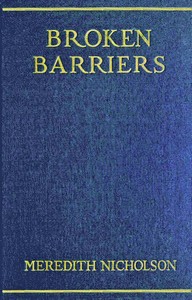
Broken Barriers — Key Ideas to Explore
(0 User reviews)
26
Project Gutenberg
2021
Not confirmed
Young women -- Fiction; Man-woman relationships -- Fiction; United States -- Social life and customs -- 20th century -- Fiction; Families -- Fiction; Indianapolis (Ind.) -- Fiction
Readers of public-domain and historical texts
Project Gutenberg digital edition
en
Edition facts
Words
122,439
Reading time
533 min
Text sections
21
This digital edition of Broken Barriers — Key Ideas to Explore is described by source-level measurements including 122,439 words, 8 hr 53 min estimated reading time, and 21 detected text sections.
The text analysis averages about 15.1 words per sentence, while the detected sections provide another way to judge how the source is divided.
Project Gutenberg metadata also associates the work with “Young women -- Fiction,” connecting these edition facts with the source record’s subject description.
Source:
Project Gutenberg record #66907
Meredith Nicholson's 1922 novel follows Grace Durland, a college graduate returning to Indianapolis, as she navigates family obligations, romantic entanglements, and social expectations. The prose reveals character through sharp dialogue and interior reflection, with a setting that contrasts old-fashioned neighborhoods with modern tensions.
Read the complete public-domain text at its original source.
Read on Project GutenbergFrom its opening paragraph, Broken Barriers establishes a protagonist whose inner life is as restless as the train carrying her home. Grace Durland's thoughts shift from bitterness to a 'spirit of adventure' with a speed that suggests both resilience and self-dramatization. Nicholson renders her emotional landscape through physical detail—the 'glow in her olive cheeks' from hasty packing, the 'variable, interesting eyes' that 'changed to jade' in shadow. The narration stays close to Grace's consciousness, filtering the world through her perceptions, yet the author's own voice intrudes in phrases like 'a fair representative of the self-reliant American girls,' a cataloguing impulse that places the character within a type even as it individualizes her.
Dialogue as a Weapon of Disenchantment
Nicholson's dialogue scenes crackle with unspoken power struggles. In the automobile exchange between Grace and Bob Cummings, every line is a parry. Grace's retorts—'I don't care how Evelyn is going to take it!'—are blunt instruments of rejection, while Bob's pleading 'You've meant too much to me' reveals his self-pity. The author uses interruptions and physical actions ('She sighed despairingly and resettled herself') to underscore emotional distance. Notably, Grace's final escape onto an interurban car is a silent rebuttal more cutting than any speech. The dialogue does not merely advance plot; it maps the shifting terrain of respect and contempt.
The City as a Character: Indianapolis in Transition
The novel's Indianapolis is not a backdrop but a force. Grace's journey home traces a geography of decline: New York Street, once 'a fashionable quarter,' now holds houses whose 'glory of the Civil War time... had departed.' The Durland home, a 'big square brick house' facing Military Park, anchors a neighborhood caught between past prestige and present shabbiness. Nicholson's descriptions are precise—the 'old canal,' the trolley lines—and they root the story in a specific urban moment. This setting mirrors Grace's own displacement: she returns to a city that has changed, just as her family's fortunes have shifted. The physical landscape becomes a measure of social erosion.
Interiority and the 'Great Curriculum' of Experience
Grace's narrative voice is marked by a self-consciousness about her own growth. After her confrontation with Bob, she reflects that 'her knowledge of life was broadening... in divisions of the Great Curriculum of whose very existence she had had only the haziest consciousness.' This metaphor of education—formal college now behind her, an unsyllabled 'curriculum' ahead—signals the novel's interest in the gap between learned ideals and lived reality. Nicholson renders Grace's interiority through abstract nouns ('freedom,' 'independence,' 'perils') that feel both earnest and ironic. The narrator's tone hovers between sympathy and detachment, allowing the reader to see Grace's naivete even as we share her perspective.
The Weight of Family: Absence and Obligation
Family dynamics in Broken Barriers are conveyed through absence and implication. Grace's mother summons her home via letter; her brother Roy is 'always the favored one,' allowed to remain at university despite showing 'neither aptitude nor zeal.' These details, dropped early, establish a pattern of unequal sacrifice that Grace accepts with 'fatalism.' The family itself remains offstage in the excerpts, yet its gravitational pull shapes every decision. Nicholson uses the mother's letter as a plot mechanism, but also as a symbol of the invisible bonds that recall daughters from their ambitions. The 'crisis in the family fortunes' is never named, only felt—a technique that keeps the reader attuned to what is withheld.
Readers attentive to Nicholson's craft will notice how he balances period detail with psychological acuity. The novel rewards those who track its recurring motifs—trains, automobiles, streetcars—as emblems of mobility and constraint. Grace's journey is both literal and figurative; the barriers she confronts are not merely social but internal. Approach the text as a study in voice: whose stories get told, and whose are silenced by the conventions of the era.
Grace Durland’s struggle to reconcile her private longings with the staid rooms of Indianapolis always reminded me of a house lit against the dusk—warm, yet full of shadows. There’s a similar quiet tension in Proud Lady, a story that knows how much a woman’s smile can hide. Both books whisper their truths slowly, like old friends. Proud Lady — Edition Insights.
There are no reviews for this eBook.
There are no comments for this eBook.
Reader reflection
Take a moment to reflect on this book
Create a short personal record of your experience with this book.
Your progress
0
/
10
2
Was reading this book enjoyable?
3
Would you recommend this book to another reader?
4
How easy was the book to follow?
5
How would you rate its originality?
6
Which part made the strongest impression?
7
Is this a title worth rereading?
8
Did the book give you something worth debating?
9
What did this book teach you most?
10