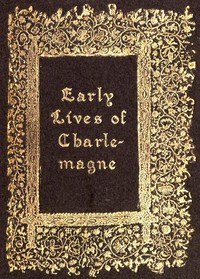
Early Lives of Charlemagne by Eginhard and the Monk of St Gall edited by Prof.…

(4 User reviews)   651
By Donna Ferrari Posted on Jan 12, 2026
In Category - Budgeting
Notker, Balbulus, 840?-912 Notker, Balbulus, 840?-912
English
Have you ever wondered what happens when two people tell stories about the same legendary king—and their versions clash completely? That’s the magic of this book. Forget a dry history lesson. Here, you get two wildly different accounts of Charlemagne’s life written just after he died. One is a formal, respectful biography by his close advisor Eginhard, painting a picture of a wise, strategic emperor. The other is a collection of wild, gossipy, and sometimes unbelievable tales by a monk who never even met him. It’s less about finding the 'truth' and more about watching a myth being born in real time. Which Charlemagne is real? The statesman or the superhero? Reading them side-by-side is a fascinating puzzle.
Share

Read "Early Lives of Charlemagne by Eginhard and the Monk of St Gall edited by Prof.…" Online

This book is available in the public domain. Start reading the digital edition below.

START READING FULL BOOK
Instant Access    Mobile Friendly

Book Preview

A short preview of the book’s content is shown below to give you an idea of its style and themes.

converted to footnotes. Their position has been corrected as necessary. Minor emendations have been made to punctuation and spelling. Running heads and the publisher’s catalogue have been omitted. THE KING’S CLASSICS EARLY LIVES OF CHARLEMAGNE [Illustration: Charlemagne] From a bronze statuette in the Musée Carnavalet. Paris EARLY LIVES OF CHARLEMAGNE BY EGINHARD AND THE MONK OF ST GALL EDITED BY PROF. A. J. GRANT ALEXANDER MORING LIMITED THE DE LA MORE PRESS 32 GEORGE STREET HANOVER SQUARE LONDON W 1905 _A lui finit la dissolution de l’ancien monde, à lui commence l’édification du monde moderne._ _Lavallée_ INTRODUCTION *The two “Lives” contrasted.*—This volume contains two lives of Charles the Great, or Charlemagne (for both forms of the name will be used indifferently in this introduction); both written within a century after his death; both full of admiration for the hero of whom they treat; both written by ecclesiastics; but resembling one another in hardly any other particular. It is not merely the value which each in its different way possesses, but also the great contrast between them, that makes it seem useful to present them together in a single volume. Professor Bury remarked in his inaugural lecture at Cambridge: “It would be a most fruitful investigation to trace from the earliest ages the history of public opinion in regard to the meaning of falsehood and the obligation of veracity”; and these two lives would form an interesting text for the illustration of such a treatise. The restrained, positive, well-arranged narrative of Eginhard seems to belong to a different age from the garrulous, credulous, and hopelessly jumbled story of the Monk of Saint Gall. And yet the two narratives were divided from one another by no long interval of time. It is impossible to fix with any certainty the date of the composition of Eginhard’s life, but there are various indications which make 820 a not impossible date. An incident mentioned by the Monk of Saint Gall makes the task of dating his work within limits an easier one. The work was suggested to him, he tells us, by Charles III. when he stayed for three days at the Monastery of Saint Gall, and it is possible to fix this event, with precision, to the year 883. We may think, therefore, of the Monk’s narrative as being separated from that of Eginhard by more than sixty years, and by about seventy from the death of its hero. But in the ninth century the mist of legend and myth steamed up rapidly from the grave of a well-known figure; there were few documents ready to the hand of a monk writing in the cloister of Saint Gall to assist him in writing an accurate narrative; there was no publicity of publication and no critical public to detect the errors of his work; above all, there was not in his own conscience the slightest possibility of reproach even if, with full consciousness of what he was doing, he changed the facts of history or interpolated the dreams of fancy, provided it were done in such a manner as “to point a moral or adorn a tale.” And so it is that, whereas through Eginhard’s narrative we look at the life of the great Charles in a clear white light, through a medium which, despite a few inaccuracies, distorts the facts of history wonderfully little, when we take up the narrative of the Monk, on the other hand, we are at once among the clouds of dreamland; and only occasionally does the unsubstantial fabric fade, and allow us to get a glimpse of reality and...

This is a limited preview. Download the book to read the full content.

This isn't your typical biography. Instead of one story, you get two competing visions of Europe's most famous emperor, Charlemagne, written within decades of his death.

The Story

First, Eginhard, Charlemagne's courtier and friend, gives us the official record. He focuses on the emperor's military campaigns, political reforms, and personal habits. It's detailed, admiring, and feels like a state document. Then, the Monk of St. Gall jumps in with a completely different energy. He never met Charlemagne and writes much later, collecting stories that were circulating. His Charlemagne is a larger-than-life folk hero—outsmarting enemies with clever tricks, dispensing rough justice, and surrounded by miraculous events. Reading them together, you see history and legend colliding on the page.

Why You Should Read It

What I love is how human it makes the past. You're not just learning what happened, but seeing how people remembered and shaped a great man's legacy. Eginhard's account feels reliable, but a bit cold. The Monk's tales are messy, funny, and full of life, even when they're probably exaggerated. The contrast is brilliant. It shows that even a thousand years ago, the line between a leader's real life and the stories told about him was beautifully blurry.

Final Verdict

Perfect for anyone curious about medieval history but bored by textbooks. If you enjoy podcasts that dissect how myths are made, or if you like seeing history as a story told by real people with their own biases, you'll adore this. It's a short, accessible, and utterly compelling look at the birth of a legend.


📜 Public Domain Content

This work has been identified as being free of known copyright restrictions. Distribute this work to help spread literacy.

Emily Jones
3 months ago

I was searching for something reliable and the clarity of the writing makes this accessible to a wide audience. This sets a high standard for similar books.

Thomas White
1 week ago

Out of sheer curiosity, the author clearly understands the subject matter in depth. I finished this feeling genuinely satisfied.

Barbara Perez
5 months ago

Initially overlooked, this book the arguments are well-supported by credible references. Absolutely essential reading.

Carol Baker
2 months ago

This quickly became one of those books where the presentation of ideas feels natural and engaging. Thanks for making this available.
4.5
4.5 out of 5 (4 User reviews )

Add a Review

Your Rating *
There are no comments for this eBook.
You must log in to post a comment.
Log in

Related eBooks