1

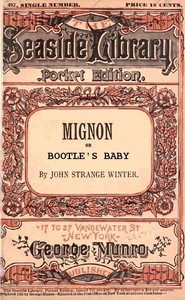
Mignon; or, Bootles' Baby — Story, Setting & Ideas
(0 User reviews)
362
Project Gutenberg
2021
Not confirmed
England -- Fiction; Adopted children -- Fiction; Foundlings -- Fiction; Soldiers -- Fiction
Readers of public-domain and historical texts
Project Gutenberg digital edition
en
Edition facts
Words
20,580
Reading time
90 min
Text sections
3
This digital edition of Mignon; or, Bootles' Baby — Story, Setting & Ideas is described by source-level measurements including 20,580 words, 1 hr 30 min estimated reading time, and 3 detected text sections.
The text analysis averages about 16.4 words per sentence, while the detected sections provide another way to judge how the source is divided.
Project Gutenberg metadata also associates the work with “England -- Fiction,” connecting these edition facts with the source record’s subject description.
Source:
Project Gutenberg record #64603
In J. S. Winter's 1885 novelette, a foundling child appears at a cavalry barracks, disrupting the mess-room banter of Captain 'Bootles' Ferrers and his fellow officers. The excerpts reveal a tight focus on regimental gossip, class snobbery, and the child's ambiguous origins, with little of the sentimental adoption plot the catalog subjects suggest.
Read the complete public-domain text at its original source.
Read on Project GutenbergThe opening scene of Mignon; or, Bootles' Baby plunges the reader into a late-night whist game at the Cavalry Barracks in Idleminster, where Captain Algernon Ferrers—known as “Bootles”—is so distracted by a headache that he trumps his partner’s trick and revokes. The other officers, Lacy, Hartog, and Preston, are surprised: Bootles is usually one of the best whist-players in the regiment. This small disruption hints at the larger upheaval to come. The catalog lists “Foundlings — Fiction” and “Adopted children — Fiction” as subjects, but the excerpts show that the foundling child, Miss Mignon, is initially treated less as a sentimental figure than as a topic of regimental gossip and suspicion. The narrative voice is brisk, colloquial, and steeped in barracks slang, with characters like the sneering Gilchrist casting doubt on Bootles’s story of the child’s arrival by letter.
Regimental Banter and Unspoken Rules
The mess-room dialogue in the excerpts is dense with unspoken codes. When Bootles stumbles through the card game, his fellow officers immediately notice: “Never saw Bootles seedy before,” says Lacy. Hartog replies, “Oh yes; he gets these headaches sometimes. Not often, though.” The clipped, knowing exchange reveals a community that reads each other’s habits closely. Later, Preston defends Bootles against Gilchrist’s insinuations: “Bootles is a right good sort—no mistake on that point. No sneaking hypocrisy about him.” The language is blunt, almost chivalric in its loyalty, and the men’s judgments are delivered with a certainty that suggests a rigid social hierarchy. Gilchrist, by contrast, is dismissed as “a jealous little beast” and “a crazy fool.” The excerpts do not show the child’s arrival or her backstory; instead, they focus on how the regiment’s internal politics shape the reception of the foundling. The reader is left to infer that Miss Mignon becomes a test of character among the officers.
Gilchrist’s Veiled Threats and the Watch on the Child
Gilchrist’s hostility toward Miss Mignon is the most dramatic element in the excerpts. He sneers at the pet name “Miss Mignon,” twists Bootles’s words, and openly wishes the child “out of the road.” When Preston rebukes him, Gilchrist retorts, “Perhaps she isn’t dead. Some people never die.” The exchange is striking for its venom, especially given the novelette’s brevity. Hartog later warns Bootles, and a “kind of watch was set upon the child.” The narrator speculates that Bootles feared Gilchrist might “encourage an already dangerous spirit of adventure” leading to an accident—a trampling or a crushing by a cart. This passage is the closest the excerpts come to a plot mechanism, yet it remains ambiguous: is Gilchrist merely a malicious gossip, or a genuine threat? The catalog subject “Soldiers — Fiction” is accurate, but the excerpts show that the soldierly world here is less about combat than about internal rivalries and the protection of a vulnerable outsider.
Bootles’s Quiet Authority and the Limits of the Excerpts
Bootles himself is a curiously passive figure in the excerpts. He is described as “the most popular man in the regiment,” but his actions are mostly reactive: he stumbles through cards, he takes the child on leave partly to avoid Gilchrist, and he sets a watch. The narrative voice reports his decisions without dramatizing his emotions. When Hartog repeats Gilchrist’s threat, Bootles’s response is not shown—only the consequence. This restraint may be a deliberate stylistic choice, or it may reflect the novelette’s compressed form. The excerpts do not reveal how Bootles acquired the child, what the letter said, or whether Mignon is biologically related to him. The catalog subject “Adopted children — Fiction” is plausible, but the text never uses the word “adopted.” Readers must rely on the officers’ speculation and the narrator’s hints. The story’s emotional core—if it exists—remains offstage, hinted at only through the protective watch and the repeated, unexplained pet name “Miss Mignon.”
The excerpts from Mignon; or, Bootles' Baby offer a narrow but vivid slice of barracks life, where a foundling child becomes a lightning rod for regimental tensions. Readers should note that the novelette’s full arc—including the child’s fate, the resolution of Gilchrist’s enmity, and the truth of Mignon’s parentage—is not represented in these passages. The story’s brevity (about 20,000 words) and its serial origins suggest a tight, episodic structure. Approach the text as a character study in miniature, where every gesture and piece of gossip carries weight.
There’s a peculiar quiet in how that barracks child unsettles the officers’ talk, much as the hard prairie light falls on A Lost Lady — Background and Themes. Both hold their secrets close, letting whispers carry what open speech cannot. I’ve shelved them near each other for years, content in their shared reticence.
There are no reviews for this eBook.
There are no comments for this eBook.
Reader reflection
How will you remember this book?
Save your reaction, strongest insight, and memorable passage.
Your progress
0
/
10
2
Did this book hold your interest?
3
Would you encourage someone else to read it?
4
What was the reading difficulty like?
5
Did the book offer a fresh perspective?
6
Did any part of the book feel personally relevant?
7
How useful did the reading feel?
8
Could you follow the author’s main argument?
9
What did this book teach you most?
10