1

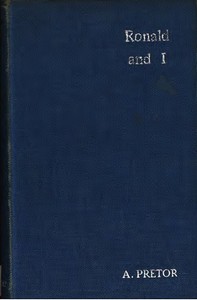
Ronald and I; or, Studies from Life — Text and Context
(0 User reviews)
30
Project Gutenberg
2020
Not confirmed
Villages -- England -- Fiction; Cousins -- Fiction; English fiction -- 19th century; Short stories, English
Readers of public-domain and historical texts
Project Gutenberg digital edition
en
Edition facts
Words
35,094
Reading time
153 min
Text sections
4
Before opening Ronald and I; or, Studies from Life — Text and Context, the edition data offers a quick orientation: 35,094 words, 2 hr 33 min estimated reading time, and 4 detected text sections.
The text analysis averages about 19.8 words per sentence, while the detected sections provide another way to judge how the source is divided.
Project Gutenberg metadata also associates the work with “Villages -- England -- Fiction,” connecting these edition facts with the source record’s subject description.
Source:
Project Gutenberg record #63308
Alfred Pretor's 1899 collection of linked sketches, set in the fictional English village of Broadwater, examines the tensions between human will and natural forces, social convention and individual impulse, through precise observations of landscape, character, and the bonds between people and animals.
Read the complete public-domain text at its original source.
Read on Project GutenbergThe opening pages of Ronald and I; or, Studies from Life establish a landscape shaped by resistance. The south-west wind, Pretor writes, 'is jealous of its prerogatives, and denudes a neighbourhood of isolated growth almost as surely as does the poison-steeped atmosphere of the midlands.' This is not a passive setting: the Atlantic brine, the lichen-painted tiles, the 'gorse and heather' that alone can 'show front'—all suggest a world where survival depends on stubborn adaptation. The narrator’s description of Broadwater as a place where you feel 'you are reaching the end of all things' before the sea appears sets a tone of precariousness that runs through the collection.
Will and Surrender in Human-Animal Bonds
The story of Judy the dog, part of the 'Ronald and I' sequence, dramatizes a conflict of will between master and pet. After a bicyclist injures her, Judy refuses to follow her master on the public road, 'plead almost in words for a change of route.' The master initially steels himself, treating it as 'a conflict of will between them.' But the walk grows 'dreary apart from his companion,' and he succumbs. This reversal—the human yielding to the animal—is characteristic of Pretor’s interest in the limits of authority. The dog’s pedigree, described with mock-seriousness (her mother was 'the daughter of a King Charles, who had been woo’d and won by a fox'), undercuts any sentimental reading. Judy’s hybrid nature—she 'sat like a cat, pounced like a cat, and washed her face like a cat'—mirrors the collection’s own mixing of tones: earnest, comic, and elegiac by turns.
The Rector and the Limits of Credulity
In the preface, Pretor notes that the story 'Our Rector' was 'received in episcopal quarters with polite incredulity.' He insists it is 'a literal study from life,' including 'the postprandial cigar.' This defensive framing signals a recurring tension: the narrator’s claim to factual accuracy against the reader’s likely disbelief. The sketch, set in the village, likely hinges on clerical behavior that strains decorum. The preface’s aside—'episcopal supervision was less far-reaching in those days than now'—locates the story in a specific historical moment, when village life could still produce events that later seemed implausible. Pretor’s method is to present the extraordinary as ordinary, letting the details (a cigar after dinner, a rector’s actions) carry the weight of verisimilitude.
Landscape as a Record of Conflict
Pretor’s Broadwater is defined by what is absent as much as by what is present. 'Trees in the open there are none,' he writes; only gorse and heather survive the 'brine-laden winds.' Yet the ravines and gullies shelter hidden growth. This pattern of exposure and refuge recurs in the human stories: the dog Judy retreats to her master’s bedroom after punishment; the narrator describes the sea as claiming 'its tithe of life and wreckage.' The landscape is not backdrop but active force, shaping the possibilities for action. The description of the road that 'begins to fall gently but without intermission towards the sea' creates a sense of inevitability, as if the characters are drawn toward something they cannot escape. This geographical determinism gives the collection a cohesive, somber undertow.
Readers approaching Ronald and I should attend to the interplay between the sketches: the same village, the same narrator, and recurring motifs (the sea, the wind, the limits of human control) create a cumulative effect. Pretor’s tone shifts from wry to mournful without warning, and the preface’s insistence on literal truth invites skepticism—perhaps deliberately. Treat each sketch as a fragment of a larger, unresolved argument about what can be known and what must be felt.
Reading Ronald and I again, I keep thinking how quietly Pretor captures the way we bend to our surroundings, and how they bend back. That same ache—of a place holding its secrets—lingers in the old house chronicled in The Van Roon — Inside the Classic, as if walls, like villagers, remember more than they ever say. It’s a strange comfort, that patience.
There are no reviews for this eBook.
There are no comments for this eBook.
Reader reflection
Before you leave, reflect on the book
Use these questions to collect your thoughts before moving on.
Your progress
0
/
10
2
Was reading this book enjoyable?
3
How likely are you to recommend this book?
4
What was the reading difficulty like?
5
Did anything about the book feel genuinely new?
6
Did you relate to its people, ideas, or situations?
7
Could you apply anything you learned?
8
How much did the book move you?
9
What did this book teach you most?
10