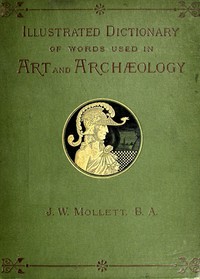
An Illustrated Dictionary of Words used in Art and Archaeology by John W. Mollett

(5 User reviews)   537
By Donna Ferrari Posted on Jan 12, 2026
In Category - Personal Finance
Mollett, John W. (John William) Mollett, John W. (John William)
English
Ever been in a museum or gallery and felt that tiny spark of frustration when you don't quite know what a word means? 'Corbel,' 'ogee,' 'triptych'—they're everywhere, and they're the secret keys to really understanding what you're looking at. John W. Mollett's 'An Illustrated Dictionary of Words used in Art and Archaeology' is your friendly, patient guide to unlocking that world. It’s not a dry textbook; it’s more like having a knowledgeable friend in your pocket who can instantly explain the difference between a fresco and a tempera, or what exactly a 'kouros' is. Forget feeling lost—this book turns confusion into clarity and makes every museum visit ten times more interesting.
Share

Read "An Illustrated Dictionary of Words used in Art and Archaeology by John W. Mollett" Online

This book is available in the public domain. Start reading the digital edition below.

START READING FULL BOOK
Instant Access    Mobile Friendly

Book Preview

A short preview of the book’s content is shown below to give you an idea of its style and themes.

PRINTED BY GILBERT AND RIVINGTON, LIMITED, ST. JOHN’S SQUARE, LONDON. [Illustration: APSE OF THE BASILICA OF ST. PAUL-WITHOUT-THE-WALLS, ROME. [_See_ BASILICA, _p. 37_. ] AN ILLUSTRATED DICTIONARY OF WORDS USED IN ART AND ARCHÆOLOGY. EXPLAINING TERMS FREQUENTLY USED IN WORKS ON ARCHITECTURE, ARMS, BRONZES, CHRISTIAN ART, COLOUR, COSTUME, DECORATION, DEVICES, EMBLEMS, HERALDRY, LACE, PERSONAL ORNAMENTS, POTTERY, PAINTING, SCULPTURE, &C., WITH THEIR DERIVATIONS. By J. W. MOLLETT, B.A. _Officier de l’Instruction Publique (France)_; AUTHOR OF THE LIVES OF “REMBRANDT” AND “WILKIE” IN THE “GREAT ARTISTS” SERIES. [Illustration] London: SAMPSON LOW, MARSTON, SEARLE, AND RIVINGTON, CROWN BUILDINGS, 188, FLEET STREET. 1883. [Illustration] PREFACE. This Dictionary was commenced as an amended edition of that written by M. Ernest Bosc, architect of Paris, and contains the 450 engravings published in the French work, to which about 250 more have been added. Little or nothing, however, of the text of M. Bosc’s work has been left standing; his definitions having, in the process of revision under reference to original works, almost entirely disappeared. The whole work, as it now stands, has been drawn from, or carefully corrected by, the best authorities in each of its special branches. Considerable prominence has been given to ARCHITECTURE, from the French original corrected from English writers; to CHRISTIAN ANTIQUITIES from _Martigny_, and the Dictionary of _Dr. Smith and Professor Cheetham_, and other authorities; to MEDIÆVAL ARMOUR, and terms of CHIVALRY, chiefly from _Meyrick’s Ancient Armour_; to COSTUME from _Planché_ and _Fairholt_; to HERALDRY from _Boutell’s_ and _Mrs. Bury Palliser’s_ works; to POTTERY, the substance of the articles on this subject being derived from _M. Jacquemart’s_ work; to NEEDLEWORK, IVORIES, MUSICAL INSTRUMENTS, GOLDSMITHS’ WORK, PAINTERS’ MATERIALS AND PROCESSES ANCIENT AND MODERN, COLOUR, &c., with references to the several authorities referred to. The GREEK AND ROMAN ANTIQUITIES, which are the principal part of M. Bosc’s work, have been in this volume reduced to the smallest possible compass: the Dictionaries of Dr. Smith and Rich must be referred to by those who require fuller definitions upon this subject, which would of itself fill ten such books as the present. A few INDIAN, CHINESE, and JAPANESE TERMS, which have come into ordinary use in art, have been sought out and inserted: in the first-mentioned _Dr. Birdwood’s Handbooks_ have been a most useful guide. Finally, it is necessary to state, that many words essential to the completeness of the work would have been in danger of omission, if I had not had before me _Mr. Fairholt’s_ admirable _Dictionary of Art Terms_, which, occupying a more restricted ground than this, is so thorough and accurate in dealing with all that it professes to include, that the only _raison d’être_ of this work is the very much wider and different ground that it covers, and the greater condensation of its definitions. Obviously the substance of every statement in the work is borrowed from some previous writer on the subject, and it is evident that a Dictionary of Reference is not a convenient vehicle for theory or invention. The appended list of CLASSIFIED CATALOGUES which have been prepared by direction of the authorities of the South Kensington Museum, will have the additional use of referring the reader to the fountain-head at which he can verify and amplify the condensed information that this work supplies. J. W. MOLLETT. _October, 1882._ CLASSIFIED CATALOGUES OF BOOKS ON ART IN THE NATIONAL ART LIBRARY, SOUTH KENSINGTON MUSEUM. _ISSUED BY AUTHORITY._ LIST OF WORKS ON COSTUME, 1_s._; FURNITURE, 1_d._; HERALDRY, 3_d._; LACE AND NEEDLEWORK, 1_d._; ORNAMENT, 6_d._; PAINTING, 4_d._; POTTERY AND PORCELAIN, 3_d._; SCULPTURE, 3_d._ _These Catalogues may be had on application...

This is a limited preview. Download the book to read the full content.

This isn't a novel with a plot, but it solves a very real mystery: the language of art and history. John W. Mollett's dictionary is a straightforward, alphabetically organized guide to hundreds of specialized terms. From architecture and heraldry to painting techniques and ancient artifacts, each entry gets a clear definition. The real magic is in the illustrations—simple line drawings that show you exactly what a 'fluting' on a column looks like or how a 'palmette' ornament is shaped. The book itself is the 'story' of demystifying a whole vocabulary that can seem intimidating.

Why You Should Read It

I keep my copy right by my desk. Whether I'm writing a blog post, planning a trip, or just browsing an auction catalog online, it's my first stop. It cuts through the jargon without being condescending. The illustrations are genuinely helpful—sometimes a picture really is worth a thousand words, especially when the word is 'cartouche' or 'cinquefoil.' This book gives you the confidence to look at a cathedral, a painting, or an archaeological find and actually see the details you now have the words for.

Final Verdict

This is a perfect reference for curious museum-goers, aspiring artists, history enthusiasts, or anyone who reads historical fiction and wants to visualize the objects described. It's not a book you read cover-to-cover, but one you dip into again and again. If you've ever nodded along while secretly wondering what something meant, this dictionary is your quiet, brilliant ally. It makes the beautiful and ancient world around us just a little more knowable.


✅ Copyright Status

This publication is available for unrestricted use. Use this text in your own projects freely.

David Gonzalez
2 weeks ago

I decided to give this a chance and the structure supports both quick reading and deep study. I would gladly recommend this to others.

Liam Adams
5 months ago

Given the topic, the pacing is just right, keeping you engaged from start to finish. A solid resource I will return to often.

Anthony Williams
1 month ago

As an avid reader, the presentation of ideas feels natural and engaging. This deserves far more attention.

Noah Thompson
1 month ago

This immediately felt different because it serves as a poignant reminder of the human condition. Time very well spent.

Betty Carter
2 months ago

Make no mistake, it creates a vivid world that you simply do not want to leave. It was exactly what I needed right now.
4.5
4.5 out of 5 (5 User reviews )

Add a Review

Your Rating *
There are no comments for this eBook.
You must log in to post a comment.
Log in

Related eBooks