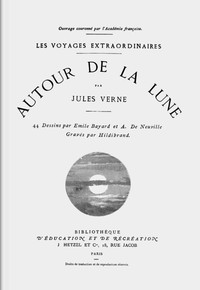
Autour de la lune by Jules Verne

(5 User reviews)   438
By Donna Ferrari Posted on Jan 12, 2026
In Category - Personal Finance
Verne, Jules, 1828-1905 Verne, Jules, 1828-1905
French
Hey, have you ever wondered what it would be like to actually fly around the moon? Forget modern NASA missions—Jules Verne imagined it all back in 1870! 'Autour de la Lune' is the wild sequel to 'From the Earth to the Moon,' picking up right where a giant space cannon shot three men in a bullet-shaped capsule toward our lunar neighbor. But here's the catch: they missed their landing. Now, they're stuck in a frantic loop *around* the moon, with limited air and no clear way home. It's a tense, funny, and surprisingly scientific joyride through space, written decades before it was even possible. If you like classic adventure with a dash of 'what do we do now?!' panic, you'll love this.
Share

Read "Autour de la lune by Jules Verne" Online

This book is available in the public domain. Start reading the digital edition below.

START READING FULL BOOK
Instant Access    Mobile Friendly

Book Preview

A short preview of the book’s content is shown below to give you an idea of its style and themes.

entreprise, déclarée réalisable par la majorité des gens compétents. Après avoir provoqué une souscription publique qui produisit près de trente millions de francs, il commença ses gigantesques travaux. Suivant la note rédigée par les membres de l'Observatoire, le canon destiné à lancer le projectile devait être établi dans un pays situé entre 0 et 28 degrés de latitude nord ou sud, afin de viser la Lune au zénith. Le boulet devait être animé d'une vitesse initiale de douze mille yards à la seconde. Lancé le 1er décembre, à onze heures moins treize minutes et vingt secondes du soir, il devait rencontrer la Lune quatre jours après son départ, le 5 décembre, à minuit précis, à l'instant même où elle se trouverait dans son périgée, c'est-à-dire à sa distance la plus rapprochée de la Terre, soit exactement quatre-vingt-six mille quatre cent dix lieues. Les principaux membres du Gun-Club, le président Barbicane, le major Elphiston, le secrétaire J.-T. Maston et autres savants tinrent plusieurs séances dans lesquelles furent discutées la forme et la composition du boulet, la disposition et la nature du canon, la qualité et la quantité de la poudre à employer. Il fut décidé: 1° que le projectile serait un obus en aluminium d'un diamètre de cent huit pouces et d'une épaisseur de douze pouces à ses parois, qui pèserait dix-neuf mille deux cent cinquante livres; 2° que le canon serait une Columbiad en fonte de fer longue de neuf cents pieds, qui serait coulée directement dans le sol; 3° que la charge emploierait quatre cent mille livres de fulmi-coton qui, développant six milliards de litres de gaz sous le projectile, l'emporteraient facilement vers l'astre des nuits. Ces questions résolues, le président Barbicane, aidé de l'ingénieur Murchison, fit choix d'un emplacement situé dans la Floride par 27° 7' de latitude nord et 5° 7' de longitude ouest. Ce fut en cet endroit, qu'après des travaux merveilleux, la Columbiad fut coulée avec un plein succès. Les choses en étaient là, quand survint un incident qui centupla l'intérêt attaché à cette grande entreprise. Un Français, un Parisien fantaisiste, un artiste aussi spirituel qu'audacieux, demanda à s'enfermer dans un boulet afin d'atteindre la Lune et d'opérer une reconnaissance du satellite terrestre. Cet intrépide aventurier se nommait Michel Ardan. Il arriva en Amérique, fut reçu avec enthousiasme, tint des meetings, se vit porter en triomphe, réconcilia le président Barbicane avec son mortel ennemi le capitaine Nicholl et, comme gage de réconciliation, il les décida à s'embarquer avec lui dans le projectile. La proposition fut acceptée. On modifia la forme du boulet. Il devint cylindro-conique. On garnit cette espèce de wagon aérien de ressorts puissants et de cloisons brisantes qui devaient amortir le contre-coup du départ. On le pourvut de vivres pour un an, d'eau pour quelques mois, de gaz pour quelques jours. Un appareil automatique fabriquait et fournissait l'air nécessaire à la respiration des trois voyageurs. En même temps, le Gun-Club faisait construire sur l'un des plus hauts sommets des Montagnes-Rocheuses un gigantesque télescope qui permettrait de suivre le projectile pendant son trajet à travers l'espace. Tout était prêt. Le 30 novembre, à l'heure fixée, au milieu d'un concours extraordinaire de spectateurs, le départ eut lieu et pour la première fois, trois êtres humains, quittant le globe terrestre, s'élancèrent vers les espaces interplanétaires avec la presque certitude d'arriver à leur but. Ces audacieux voyageurs, Michel Ardan, le président Barbicane et le capitaine Nicholl, devaient effectuer leur trajet en _quatre-vingt dix-sept heures treize minutes et vingt secondes_. Conséquemment, leur arrivée à la surface du disque lunaire ne pouvait avoir lieu que le 5 décembre, à...

This is a limited preview. Download the book to read the full content.

The Story

Picking up immediately after the cliffhanger of From the Earth to the Moon, this book follows the three passengers—the cool-headed Impey Barbicane, his rival Captain Nicholl, and the enthusiastic Frenchman Michel Ardan—trapped inside their projectile. They've survived the launch, but a minor course correction with a rogue rocket sends them whipping past the moon instead of landing on it. Now, they're prisoners of gravity, locked in an orbit that takes them on a breathtaking tour of the lunar landscape. The story becomes a race against their dwindling supplies, especially oxygen, as they witness the moon's hidden far side and grapple with the very real possibility of becoming permanent residents of deep space.

Why You Should Read It

What blew me away was how conversational and human it feels. These aren't just explorers; they're three very different guys stuck in a metal can, debating science, playing cards, and trying not to freak out. Verne mixes their cabin fever with genuinely awe-inspiring descriptions of the cosmos. His predictions about weightlessness and the moon's geography are fascinating, even when they're wrong. The heart of the book isn't just the adventure; it's about friendship and intellect triumphing over a seemingly hopeless situation. You're rooting for them the whole way.

Final Verdict

Perfect for fans of classic sci-fi who enjoy the journey as much as the destination. If you like smart, talkative characters and stories where problem-solving is the real hero, you'll be hooked. It's also a great pick for anyone curious about the history of science fiction and seeing where our space-age dreams began. Just be ready to Google some of the 19th-century astronomy references—it's part of the fun!


🏛️ No Rights Reserved

This work has been identified as being free of known copyright restrictions. Use this text in your own projects freely.

Joseph White
5 months ago

This quickly became one of those books where the structure allows easy navigation and quick referencing. Don't hesitate to download this.

Dorothy Green
2 months ago

I was skeptical at first, but the progression of ideas feels natural and coherent. It exceeded all my expectations.

Amanda Green
5 months ago

From the very first page, the emotional weight of the story is balanced perfectly with moments of levity. An excellent read overall.

Susan Moore
1 month ago

Without a doubt, the translation seems very fluid and captures the original nuance perfectly. I couldn't put it down until the very end.

Sandra Wilson
1 month ago

During my studies, I found that the content flows smoothly from one chapter to the next. Highly recommended for everyone.

5
5 out of 5 (5 User reviews )

Add a Review

Your Rating *
There are no comments for this eBook.
You must log in to post a comment.
Log in

Related eBooks