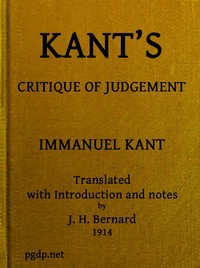
Kant's Critique of Judgement by Immanuel Kant

(5 User reviews)   783
By Donna Ferrari Posted on Jan 12, 2026
In Category - Personal Finance
Kant, Immanuel, 1724-1804 Kant, Immanuel, 1724-1804
English
Okay, hear me out. I know a 250-year-old German philosophy book sounds like homework, but this one is different. Kant's 'Critique of Judgement' is his attempt to solve a massive puzzle: How do we connect the cold, mechanical laws of science with the messy, beautiful, and free world of human experience? It's about the gap between what we know and what we feel. Why do we all agree a sunset is beautiful, even though it's just light and gas? How can art move us? This book is Kant trying to build a bridge between two separate continents of the mind. It's challenging, but it fundamentally changed how we think about beauty, art, and purpose.
Share

Read "Kant's Critique of Judgement by Immanuel Kant" Online

This book is available in the public domain. Start reading the digital edition below.

START READING FULL BOOK
Instant Access    Mobile Friendly

Book Preview

A short preview of the book’s content is shown below to give you an idea of its style and themes.

so many from the Critical Philosophy even in its earlier sections. These “symmetrical architectonic amusements,” as Schopenhauer called them, encumber every page of Kant’s later writings, and they are a constant source of embarrassment to his unhappy translator. For, as every translator knows, no single word in one language exactly covers any single word in another; and yet if Kant’s distinctions are to be preserved it is necessary to select with more or less arbitrariness English equivalents for German technical terms, and retain them all through. Instances of this will be given later on; I only remark here on the fact that Kant’s besetting sin of over-technicality is especially conspicuous in this treatise. Another fault--an old fault of Kant--apparent after reading even a few pages, is that repetitions are very frequent of the same thought in but slightly varied language. Arguments are repeated over and over again until they become quite wearisome; and then when the reader’s attention has flagged, and he is glancing cursorily down the page, some important new point is introduced without emphasis, as if the author were really anxious to keep his meaning to himself at all hazards. A book written in such fashion rarely attracts a wide circle of readers. And yet, not only did Goethe think highly of it, but it received a large measure of attention in France as well as in Germany on its first appearance. Originally published at Berlin in 1790, a Second Edition was called for in 1793; and a French translation was made by Imhoff in 1796. Other French versions are those by Keratry and Weyland in 1823, and by Barni in 1846. This last I have had before me while performing my task, but I have not found it of much service; the older French translations I have not seen. The existence of these French versions, when taken in connexion with the absence until very recently of any systematic account of the Critique of Judgement in English, may be perhaps explained by the lively interest that was taken on the Continent in the Philosophy of Art in the early part of the century; whereas scientific studies on this subject received little attention in England during the same period. The student of the Critique of Pure Reason will remember how closely, in his Transcendental Logic, Kant follows the lines of the ordinary logic of the schools. He finds his whole plan ready made for him, as it were; and he proceeds to work out the metaphysical principles which underlie the process of syllogistic reasoning. And as there are three propositions in every syllogism, he points out that, in correspondence with this triplicity, the higher faculties of the soul may be regarded as threefold. The Understanding or the faculty of concepts gives us our major premise, as it supplies us in the first instance with a general notion. By means of the Judgement we see that a particular case comes under the general rule, and by the Reason we draw our conclusion. These, as three distinct movements in the process of reasoning, are regarded by Kant as indicating three distinct faculties, with which the Analytic of Concepts, the Analytic of Principles, and the Dialectic are respectively concerned. The full significance of this important classification does not seem, however, to have occurred to Kant at the time, as we may see from the order in which he wrote his great books.[1] The first problem which arrests the attention of all modern philosophers is, of course, the problem of knowledge, its conditions and its proper objects. And in the Critique of Pure...

This is a limited preview. Download the book to read the full content.

Let's be clear: this isn't a book with a plot in the traditional sense. There's no hero's journey, but there is a central intellectual adventure. Immanuel Kant had already written two massive works explaining how we understand the world (science) and how we should act in it (morality). In the Critique of Judgement, he tackles what's left: our feelings of beauty and our sense of purpose in nature.

The Story

Think of it as Kant's third act. He asks questions that seem simple but are incredibly deep. When we call something beautiful, what are we actually doing? He argues it's a special kind of judgment where our imagination and understanding play freely. We feel pleasure, and we believe others should agree, even though there's no rule forcing them to. He then looks at nature and asks if we can see purpose in it, not as a scientific fact, but as a necessary way for us to make sense of the world. The 'story' is watching a brilliant mind try to fit these human experiences into his grand philosophical system.

Why You Should Read It

This book gives you the philosophical foundation for almost every conversation about art and beauty you've ever had. It explains why arguing about taste isn't completely pointless, and why we look for meaning in nature. Reading Kant is tough—his sentences are famously long—but the payoff is huge. You start seeing his ideas everywhere: in museum reviews, environmental debates, and even in how you decide what music to play. It makes you a more thoughtful observer of your own reactions.

Final Verdict

This is for the curious reader who isn't afraid of a challenge. It's perfect for art lovers who want to know why art matters, for science-minded folks curious about aesthetics, or for anyone who's ever wondered if there's a link between a beautiful poem and a moral action. Don't rush it. Read a few pages at a time, let it simmer, and be prepared to see the world a little differently.


📜 Public Domain Notice

There are no legal restrictions on this material. Access is open to everyone around the world.

John Wright
3 months ago

My professor recommended this and the logical flow of arguments makes it an essential resource for research. An impressive piece of work.

Donald Ramirez
4 months ago

In my opinion, the logical flow of arguments makes it an essential resource for research. I couldn't put it down until the very end.

Lisa King
1 week ago

Having read this twice, the depth of coverage exceeded my expectations. Don't hesitate to download this.

Ethan Roberts
5 months ago

Believe the hype, the content remains relevant throughout without filler. A true masterpiece of its kind.

Kevin Green
4 months ago

From a technical perspective, the progression of ideas feels natural and coherent. I will be reading more from this author.
5
5 out of 5 (5 User reviews )

Add a Review

Your Rating *
There are no comments for this eBook.
You must log in to post a comment.
Log in

Related eBooks