1

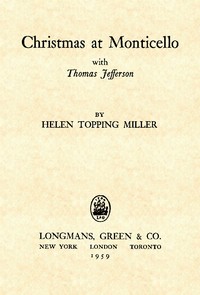
Christmas at Monticello with Thomas Jefferson — Inside the Classic
(0 User reviews)
1845
Project Gutenberg
2021
Not confirmed
Christmas stories; Biographical fiction; Jefferson, Thomas, 1743-1826 -- Fiction; Presidents -- United States -- Fiction; Monticello (Va.) -- Fiction
Readers of public-domain and historical texts
Project Gutenberg digital edition
en
Edition facts
Words
18,774
Reading time
82 min
Text sections
2
For Christmas at Monticello with Thomas Jefferson — Inside the Classic, the stored edition analysis reports 18,774 words, 1 hr 22 min estimated reading time, and 2 detected text sections.
The text analysis averages about 16.9 words per sentence, while the detected sections provide another way to judge how the source is divided.
Project Gutenberg metadata also associates the work with “Christmas stories,” connecting these edition facts with the source record’s subject description.
Source:
Project Gutenberg record #65806
This editorial note examines how Helen Topping Miller's 1959 novel uses a fictionalized Thomas Jefferson to explore tensions between public duty and private life at Monticello, focusing on the gap between catalog subjects (Christmas, biography) and the actual excerpts, which emphasize Jefferson's exhaustion, domestic frustrations, and the relentless stream of visitors.
Read the complete public-domain text at its original source.
Read on Project GutenbergHelen Topping Miller's Christmas at Monticello with Thomas Jefferson opens not with holiday cheer but with a weary sixty-six-year-old Jefferson climbing the White House stairs after the 1809 Inaugural Ball, grateful to leave public life. The catalog subjects—Christmas stories, biographical fiction—suggest a festive domestic portrait, yet the excerpts dwell on Jefferson's physical aches, political worries, and the burden of fame. The novel's title promises a Christmas focus, but the provided text sections, set in March and late summer, show no Christmas scenes. This note examines how Miller's portrayal of Jefferson's retirement at Monticello centers on the conflict between his desire for privacy and the demands of hospitality, a theme that overshadows the holiday framing.
A President's Exhaustion, Not a Founder's Glory
The first excerpt, dated March 1809, presents Jefferson as an old man with “twinges in his knees” from too many miles in the saddle and “too much tension, not enough rest.” His relief at leaving office is palpable: “My work is done. I am going home.” Miller emphasizes physical decline and political anxiety—British and French ships seizing American cargoes—over any celebration. The catalog subject “Presidents -- United States -- Fiction” might imply a focus on Jefferson's achievements, but the text highlights his weariness and worry for James Madison's ability to avoid war. Jefferson's pet mockingbird, a recurring detail, adds a domestic touch, yet the overall tone is one of escape, not triumph.
The Siege of Monticello: Visitors as a Plague
In the late summer 1809 excerpt, Monticello is under siege by uninvited guests. Jefferson's daughter Patsy complains that strangers “have to be kept for the night; they must be fed,” and the steward Petit is “getting really fractious.” Jefferson himself laments that visitors “invade every corner without leave or apology,” even pulling out desk drawers. Miller uses comic relief—a visitor mistakes a dumbwaiter for a hiding place from “Injuns”—but the underlying tension is serious: Jefferson cannot afford this hospitality. The catalog subject “Monticello (Va.) -- Fiction” suggests a setting of refined domesticity, yet the text portrays it as a public house where privacy is impossible. Jefferson's polite but strained responses reveal a man trapped by his own reputation.
Christmas Absent: The Gap Between Title and Text
Despite the title Christmas at Monticello with Thomas Jefferson, the two excerpts provided contain no Christmas references. The first is set in March 1809, the second in late summer. The catalog subject “Christmas stories” implies a holiday narrative, but the text focuses on Jefferson's post-presidential life and the burdens of celebrity. Miller may have intended a Christmas scene later in the book, but the excerpts suggest the novel is more about Jefferson's retirement than about Christmas itself. Readers expecting a festive tale will find instead a portrait of a man exhausted by public service and struggling to reclaim his home. The holiday framing may serve as a backdrop for themes of family and generosity, but the evidence shows a work preoccupied with the costs of fame.
Readers approaching this novel should set aside expectations of a Christmas story and instead attend to Miller's depiction of Jefferson's domestic trials. The excerpts reveal a work more concerned with the tension between public adulation and private peace than with holiday celebration. The catalog subjects may mislead; the text itself offers a nuanced, sometimes humorous, portrait of a founder who cannot escape his own legend. For those interested in Jefferson's later years or the social history of Monticello, this novel provides a fictionalized but grounded perspective.
Reading about Jefferson’s exhaustion at Monticello—the endless visitors, the duty pressing on his private hours—I found myself thinking of the quieter wildness in Shepherds of the Wild — Context and Discussion. There’s a shared ache there, the cost of tending something larger than yourself, and the small loneliness that lingers afterward, like the last ember on a cold hearth.
There are no reviews for this eBook.
There are no comments for this eBook.
Reader reflection
How did this book work for you?
Your answers remain private and are stored only in this browser.
Your progress
0
/
10
2
Was reading this book enjoyable?
3
How likely are you to recommend this book?
4
How easy was the book to follow?
5
How clear did the writing feel?
6
Was the book moving at the right speed?
7
What did you appreciate most?
8
Could you see yourself revisiting this book?
9
What is the main idea you are taking away?
10