1

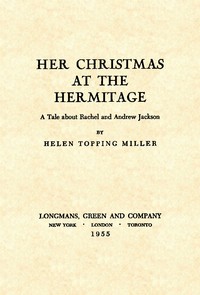
Her Christmas at the Hermitage: A Tale About Rachel and Andrew Jackson — Edition Insights
(0 User reviews)
202
Project Gutenberg
2021
Not confirmed
Christmas stories; Biographical fiction; Jackson, Andrew, 1767-1845 -- Fiction; Presidents -- United States -- Fiction; Jackson, Rachel, 1767-1828 -- Fiction; Hermitage (Hermitage, Tenn.) -- Fiction
Readers of public-domain and historical texts
Project Gutenberg digital edition
en
Edition facts
Words
18,893
Reading time
83 min
Text sections
3
The source record for Her Christmas at the Hermitage: A Tale About Rachel and Andrew Jackson — Edition Insights measures this digital text at 18,893 words, 1 hr 23 min estimated reading time, and 3 detected text sections.
The text analysis averages about 15.1 words per sentence, while the detected sections provide another way to judge how the source is divided.
Project Gutenberg metadata also associates the work with “Christmas stories,” connecting these edition facts with the source record’s subject description.
Source:
Project Gutenberg record #65782
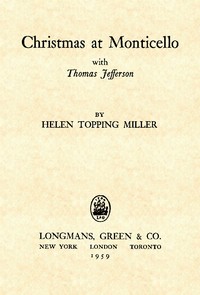
This editorial note examines how Helen Topping Miller's 1955 biographical Christmas story uses the opening kitchen scene, a boy's cruel taunt, and Rachel Jackson's private memory of a duel to guide a first reading of the novella.
Read the complete public-domain text at its original source.
Read on Project GutenbergThe story begins not with Rachel Jackson but with Hannah, a fat, stiff-kneed enslaved cook who bullies the kitchen staff at the Hermitage. The opening paragraph dwells on Hannah's physical effort—'a groaning misery for her to get up again'—and her sharp commands to 'black trash' like Betty, a cook with a past. This domestic hierarchy, established through concrete details of sage dressing and polished stools, immediately signals that the narrative will filter the Jackson household through the voices and tensions of those who serve it. A first reader should note how quickly the story moves from Hannah's authority to Emily Donelson's quiet countermand, and how Betty's backstory—nearly whipped by General Jackson, saved by his wife's 'heart as soft as butter'—introduces the central couple's contrasting reputations before either appears.
A Boy's Taunt and the Weight of History
In the middle excerpt, the Christmas Eve preparations are shattered by young Andy Jackson's cruel remark: 'boys used to yell at me that my father had killed a man—on account of Mama.' The line lands with force because the reader has already seen the household's careful order. An aunt's rebuke—'there are things never mentioned in your mother's presence'—names the taboo: Charles Dickinson and 'that tragic duel that happened before you were ever born.' The scene does not resolve the boy's defiance; instead, it pivots to Rachel alone in her room. The reader is left to weigh the aunt's defense of honor killing against the pain the memory causes. The excerpt offers no judgment, only the raw collision of a child's cruelty and a family's buried grief.
Rachel's Private Archive of a Duel
The later excerpt shifts to Rachel's interior world. Standing before her chest, she recalls the 1806 race day when Charles Dickinson's sneer about her first marriage ignited the fatal quarrel. The memory is sensory and precise: 'an April wind was blowing sweet off the fields,' the crowd in 'bright velvet' and 'tall beaver hats.' Miller renders the scene as a vivid flashback, but the key detail is Rachel's hidden document—a copy of the duel's agreement, dated May 23, 1806, signed by both men. She keeps it 'under lavender-scented linen,' a secret hoard that the General would destroy if he knew. This object, glimpsed but not described fully, becomes a quiet symbol of her private burden. The reader, like Rachel, holds knowledge that the household's Christmas cheer cannot dispel.
The Hermitage as a Stage for Unspoken Tensions
Across the excerpts, the Hermitage itself functions as a charged setting. The opening kitchen bustles with preparation for 'heap of company,' yet the work is shadowed by Betty's stigma and Hannah's tyranny. The Christmas Eve scene in the house carries the weight of Andy's outburst and Rachel's retreat. Miller does not describe the mansion's grandeur; instead, she focuses on the well-polished stool, the long table where Emily counts silver, the dimly lit room where Rachel opens a drawer. These domestic spaces become containers for histories that the characters cannot fully speak. A first-time reader should attend to how the physical environment—the kitchen, the hallway, the bedroom—shapes what can be said and what must be hidden.
Voice and the Layering of Perspective
Miller employs a shifting third-person voice that moves between characters without abrupt markers. The opening paragraph stays close to Hannah's aching body and sharp tongue; later, the narrative slips into Emily's calm authority, then into Rachel's anguished memory. This technique allows the reader to see the same household from multiple angles—the cook's resentment, the niece's efficiency, the wife's grief. Notably, the excerpts never enter Andrew Jackson's consciousness; he appears only through others' words and Rachel's recollection of his 'cold terrible rage.' The effect is to center Rachel's experience while keeping the General at a slight remove, a choice that shapes the story's emotional arc. Readers may find that the most vivid character is not the famous president but the woman who hides a yellowed paper in her linen drawer.
Because the excerpts cover only the opening, a middle scene, and a later flashback, the full shape of the Christmas story remains unknown. The narrative may return to the holiday celebration or follow Rachel's memory further. A first-time reader will benefit from noting how Miller uses small objects—a stool, a spoon, a document—to anchor emotional weight, and how the household's social layers complicate any simple portrait of the Jackson marriage. The story rewards attention to what is left unsaid as much as to what is spoken.
Years among these shelves, I’ve noticed how quiet moments shape us—Rachel Jackson’s flickering memory of a duel, a king’s lonely arithmetic of power. Both books hold that ache of chosen burdens, the private weight behind public faces. An Uncrowned King: A Romance of High Politics — Reading Notes shares that same hush, a counsel between covers for thoughtful hearts.
There are no reviews for this eBook.
There are no comments for this eBook.
Reader reflection
How will you remember this book?
Save your reaction, strongest insight, and memorable passage.
Your progress
0
/
10
2
What was your overall reaction to the book?
3
Would you encourage someone else to read it?
4
What was the reading difficulty like?
5
How closely did the book connect with your experience?
6
Was the book moving at the right speed?
7
Could you apply anything you learned?
8
Was the book what you thought it would be?
9
In one sentence, what did you learn?
10