1

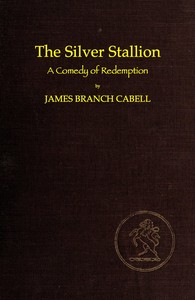
The Silver Stallion: A Comedy of Redemption — A Reader’s Guide
(0 User reviews)
1340
Project Gutenberg
2022
Not confirmed
Fantasy fiction; Knights and knighthood -- Fiction; Middle Ages -- Fiction; Humorous stories; Quests (Expeditions) -- Fiction; Alternative histories (Fiction)
Readers of public-domain and historical texts
Project Gutenberg digital edition
en
Edition facts
Words
74,899
Reading time
326 min
Text sections
71
The catalog record for The Silver Stallion: A Comedy of Redemption — A Reader’s Guide provides practical reading context through 74,899 words, 5 hr 26 min estimated reading time, and 71 detected text sections.
The text analysis averages about 22.7 words per sentence, while the detected sections provide another way to judge how the source is divided.
Project Gutenberg metadata also associates the work with “Fantasy fiction,” connecting these edition facts with the source record’s subject description.
Source:
Project Gutenberg record #67744
An editorial note on James Branch Cabell's 'The Silver Stallion: A Comedy of Redemption,' focusing on authorial choices in diction, dialogue, and description, with observations on the mock-heroic tone, the use of archaic and invented language, and the interplay between mundane and supernatural elements.
Read the complete public-domain text at its original source.
Read on Project GutenbergJames Branch Cabell's The Silver Stallion: A Comedy of Redemption opens with a mock-heroic dedication that sets the tone for the entire work: a quatrain rhyming 'forever' with 'never' and 'sorrow' with 'to-morrow,' promising that 'Redeemers will be coming by and by, / En route to make our sixes and our sevens / Neat as a trivet or an apple-pie.' This deliberate bathos—juxtaposing cosmic redemption with domestic tidiness—announces a narrative voice that treats grand quests with ironic detachment. The subtitle itself, 'A Comedy of Redemption,' signals that Cabell is less interested in earnest salvation than in the absurdities of the quest for it.
Diction and the Mock-Heroic Register
Cabell's diction oscillates between high-flown archaism and colloquial deflation. The narrator describes Guivric's feet as 'glitter[ing] each with a pallid halo, for in that instant he had trodden very near to God,' only to have the character himself speak in a worldly, almost flippant tone: 'I have loved a number of women, madame,—although I have of course avoided giving rise to any regrettable scandal.' The contrast between the solemn description and the character's mundane concerns creates a persistent ironic gap. Cabell also employs invented or obscure terms—'dactyliomancy' (divination by rings) and 'thaumaturgies' (miracles or magic)—that lend an air of learned fantasy while remaining accessible through context. This lexical playfulness is part of the book's comedy: the narrator treats the supernatural with a straight face while the characters undercut it with everyday practicality.
Dialogue as a Vehicle for Character and Irony
Dialogue in the excerpt reveals character through rhythm and register. Guivric's speech is marked by polite circumlocution and a defensive wit: 'It enables one to combine physical with mental exercise.' His interlocutor, the mysterious woman, speaks in a more lyrical and direct mode: 'Time upon time it has been so with us. But something has gone wrong—' The contrast between Guivric's evasiveness and her clarity underscores his reluctance to confront the supernatural. Cabell also uses dialogue to deliver exposition without breaking character: the woman explains the Sylan's plot in natural conversation, and Guivric's responses—'Eh, then, and do you also, madame, dismiss me as a phantom!'—show his irritation and fear. The dialogue thus advances the plot while maintaining the ironic tone.
Description and the Supernatural Mundane
Cabell's descriptive passages blend the fantastical with the quotidian. The room 'hung with green and rose-color' contains 'white pigeons ... walking about and eating barley' and a woman 'burning violets and white rose-petals and olive wood in a new earthen dish.' The specificity of the materials—violets, rose-petals, olive wood, a new earthen dish—grounds the magical ritual in domestic detail. Similarly, the Sylan's house is described as a 'mischancy place' where 'no person's body may enter,' yet the woman's body is 'that of a very old woman in Cataia, nodding among my body's many children and grandchildren.' This juxtaposition of the otherworldly with the homely (a grandmother nodding among grandchildren) creates a strange intimacy. Cabell's descriptions often linger on sensory particulars—colors, textures, actions—that make the impossible seem plausible.
Structure and the Pacing of Revelation
The excerpt's structure moves from Guivric's confident circumambulation to his gradual deflation. The chapter heading 'One Warden Left Uncircumvented' hints at a systematic process, but the narrative subverts expectation: Guivric's magical protections (walking widdershins, noting numbers) prove inadequate against the woman's gentle persistence. The pacing alternates between action and reflection: Guivric's brisk movements ('Guivric still went onward') are interrupted by long exchanges that reveal his emotional state. The final image—'his broad shoulders sagged a little'—after his brave declaration 'Nevertheless, I go' undercuts the heroic pose. Cabell uses this rhythm to create a comedy of deflation: each step toward the quest reveals more of the protagonist's vulnerability.
Readers attentive to Cabell's stylistic choices will find a work that rewards close attention to its verbal texture. The comedy arises not from slapstick but from the tension between elevated language and mundane reality, between the characters' self-importance and their actual powerlessness. The excerpts suggest a narrative that delights in its own artifice while never losing sight of the human frailties that drive the story. Approach The Silver Stallion as a performance of erudition and irony, where every archaism and every deflation is deliberate.
Reading this guide again, I kept thinking how Cabell’s mock-heroic playfulness is really a quiet plea for second chances, not grand redemption. There’s a particular ache in that. It made me recall the gentler uncertainty of a certain yellow wood—where choices linger and paths remain unjudged. In a Yellow Wood — Story, Setting & Ideas feels like the same wistful pause, just differently dressed.
There are no reviews for this eBook.
There are no comments for this eBook.
Reader reflection
What was your reading experience?
Capture what you thought, learned, and would like to remember.
Your progress
0
/
10
2
How did the book work for you overall?
3
Would you recommend this book to another reader?
4
How demanding did the text feel?
5
How would you describe its reading pace?
6
What was its emotional impact?
7
Would you start a conversation about this book?
8
Which element worked best for you?
9
What changed or sharpened your thinking?
10