1

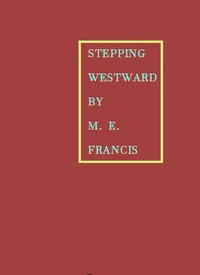
Stepping Westward — Edition Insights
(0 User reviews)
383
Project Gutenberg
2021
Not confirmed
Short stories; Country life -- Fiction; Dorset (England) -- Fiction; Lancashire (England) -- Fiction
Readers of public-domain and historical texts
Project Gutenberg digital edition
en
Edition facts
Words
82,632
Reading time
360 min
Text sections
8
Before opening Stepping Westward — Edition Insights, the edition data offers a quick orientation: 82,632 words, 6 hr estimated reading time, and 8 detected text sections.
The text analysis averages about 18.1 words per sentence, while the detected sections provide another way to judge how the source is divided.
Project Gutenberg metadata also associates the work with “Short stories,” connecting these edition facts with the source record’s subject description.
Source:
Project Gutenberg record #66833
M. E. Francis's 1907 collection of short stories set in rural England, primarily Dorset and Lancashire, explores country life through dialect-rich dialogue and detailed seasonal settings. The opening story 'Tranter Sally' contrasts a hedger's labor with autumn's beauty, while later tales like 'Farmer Barnes’s Dilemma' reveal family negotiations and social customs.
Read the complete public-domain text at its original source.
Read on Project GutenbergThe collection opens with 'Tranter Sally,' where the narrator lingers on an autumn hedgerow—'gay with its autumn tints'—before introducing Sol Bowditch, a hedger who methodically cuts down the very beauty described. The contrast between the lyrical landscape and Sol's 'uncompromising bill-hook' sets a pattern: Francis often pairs detailed natural observation with blunt human activity. The story's title character, Sally, is a 'tranter' (a carrier of goods), and her entrance shifts the focus from scenery to social dynamics. This opening establishes a world where work and nature are in constant tension, and where characters speak in regional dialect that conveys both humor and gravity.
Dialect and Voice
Francis renders speech with careful attention to regional inflection. In 'Farmer Barnes’s Dilemma,' the farmer tells his daughter Maimie, 'Thou’rt but young, as I say, and I mustn’t expect too much fro’ thee.' The dropped consonants and softened vowels ('fro’' for 'from') are consistent across characters, yet each voice retains individuality. Maimie's protests—'Nay, but, feyther'—contrast with her father's emphatic 'Nay, but, I’ll not ha’ no buts.' The dialect is not merely decorative; it carries emotional weight. When Barnes speaks of his deceased wife, his speech becomes halting: 'your mother, my dear, was fifty-four and a bit—’tis a nice age.' The rhythm of the dialogue mimics spoken thought, with pauses marked by dashes and repetitions. Readers unfamiliar with Lancashire or Dorset speech may need to adjust, but the meaning is always clear from context.
Seasonal and Agricultural Detail
The natural world is never a mere backdrop. In 'Tranter Sally,' the hedge is described with botanical precision: 'crane’s-bill, mallow and scabious' still bloom, while 'new blossoms of guelder-rose' appear alongside 'claret-coloured leaves.' This attention to specific plants and their seasonal behavior recurs throughout. Autumn is not just a setting but an active force—'the finger of autumn had left its trace.' Yet the human response to nature is often utilitarian. Sol Bowditch cuts the hedge for Farmer House, who 'cared little for the poetical aspect of things.' Francis thus embeds a quiet commentary on rural labor: the same hedgerow that delights the narrator is a task to be completed. Later stories may shift to indoor settings, but the rhythms of planting, harvest, and weather remain implicit.
Family and Social Negotiation
'Farmer Barnes’s Dilemma' centers on a widower's decision to remarry. The scene is a domestic negotiation: Maimie protests that her mother 'would never ha’ liked that,' while Barnes insists on 'doin’ my dooty by your poor mother.' The humor arises from his practical reasoning—he plans to court Mrs. Wharton, a widow with six children, because 'they’ll come in handy about the place.' Yet the dialogue also reveals genuine grief. Barnes speaks of his late wife with 'moist eyes' and a broken voice. Francis balances comedy and pathos without tipping into sentimentality. The story does not resolve whether the marriage will occur; the excerpt ends with Maimie's reluctant compliance. This open-endedness is typical of the collection, which often presents a dilemma or a character study rather than a neatly tied conclusion.
Structure and Narrative Distance
The stories are linked by setting and theme but stand independently. The table of contents lists fourteen titles, from 'Tranter Sally' to 'April Fools,' suggesting a range of tones and situations. Francis employs a third-person narrator who occasionally steps back to offer a wry observation—'Thus was beauty laid low and nature’s kindly forethought set at nought'—but mostly lets dialogue and action carry the story. The narrative voice is closer to the characters' perspectives than to an omniscient commentator. In 'Farmer Barnes’s Dilemma,' the reader learns of Barnes's intentions through his conversation with Maimie, not through interior monologue. This technique creates a sense of eavesdropping on real rural life. The excerpts do not reveal whether later stories maintain this approach, but the pattern in the opening tales is consistent: Francis trusts her readers to infer motive and emotion from what is said aloud.
As you read, attend to the balance between description and dialogue. Francis often lets a character's speech reveal more than the narrator states directly. The dialect may slow you at first, but it rewards patience with authenticity. Notice how each story begins—sometimes with landscape, sometimes with a character in action—and how the ending often leaves a question hanging. These are not moral tales but glimpses of lives shaped by place and circumstance.
Sometimes a book stays with you less for its plot than for its weather—the way Stepping Westward lingers in that amber autumn light, with hedgers working against the season’s quiet fading. Evered — Inside the Classic reminded me of that same tenderness, that careful watching of small lives. I keep thinking about both, the way one remembers a late walk.
There are no reviews for this eBook.
There are no comments for this eBook.
Reader reflection
Record your reading impressions
A brief reflection can help important ideas stay with you longer.
Your progress
0
/
10
2
Did this book hold your interest?
3
Would you encourage someone else to read it?
4
How demanding did the text feel?
5
How useful did the reading feel?
6
How personally connected did you feel to the book?
7
Which part made the strongest impression?
8
How original did the book feel?
9
What did this book teach you most?
10