1

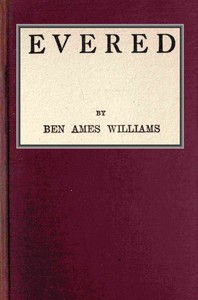
Evered — Inside the Classic
(0 User reviews)
370
Project Gutenberg
2021
Not confirmed
Maine -- Fiction; Man-woman relationships -- Fiction; Farmers -- Fiction; Husband and wife -- Fiction; Families -- Fiction; Butchers (Persons) -- Fiction
Readers of public-domain and historical texts
Project Gutenberg digital edition
en
Edition facts
Words
46,112
Reading time
201 min
Text sections
5
Before opening Evered — Inside the Classic, the edition data offers a quick orientation: 46,112 words, 3 hr 21 min estimated reading time, and 5 detected text sections.
The text analysis averages about 15.7 words per sentence, while the detected sections provide another way to judge how the source is divided.
Project Gutenberg metadata also associates the work with “Maine -- Fiction,” connecting these edition facts with the source record’s subject description.
Source:
Project Gutenberg record #64398
An editorial note on Ben Ames Williams's Evered, focusing on the author's diction, dialogue, and descriptive choices in this 1921 novel set in rural Maine. The note examines the narrator's opening landscape rhetoric, the protagonist's internal turmoil conveyed through physical action, and the tension between community judgment and personal isolation.
Read the complete public-domain text at its original source.
Read on Project GutenbergThe narrator of Ben Ames Williams's Evered opens with a sweeping, almost rhapsodic description of the Maine landscape, calling it a land of "romance" and "drama—comedy or tragedy according to the eye and the mood of the seer." This rhetorical gesture immediately establishes a tension between the external beauty of the setting and the internal conflicts of the characters. The prose is deliberately lyrical, with short, rhythmic clauses and a catalog of opposites—"Loneliness and comradeship, peace and conflict"—that foreshadow the novel's central oppositions. Yet the narrator quickly pivots to specific details: the names of villages—Liberty, Union, Fraternity—which carry historical weight from the Revolutionary era, and the observation that farms are "set high upon the hills, bare to the bleak gales." This juxtaposition of idealistic place names with harsh realities hints at the story's concerns with pride, isolation, and the weight of community judgment.
The Weight of a Name
The title Evered is the protagonist's surname, and the narrator uses it almost exclusively, rarely giving a first name. This choice creates a sense of formality and distance, aligning the reader with the community's perspective—the townspeople refer to him as "Evered" as well. The name itself suggests endurance ("ever" + "-ed"), which is fitting for a man who "was growing old through much thought upon the matter" and who "would not kill the bull, partly from native stubbornness." The narrator's diction emphasizes his stoic, almost monolithic quality: he is "a man so used to loneliness," driven by "some inner uneasiness which demanded an outlet." The repetition of "the man" in passages like "The man went furiously to the next, and to the next thereafter" reinforces his archetypal, almost mythic status as a figure of rural endurance.
Action as Interior Monologue
Williams conveys Evered's psychological state almost entirely through physical action. When Evered takes down his "double-bitted ax" and goes to the grindstone, the reader is told he does so "in response to some inner uneasiness." The ax becomes an extension of his turmoil: he "struck the ax into the first tree with a hot energy" and works "at a relentless pace for perhaps half an hour, drunk with his own labors." The narrator explicitly links physical exertion to emotional release, noting that Evered's "overflowing energy had always been his master" and now drives him "with a new spur—the spur of his own thoughts." This technique allows the reader to infer his anguish without direct confession. The scene where he decides to go to the spring where his wife died—despite hating and fearing the place—is presented as a test of character: "because it was ever the nature of the man to meet danger or misfortune or unpleasantness face to face." The narrator's omniscient commentary here is sparing but pointed, framing Evered's choice as a matter of ingrained principle.
The Community's Furtive Gaze
The townspeople of Fraternity are a constant, oppressive presence in the excerpts. The narrator reports that "the men of the town, he saw, were watching him with furtive eyes; the women looked upon him spitefully." This collective judgment is rendered in short, parallel clauses that mimic the weight of gossip. The community's expectation is clear: "most people thought he should have killed the red bull before this." Yet Evered's refusal is not explained as weakness but as a complex mix of "native stubbornness" and "an unformed feeling that he, not the bull, was actually responsible." The narrator's phrasing—"unformed feeling"—is deliberately vague, leaving the reader to wonder whether Evered's guilt is justified or a product of his own tortured mind. The dialogue between Ruth and John, overheard or inferred, adds another layer: "Does he know Darrin is there, I wonder?" Ruth's reply—"He sees more than you think"—suggests that Evered's awareness exceeds what others assume, deepening the sense of his isolation.
Landscape as Emotional Counterpoint
The narrator repeatedly uses the natural world to mirror or contrast Evered's inner state. On the day his wife died, the weather was "sultry and lowering and oppressive; there was death in the very air." In the present scene, the day is "bright, crisp, cool; the air like wine, the earth a vivid panorama of brilliant coloring." This stark contrast underscores Evered's inability to find solace in beauty: "There was no song in Evered; nevertheless, he felt the influence of the glory all about him. It made him, somehow, lonely." The narrator's use of "somehow" is telling—it acknowledges the paradox of feeling isolated in the midst of splendor. The description of the spring, which Evered has avoided since his wife's death, is withheld from the reader; we only know that he "could see it all too vividly without bringing the actual surroundings before his eyes." This restraint maintains the mystery of what happened while emphasizing the place's traumatic power.
Williams's prose in Evered is notable for its economy of psychological revelation: the reader must infer Evered's thoughts from his actions and from the narrator's spare, often ironic commentary. The landscape is never merely decorative; it functions as a barometer of emotional pressure. Readers attentive to the rhythm of the sentences—the short, breathless clauses during moments of exertion, the longer, more lyrical passages in descriptive interludes—will find a novel that rewards close attention to craft. The excerpts suggest a work that is as much about the weight of community expectation as it is about one man's private torment.
That quiet ache in Evered—the way a man's inner storm gets lost under small-town glances—stayed with me long after the prose settled. There's something similar lingering in An Uncrowned King: A Romance of High Politics — Reading Notes, where the solitude isn't rural but regal, yet feels just as heavy. I keep thinking about how both stories measure a person's distance from everyone else.
There are no reviews for this eBook.
There are no comments for this eBook.
Reader reflection
What did you think of this book?
Answer a few questions and save a private reflection on this device.
Your progress
0
/
10
2
Did this book hold your interest?
3
Would you pass this book on to a friend?
4
How easy was the book to follow?
5
How did the pace of the book feel?
6
Did anything about the book feel genuinely new?
7
Would you start a conversation about this book?
8
How well did it match your expectations?
9
What is the main idea you are taking away?
10