1

Fortune's Fool — Reading Notes
(0 User reviews)
666
Project Gutenberg
2021
Not confirmed
Historical fiction; Adventure stories; Abduction -- Fiction; Great Britain -- History -- Restoration, 1660-1688 -- Fiction
Readers of public-domain and historical texts
Project Gutenberg digital edition
en
Edition facts
Words
96,374
Reading time
420 min
Text sections
9
For Fortune's Fool — Reading Notes, the stored edition analysis reports 96,374 words, 7 hr estimated reading time, and 9 detected text sections.
The text analysis averages about 15.7 words per sentence, while the detected sections provide another way to judge how the source is divided.
Project Gutenberg metadata also associates the work with “Historical fiction,” connecting these edition facts with the source record’s subject description.
Source:
Project Gutenberg record #65939
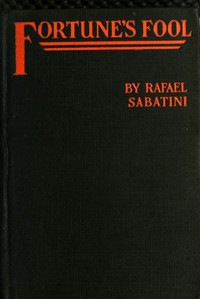
Sabatini's Restoration adventure follows Randal Holles, a Royalist reduced to penury, as he navigates a London riven by plague, political intrigue, and the predatory schemes of the Duke of Buckingham. The novel contrasts Martha Quinn's pragmatic materialism with the reckless ambitions of aristocrats, using the 1665 plague as both setting and metaphor for moral decay.
Read the complete public-domain text at its original source.
Read on Project GutenbergThe novel opens not with a hero but with Martha Quinn, hostess of the Paul's Head, whose mind "confined itself to the essentials of life: its sustenance and reproduction." This blunt materialism establishes a grounding contrast to the volatile world of Restoration politics and romance that follows. Sabatini immediately signals a story attentive to the gap between practical survival and the grandiose schemes of the powerful.
The excerpts reveal a narrative voice that relishes ironic detachment, especially when describing the Duke of Buckingham's machinations. His servant Bates is called "intimately acquainted with his conscience," a wry acknowledgment of the moral compromises that underpin aristocratic power. The plague, mentioned early as a distant threat, will soon become an inescapable reality.
Martha Quinn's World and the Plague's Shadow
The first chapter introduces a London where the plague is already a rumor, but Martha Quinn is more concerned with "the vices of the Court" and the fashion for "yellow bird's-eye hoods." Her priorities—meat, drink, and the practical details of running an inn—stand in deliberate contrast to the political and romantic intrigues that will drive the plot. Sabatini uses her perspective to ground the reader in the material realities of 1665: the scarcity of tenants, the fear that empties streets, the daily business of a prosperous house. The plague is not yet a catastrophe but a background anxiety, one that the powerful—like Buckingham—see as an opportunity for secrecy. When Bates reports that "more than half the houses in Knight Ryder Street are empty," the Duke is pleased: the depopulation will shield his schemes. This early juxtaposition of Martha's sensible world and Buckingham's predatory opportunism sets up a central tension between those who endure and those who exploit.
Buckingham's Schemes and the Language of Comedy
The Duke of Buckingham is introduced through his dialogue with Bates, a servant whose "humorous insolence" is tolerated because of his intimate knowledge of his master's conscience. Their exchange about the planned abduction of Sylvia Farquharson is laced with ironic understatement: Buckingham calls it a "little comedy" and a "more serious note." The language of theater pervades their plotting—"comedy," "acting," "part"—suggesting that the aristocracy treats life as a performance. Bates's dry responses and his memory of a previous "cudgelling" hint at a pattern of violence disguised as entertainment. Sabatini does not present Buckingham as a villain in the melodramatic sense; instead, he is a man who "flout[s] all laws but those of his own desires," and whose plans are executed with a blend of casual cruelty and bureaucratic efficiency. The house in Knight Ryder Street, rented in Bates's name, becomes a stage for a coercion that the Duke frames as a theatrical improvement on a failed earlier attempt.
The Mercenary's Predicament and the Weight of History
The chapter titled "The Mercenary" (Chapter V) suggests a shift in focus to Randal Holles, a Royalist soldier whose fortunes have fallen since the Restoration. The excerpts do not reveal his full story, but the title and the novel's historical setting—the Restoration period, with its unresolved tensions between Cavaliers and Parliamentarians—imply a man caught between past loyalties and present necessity. The catalog subjects list "abduction" and "adventure," and the secondary topic "historical-fiction" places Holles within a tradition of wandering heroes. Sabatini's prose, as seen in the opening, favors concrete detail and ironic observation over sentimental reflection. Holles is likely to be a figure of compromised honor, navigating a world where the old certainties of the Civil War have given way to the cynical pragmatism of the Restoration court. The plague, which will later dominate the narrative (chapters XXVI–XXIX), serves as an equalizing force, threatening both the powerful and the powerless.
Readers should attend to the way Sabatini uses the plague not merely as a historical backdrop but as a narrative device that strips away social pretenses. The contrast between Martha Quinn's unflappable practicality and Buckingham's theatrical scheming offers a key to the novel's moral landscape. The excerpts suggest a story where survival depends on knowing when to play a part and when to attend to the essentials—a lesson that Holles, the titular "fool," may learn at considerable cost.
That rainy afternoon, Sabatini’s plague-ridden London felt uncomfortably close, the moral rot seeping through every page. When the rain finally lightened, I found myself reaching for something with a colder, wilder shore, something less stifled by human scheming. Greensea Island: A Mystery of the Essex Coast — Reading Companion came to hand almost by itself, its salt air a quiet relief.
There are no reviews for this eBook.
There are no comments for this eBook.
Reader reflection
Your personal reading reflection
Build a private reading journal entry for this title.
Your progress
0
/
10
2
Was reading this book enjoyable?
3
Is this a title you would suggest to others?
4
What was the reading difficulty like?
5
How distinctive were its ideas or approach?
6
Did it raise ideas you would like to talk about?
7
How did the pace of the book feel?
8
How did the reading compare with what you expected?
9
Which lesson or insight stayed with you?
10