1

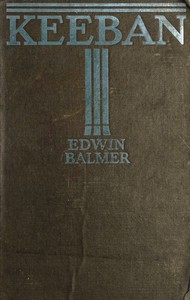
Keeban — Inside the Classic
(0 User reviews)
741
Project Gutenberg
2021
Not confirmed
Detective and mystery stories; Chicago (Ill.) -- Fiction; Adventure stories; Brothers -- Fiction
Readers of public-domain and historical texts
Project Gutenberg digital edition
en
Edition facts
Words
62,176
Reading time
271 min
Text sections
6
This digital edition of Keeban — Inside the Classic is described by source-level measurements including 62,176 words, 4 hr 31 min estimated reading time, and 6 detected text sections.
The text analysis averages about 15.8 words per sentence, while the detected sections provide another way to judge how the source is divided.
Project Gutenberg metadata also associates the work with “Detective and mystery stories,” connecting these edition facts with the source record’s subject description.
Source:
Project Gutenberg record #66114
Edwin Balmer's 1923 mystery follows Steve Fane as he tracks his brother Jerry, who appears in two places at once. The narrative, told in Steve's colloquial first-person voice, blends Chicago settings with underworld slang and a counterfeit-money plot. Observations focus on Balmer's use of dialogue, descriptive detail, and the brotherly dynamic.
Read the complete public-domain text at its original source.
Read on Project GutenbergFrom its first sentence—'The quick, quiet unlocking and then the closing of the hall door on the floor below told me that Jerry had come in'—Edwin Balmer establishes a narrator who reads meaning into small actions. Steve Fane's voice is colloquial, observant, and self-deprecating, often breaking into asides like 'I never realized, till I began analyzing Jerry, how much more you need than a brain for thinking.' The prose moves between tense action and reflective commentary, with a fondness for cataloging details: the 'Astor Street marble mansion,' the 'shaded reading lamp,' the 'double blinds.' Balmer's Chicago is a city of contrasts—wealthy homes and underworld dives—and his dialogue shifts register accordingly, from polite society chatter to the clipped slang of safe-blowers and grifters.
A Narrator Who Notices Everything
Steve Fane is not a typical detective; he is a brother drawn into a mystery by loyalty and curiosity. His narration is marked by a constant awareness of his own limitations: 'I’m one of those mute buyers,' he says, contrasting himself with Jerry, who 'notices everything' and 'has the clear head and the nervous energy to make out' meanings. Balmer uses Steve's self-deprecation to create a relatable, fallible guide. The reader sees the world through Steve's senses—he remarks on a 'pretty, slender, strong little hand,' the 'wallop' of a woman's appearance, the texture of a counterfeit bill. This sensory detail grounds the mystery in tangible observation, making the reader complicit in Steve's deductions.
The Underworld and Its Language
Balmer populates his Chicago with a rogues' gallery that speaks in a distinct argot. Terms like 'bump-off,' 'getaway,' 'safe blower,' and 'the Queer' (counterfeit money) appear without explanation, immersing the reader in Steve's world. Dialogue is crisp and functional: 'I almost collided with a couple of my friends—girls—from up the Drive and around on Astor. We nearly crashed because they were looking, too.' The contrast between polite society and the underworld is sharpened by Steve's ability to move between both, adopting a 'hired Erasmus get-up' to infiltrate a thieves' ball. Balmer's ear for speech patterns extends to the women: Cleopatra's alias 'Miss Wellington of Denver' and her careful story about breaking a hundred-dollar bill reveal a practiced deceiver.
Brotherly Bonds and Divided Loyalties
The relationship between Steve and Jerry is the emotional core. Jerry is described as a force of nature—'He put life into any place'—and Steve's admiration is tinged with worry. The opening chapter's title, 'My Brother Finds Himself in Two Places at Once,' sets up a puzzle that is also a personal crisis. Steve's loyalty is tested when he recognizes Cleopatra as his dance partner from the Flamingo Feather; he owes her a debt for warning him, yet she is passing counterfeit bills. Balmer lets Steve wrestle with this conflict in real time: 'From a Puritanical point of view, I had one plain duty... On the other hand, my acquaintance with Cleopatra... had been gained under circumstances which any one would call privileged.' This moral ambiguity gives the mystery a human weight.
Setting as Character: Chicago in the 1920s
Balmer's Chicago is vividly rendered through specific locations: the 'Astor Street marble mansion,' Michigan Boulevard, Field's department store, the Blackstone Hotel. These are not mere backdrops but active elements in the plot. The city's geography matters—Steve trails Cleopatra 'down Michigan Boulevard,' noting the traffic officer at the corner. The contrast between the wealthy 'Drive' and the riverfront underworld (Chapter III: 'I Have an Encounter by the River') reflects the social divisions that drive the story. Balmer also uses weather and time of day: the story opens at 'two-thirty on a morning after everybody else has gone to bed,' and later a 'very hot night' creates oppressiveness. These details anchor the fantastical elements—a man in two places, a secret gas called KX—in a recognizable, gritty reality.
Readers approaching Keeban should attend to the way Balmer builds suspense through Steve's limited perspective. The narrator knows only what he sees and hears, and his interpretations are often wrong. The pleasure lies in watching him piece together clues—a voice, a hand, a counterfeit bill—while the larger picture remains hidden. Balmer's prose rewards close reading; his descriptions of people and places are economical but precise, and his dialogue carries subtext. This is a mystery that values atmosphere and character as much as plot, and its 1923 Chicago feels immediate and dangerous.
I keep thinking about how Balmer's Steve spends the whole book chasing a brother who's somehow in two places at once—that ache of recognizing someone and not quite knowing them. Honor of Thieves: A Novel — Edition Insights reminded me of that same quiet unease, the way loyalty and suspicion can braid together until you're not sure which thread you're holding. It lingered like an old photograph.
There are no reviews for this eBook.
There are no comments for this eBook.
Reader reflection
Record your reading impressions
A brief reflection can help important ideas stay with you longer.
Your progress
0
/
10
2
Did this book hold your interest?
3
Would you recommend this book to another reader?
4
What was the reading difficulty like?
5
Did any part of the book stay with you emotionally?
6
How closely did the book connect with your experience?
7
How well did it match your expectations?
8
Would you read this book again?
9
What is the main idea you are taking away?
10