1

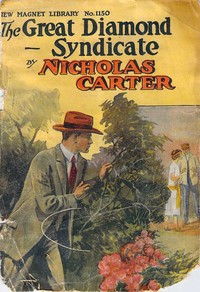
The Great Diamond Syndicate; Or, The Hardest Crew on Record — Background and Themes
(0 User reviews)
449
Project Gutenberg
2020
Not confirmed
Detective and mystery stories; Murder -- Investigation -- Fiction; Dime novels; Jewel thieves -- Fiction
Readers of public-domain and historical texts
Project Gutenberg digital edition
en
Edition facts
Words
58,068
Reading time
253 min
Text sections
36
The source record for The Great Diamond Syndicate; Or, The Hardest Crew on Record — Background and Themes measures this digital text at 58,068 words, 4 hr 13 min estimated reading time, and 36 detected text sections.
The text analysis averages about 12.8 words per sentence, while the detected sections provide another way to judge how the source is divided.
Project Gutenberg metadata also associates the work with “Detective and mystery stories,” connecting these edition facts with the source record’s subject description.
Source:
Project Gutenberg record #63340
Nick Carter traces a diamond theft and murder from a theatrical club to a Parisian tailor's disguise, using physical clues like red hairs and a black wig to unmask a female conspirator.
Read the complete public-domain text at its original source.
Read on Project GutenbergThe opening chapter, 'A Dark Night’s Work,' sets a brisk pace with a murder committed offstage, reported through terse dialogue. The narrative voice—detached, procedural—relies on Nick Carter’s methodical observations rather than emotional reaction. A key early clue involves a suit with a tailor’s trademark linked to Dumond, 'the thieves’ tailor,' who makes disguises for actors and criminals. This detail anchors the story in a world of theatrical deception, where clothing becomes evidence.
The prose moves swiftly, with short paragraphs and frequent line breaks mimicking the dime-novel style. Chapters are brief (averaging under 2,000 words), and each ends on a revelation or question, propelling the reader forward. The language is plain, favoring action verbs and concrete nouns over description.
Clues from the Washstand
In Chapter XII, Nick Carter reconstructs the suspect’s appearance from residue left in a hotel room. He notes 'short red hairs' in a brush and comb, a black sediment in the washbowl from face stain, and a dry spot on the carpet indicating a small shoe. The passage demonstrates the story’s reliance on physical evidence rather than witness testimony. Nick’s reasoning is explicit: 'She combed her hair, after removing her black wig, before she removed her clothes.' The detective transforms a messy room into a timeline of disguise removal.
The exchange with Maynard highlights the narrative’s educational tone—Nick explains each step, turning the reader into a student of detection. The language is clinical: 'black sediment,' 'rimmed with black,' 'still moist.' This forensic detail contrasts with the earlier, more atmospheric 'dark night’s work,' showing how the story shifts between moody setup and analytic payoff.
The Theatrical Milieu
The setting is a theatrical club where diamonds are used as props. Maynard, a club member, had the gems at rehearsal, and 'the members of the club knew that you had them with you.' This insider access creates a closed circle of suspects. The narrative voice treats the stage world as inherently duplicitous: actors, costumes, and false identities are routine. Dumond’s shop, which makes 'duplicates, imitations, disguises, and all sorts of trick garments,' literalizes the theme of performance.
The story’s pace accelerates when Nick focuses on a specific suspect, Julius Mantelle, 'a recent acquaintance from Paris.' The clipped dialogue—'Who is he?' 'A recent acquaintance from Paris and a member of the club'—moves the plot forward without elaboration. The reader is left to infer Mantelle’s role from context, as the narrative prioritizes action over interiority.
Voice and Sentence Rhythm
The narrator maintains a flat, reportorial tone, even during tense moments. Sentences are short and declarative: 'Nick did not reply immediately.' 'He was examining a comb and brush.' 'Maynard took the brush into his hand.' This rhythm creates a staccato effect, mirroring the detective’s step-by-step reasoning. Dialogue often consists of questions and answers, with Nick supplying the logic.
Changes in pace occur through chapter breaks and shifts from investigation to confrontation. The early chapters (I–XI) build clues; later ones (XII onward) introduce the syndicate and escalate danger. The language remains consistent—no stylistic variation between scenes of deduction and scenes of action. This uniformity reinforces the dime-novel formula: the detective’s voice is the constant, even as the plot twists.
Readers should attend to the interplay between what is seen and what is inferred. The narrative rewards attention to small details—a wet washbowl, a dry footprint—that Nick Carter transforms into evidence. The story’s brevity and episodic structure make it suitable for quick consumption, but the layered clues invite rereading. Note how the author uses theatrical disguise as both plot device and metaphor for the detective’s work of unmasking.
That rainy afternoon, I kept thinking how Nick Carter’s red hairs and black wig were just flimsy threads—yet they held. The theatrical disguises felt like masks we all wear. Later, almost by accident, I found myself reading The Texas Hawks; or, The Strange Decoy — Context and Discussion, and the same quiet question lingered: how much of anyone’s surface is ever the truth?
There are no reviews for this eBook.
There are no comments for this eBook.
Reader reflection
Take a moment to reflect on this book
Create a short personal record of your experience with this book.
Your progress
0
/
10
2
How did the book work for you overall?
3
Would you pass this book on to a friend?
4
How much effort did this book require?
5
Would you start a conversation about this book?
6
How original did the book feel?
7
Was the book what you thought it would be?
8
Do you expect to return to this book?
9
What is the main idea you are taking away?
10