1

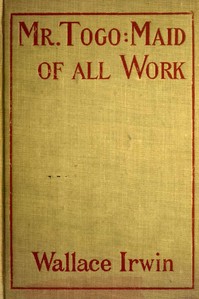
Mr. Togo: Maid of all Work — Edition Insights
(0 User reviews)
1870
Project Gutenberg
2021
Not confirmed
Humorous stories; Epistolary fiction; Household employees -- Fiction; Japanese -- United States -- Fiction
Readers of public-domain and historical texts
Project Gutenberg digital edition
en
Edition facts
Words
28,644
Reading time
125 min
Text sections
4
This digital edition of Mr. Togo: Maid of all Work — Edition Insights is described by source-level measurements including 28,644 words, 2 hr 5 min estimated reading time, and 4 detected text sections.
The text analysis averages about 11.0 words per sentence, while the detected sections provide another way to judge how the source is divided.
Project Gutenberg metadata also associates the work with “Humorous stories,” connecting these edition facts with the source record’s subject description.
Source:
Project Gutenberg record #65614
Wallace Irwin's 1913 comic novel presents Japanese servant Hashimura Togo's epistolary misadventures in American households, blending broken English narration with slapstick chaos involving vacuum cleaners, soap buckets, and social satire.
Read the complete public-domain text at its original source.
Read on Project GutenbergHashimura Togo, a Japanese domestic servant in early-20th-century America, narrates his misadventures through letters to a newspaper advice columnist. The opening chapter introduces his first encounter with a vacuum cleaner, which he treats as a living creature—the “Hon. Vacuum”—and describes with mock-heroic instructions. Togo’s voice, a deliberate mix of grammatical errors, malapropisms, and formal Japanese honorifics, immediately establishes the book’s comic register. The humor derives less from plot than from the collision between Togo’s literal-minded logic and the baffling conventions of American domestic life.
Togo’s Unreliable English as a Comic Engine
Irwin crafts Togo’s language as a sustained performance. The narrator consistently misapplies verb tenses (“I have just abandoned,” “I are”), invents compound words (“sweethearted lady,” “curly-puff hair”), and redefines common objects through analogy: a vacuum is “like an ingrowing garden hose” that “can inhale forever without coughing outwards.” These linguistic tics are not random; they follow a pattern of treating machines as animate beings (the vacuum “want to eat dust”) and social interactions as baffling rituals. The effect is a defamiliarization of ordinary household tasks, making the reader see cleaning through alien eyes. Irwin rarely breaks character—Togo’s voice remains consistent across the excerpts, even during physical comedy, which suggests the author’s careful control of the persona.
Physical Comedy and Social Hierarchy
The excerpts showcase slapstick built on status inversion. In the opening, Togo accidentally dumps soapy water on a wealthy visitor’s hat and a chauffeur, then flees through a window. The scene escalates from verbal misunderstanding to physical chaos, with Togo’s internal logic (“I could not be a burglar and be so noisy”) heightening the absurdity. The humor targets class pretension: the “400” lady in “Arctic mouse-skins fur” and the chauffeur in “expensive boots” are reduced to sputtering indignation. Togo’s perspective as a low-paid servant ($4.50 weekly) who nonetheless claims moral and intellectual superiority (“I am an experienced soaper and a fearless rubb”) creates a running tension between his subordinate role and his narrative authority. The comedy depends on the reader recognizing the gap between Togo’s self-assessment and the disasters he causes.
Epistolary Structure and Reader Address
The novel is framed as a series of letters to the editor of a “Woman’s Page,” a choice that shapes both tone and content. Togo directly addresses “Mr. Editor,” offering unsolicited advice on housekeeping while recounting his failures. This format allows Irwin to blend instructional parody (the numbered steps for vacuum use) with anecdotal narrative. The letter convention also explains why Togo’s voice remains so consistent: each chapter is a discrete episode, often ending with a cliffhanger or a moral tag. The excerpts suggest that the book’s humor relies on the reader’s familiarity with early-1900s domestic advice columns, which Irwin subverts by having a servant lecture the experts. The epistolary frame also limits the scope—readers never see events from outside Togo’s perspective, which keeps the comedy tightly focused on his interpretations.
Recurring Motifs: Machines, Food, and Social Climbing
Several motifs recur across the excerpts. Machines are consistently anthropomorphized: the vacuum is “Hon. Vacuum,” an automobile is “gas-machinery,” and Togo treats them as unpredictable animals. Food appears as a source of conflict—the “sudds bucket” and “soap-water” are weaponized, and later chapters promise “Paper-Bag Cooking.” Social climbing is a constant theme: Togo is awed by wealth (“I was enraptured to be standing above so much money”) yet his actions undermine the very hierarchy he admires. The chapter titles themselves (“The Hon. Vacuum Who Cleans Things,” “Hon. Baby and What To Do with Him”) suggest a pattern of treating domestic objects and family members with the same mock-formal respect. These recurring elements give the episodic narrative a structural coherence, even without a overarching plot.
Readers should approach Mr. Togo: Maid of all Work as a performance of voice rather than a conventional novel. The pleasure lies in watching Togo’s logic collide with American domesticity, not in following a sustained story arc. Because the excerpts are limited to early chapters, the later developments—particularly the promised “Paper-Bag Cooking” and “Automobiles”—may shift the comic focus. Pay attention to how Irwin balances linguistic play with physical comedy; the book rewards those who read Togo’s malapropisms as deliberate craft rather than mere error.
There’s something tender about watching someone fumble through a world they don’t fully understand, like Hashimura Togo tripping over soap buckets and polite lies. That same quiet ache surfaces in Honor of Thieves: A Novel — Edition Insights, where honor gets bent in strange places. I kept thinking about how we all just try to belong, somehow.
There are no reviews for this eBook.
There are no comments for this eBook.
Reader reflection
How did this book work for you?
Your answers remain private and are stored only in this browser.
Your progress
0
/
10
2
What was your overall reaction to the book?
3
Would you recommend this book to another reader?
4
What was the reading difficulty like?
5
Would you start a conversation about this book?
6
How much did the book move you?
7
Could you see yourself revisiting this book?
8
Did the book meet your expectations?
9
What did this book teach you most?
10