1

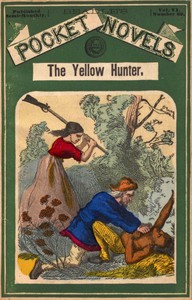
The Yellow Hunter; or, The Winding Trail of Death — Story, Setting & Ideas
(0 User reviews)
69
Project Gutenberg
2022
Not confirmed
Indians of North America -- Fiction; Adventure stories; Dime novels; Frontier and pioneer life -- United States -- Fiction
Readers of public-domain and historical texts
Project Gutenberg digital edition
en
Edition facts
Words
36,532
Reading time
159 min
Text sections
19
The source record for The Yellow Hunter; or, The Winding Trail of Death — Story, Setting & Ideas measures this digital text at 36,532 words, 2 hr 39 min estimated reading time, and 19 detected text sections.
The text analysis averages about 17.0 words per sentence, while the detected sections provide another way to judge how the source is divided.
Project Gutenberg metadata also associates the work with “Indians of North America -- Fiction,” connecting these edition facts with the source record’s subject description.
Source:
Project Gutenberg record #67958
This editorial note examines the structure and recurring imagery in T. C. Harbaugh's dime novel, focusing on the opening siege, the winding trail motif, and the use of animalistic descriptions to characterize the hero and villain.
Read the complete public-domain text at its original source.
Read on Project GutenbergThe novel opens not with its hero but with a historical event: the assassination of Pontiac. This choice immediately situates the story within a broader conflict, the Pontiac War, and establishes a tone of vengeance and bloodshed. The narrator declares that the reader will follow fortunes that “pale the cheek and almost turn the blood to ice,” a promise of sensational violence typical of the dime novel genre. The first chapter, titled “Besieged,” introduces a young woman waiting for her father, but the narrative quickly shifts to a tense encounter between the scout Bob Somerville and the villain Jules Bardue, the “Yellow Bloodhound.” This opening structure—moving from historical panorama to intimate confrontation—sets a pattern for the novel’s alternation between wide-angle views of war and close-up scenes of personal peril.
The Winding Trail as Structural Principle
The subtitle, “The Winding Trail of Death,” is more than a tagline; it describes the narrative’s movement. The excerpts show a series of chases, captures, and escapes that follow a sinuous path through the Illinois forest. Bob Somerville’s pursuit of Kate Blount and his confrontations with Bardue are punctuated by sudden reversals: a knife fight by the Cahokia River, a hidden signal exchanged in darkness, a villain’s apparent death that may not be final. The trail metaphor also applies to the reader’s experience, as the plot twists and doubles back on itself. Harbaugh uses the landscape—creeks, trees, and riverbanks—as both setting and obstacle, forcing characters into ambushes and narrow escapes. This winding structure keeps the action fluid and unpredictable, a hallmark of the adventure serial.
Animal Imagery and the Human Predator
Harbaugh repeatedly describes characters in animal terms, blurring the line between human and beast. The villain Jules Bardue is called the “Yellow Bloodhound,” a name that emphasizes his tracking ability and savagery. Bob Somerville, in turn, is said to crouch “like the panther ready for a spring” and glare “with the ferocity of the tiger.” Even the narrative voice adopts this bestial register: Bardue’s shriek is “scarce half-human,” and Somerville’s strength is compared to that of a child when thrown off. This imagery serves a dual purpose: it heightens the physical intensity of confrontations and reinforces the moral simplicity of the dime novel, where heroes and villains are distinguished by their degree of animality. The hero’s controlled ferocity contrasts with the villain’s unbridled brutality, a pattern that recurs throughout the genre.
The Role of the Historical Frame
The novel begins with a lengthy historical preamble detailing Pontiac’s death and the ensuing war. This frame is not merely background; it provides a rationale for the chaos that follows. The narrator claims that “before the war that followed, all other Indian conflicts sink into utter insignificance,” a hyperbolic assertion that elevates the stakes of the personal drama. However, the excerpts suggest that the historical events quickly recede into the background once the action begins. The focus narrows to Somerville’s quest for Kate Blount, and the larger war becomes a source of danger rather than a subject of analysis. This tension between historical scope and personal adventure is typical of Beadle’s dime novels, which often used real conflicts as a backdrop for fictional exploits. The reader is invited to experience history through the lens of individual peril.
Dialogue as a Tool of Revelation and Deception
Harbaugh uses dialogue not only to advance the plot but also to reveal character and create suspense. In the excerpt, Somerville and Bardue exchange threats and taunts, with each line escalating the tension. Bardue’s laugh and his refusal to answer questions about Kate’s whereabouts demonstrate his cruelty and defiance, while Somerville’s repeated questions show his desperation. The use of code words like “Nogawa” and animal calls (the hoot of an owl, the notes of a nightingale) adds a layer of secrecy and danger, as characters must interpret signals correctly to survive. This reliance on verbal cues reflects the precariousness of the frontier setting, where a misheard sound can mean death. The dialogue is functional and direct, lacking the psychological depth of later fiction, but it effectively drives the action and maintains a rapid pace.
Readers approaching The Yellow Hunter should expect a fast-paced narrative that prioritizes action over introspection. The novel’s structure—alternating between historical exposition and intimate combat—creates a rhythm that rewards attention to detail. Pay particular attention to the way Harbaugh uses the landscape and animal imagery to reinforce the moral stakes of the story. The winding trail is not just a plot device but a metaphor for the reader’s journey through a world where every shadow may hide an enemy.
Reading about Harbaugh’s winding trail again, I kept thinking how every turn in those old stories feels like a memory half-remembered. There’s a similar ache in Weeds — A Closer Reading, where the quiet grows louder than any chase. It’s strange how stillness can haunt you just as much as death does.
There are no reviews for this eBook.
There are no comments for this eBook.
Reader reflection
Take a moment to reflect on this book
Create a short personal record of your experience with this book.
Your progress
0
/
10
2
How did the book work for you overall?
3
How likely are you to recommend this book?
4
How easy was the book to follow?
5
Was the book easy to understand?
6
Would you like to discuss this book with someone?
7
Did the story or argument move comfortably?
8
What was the strongest part of the book?
9
In one sentence, what did you learn?
10