1

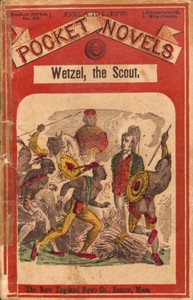
Wetzel, the Scout; or, The Captives of the Wilderness — Reading Companion
(0 User reviews)
1265
Project Gutenberg
2021
Not confirmed
Frontier and pioneer life -- Fiction; Dime novels; Shawnee Indians -- Fiction; Ohio River Valley -- Fiction
Readers of public-domain and historical texts
Project Gutenberg digital edition
en
Edition facts
Words
35,748
Reading time
156 min
Text sections
5
This digital edition of Wetzel, the Scout; or, The Captives of the Wilderness — Reading Companion is described by source-level measurements including 35,748 words, 2 hr 36 min estimated reading time, and 5 detected text sections.
The text analysis averages about 17.5 words per sentence, while the detected sections provide another way to judge how the source is divided.
Project Gutenberg metadata also associates the work with “Frontier and pioneer life -- Fiction,” connecting these edition facts with the source record’s subject description.
Source:
Project Gutenberg record #66335
This editorial note examines the narrative voice and pacing in Edward Sylvester Ellis's 1871 dime novel, focusing on the contrast between comic dialogue and intense battle scenes, and the use of dialect and abrupt shifts in tone.
Read the complete public-domain text at its original source.
Read on Project GutenbergThe opening chapter of Wetzel, the Scout; or, The Captives of the Wilderness introduces Captain Parks and his servant Pompey through a comic exchange marked by dialect and physical humor. Pompey's speech—"Heben sabe me, massa captain"—and his accidental discharge of a rifle establish a tone of farce that sits oddly with the frontier setting. This voice, however, is not sustained. As the narrative progresses, the prose shifts abruptly into a stark, rapid-fire account of a Shawnee attack on a settlement, where the pace accelerates through short declarative sentences and repeated commands: "Fire quicker, boys, and with a sure aim." The juxtaposition of these two registers—buffoonery and brutality—raises questions about the novel's intended audience and its handling of violence.
Dialect as Characterization and Comic Relief
Pompey's dialect is rendered phonetically and consistently: "I bring to mind I did have de hammer up." Captain Parks responds with physical abuse—"giving his servant a tremendous kick"—and threats of abandonment. The humor depends on the reader's complicity in viewing Pompey as inept and fearful. This treatment of the enslaved character aligns with the dime novel's conventions of broad caricature, but it also creates a tonal dissonance when the same author later describes the death of a settler with clinical detachment: "An Indian bullet had entered the orifice directly beside the muzzle of his rifle." The comic opening does not prepare the reader for the grim realism of the battle sequences.
Acceleration and Compression in Battle Scenes
The attack on the settlement is narrated with a staccato rhythm. Sentences are short, often beginning with conjunctions: "And now came the struggle for life." The description of the breach is compressed into a single paragraph that moves from "the pickets yielded" to "the dead bodies of their own comrades blocking up the breach" in a few lines. The narrator withholds emotional commentary, reporting actions and outcomes without interiority. This technique creates a sense of relentless forward motion, contrasting sharply with the earlier, more leisurely comic dialogue. The shift in pace is not gradual but abrupt, suggesting that the novel's structure is built on alternating modes rather than a unified tone.
The Renegade and the Ranger: Offstage Authority
Although the title promises Wetzel as the central figure, the excerpts show him only as a reference point—"the renowned ranger Lew Wetzel"—whose directions guide the plot but whose presence is deferred. Similarly, the chapter list includes "The Renegade" and "Colonel Clark and His Rangers," but the provided text focuses on Captain Parks and the minister Edwards. This narrative strategy keeps the eponymous scout at a distance, building anticipation through absence. The voice of the novel, then, is not Wetzel's but that of an omniscient narrator who moves between comic and violent registers, leaving the reader to wonder how the scout's eventual appearance will reconcile these disparate tones.
Readers approaching Wetzel, the Scout should attend to its shifts in pace and register as deliberate structural choices rather than inconsistencies. The novel's alternation between slapstick and stark violence reflects the dime novel's need to hold a broad audience, but it also creates a reading experience that is jarring and unpredictable. Pay particular attention to how the narrator handles transitions between scenes—the gaps are as telling as the action itself.
There’s something about that old Ellis voice—all rough jokes one minute, then a sudden hush before the tomahawk falls—that stays with you. It reminds me of turning pages by lamplight, half-holding my breath. That same wild, wistful feeling lives in The Wolf Queen; or, The Giant Hermit of the Scioto — Key Ideas to Explore, as if the woods themselves are listening.
There are no reviews for this eBook.
There are no comments for this eBook.
Reader reflection
What was your reading experience?
Capture what you thought, learned, and would like to remember.
Your progress
0
/
10
2
How much did you enjoy the reading experience?
3
Would you pass this book on to a friend?
4
What was the reading difficulty like?
5
How did the reading compare with what you expected?
6
How useful did the reading feel?
7
How closely did the book connect with your experience?
8
Did the book offer a fresh perspective?
9
In one sentence, what did you learn?
10