1

A Lucky Deal; or The 'Cutest Boy in Wall Street — Reading Notes
(0 User reviews)
1983
Project Gutenberg
2022
Not confirmed
Bildungsromans; Dime novels; Wall Street (New York, N.Y.) -- Fiction; Deals -- Fiction
Readers of public-domain and historical texts
Project Gutenberg digital edition
en
Edition facts
Words
36,101
Reading time
157 min
Text sections
24
The catalog record for A Lucky Deal; or The 'Cutest Boy in Wall Street — Reading Notes provides practical reading context through 36,101 words, 2 hr 37 min estimated reading time, and 24 detected text sections.
The text analysis averages about 13.7 words per sentence, while the detected sections provide another way to judge how the source is divided.
Project Gutenberg metadata also associates the work with “Bildungsromans,” connecting these edition facts with the source record’s subject description.
Source:
Project Gutenberg record #67380
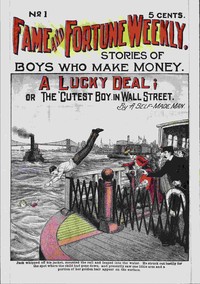
This editorial note examines how the opening, middle, and later excerpts of this 1905 dime novel guide a first reading, focusing on the shift from domestic crisis to Wall Street dealings, the use of dialogue and humor, and the portrayal of the young protagonist Jack Hazard.
Read the complete public-domain text at its original source.
Read on Project GutenbergThe first chapter of A Lucky Deal; or The 'Cutest Boy in Wall Street opens not on the trading floor but in a domestic scene of financial distress. Mrs. Hazard discovers that the rent money has vanished, and the family—a widowed mother, her daughter Annie, and son Jack—faces eviction. The narrator quickly establishes that Jack, sixteen and recently unemployed, is the family’s best hope. This setup, typical of dime-novel serials, immediately creates sympathy and stakes. The missing fifteen dollars is a small sum, but the text insists it represents their entire capital, heightening the tension. Readers familiar with the genre will recognize the pattern: a sudden crisis propels the young hero into the wider world.
From Parlor to Street: The Opening’s Dual World
The opening chapter alternates between the Hazard home and the bustling streets of New York. Inside, the language is sentimental: Mrs. Hazard is a “pleasant-featured little woman,” Annie sews infant jackets, and the missing money is described as a “fresh misfortune.” Outside, the narrative shifts to a more brisk, commercial tone. Jack’s former job at a wholesale house and his father’s lack of life insurance are mentioned matter-of-factly. This contrast prepares readers for the boy’s transition from domestic protector to street-wise operator. The excerpt does not yet show Wall Street, but the title promises it, and the opening’s emphasis on money and loss primes the reader for a story about financial survival.
Dialogue as Character: Jack’s Voice and the Office Scene
In the middle excerpt, Jack’s personality emerges through dialogue. When the broker Mr. Bird warns him against repeated speculation, Jack replies, “if I see another good thing going to waste I should feel sorry to let it get away from me.” This line reveals his confidence and a hint of recklessness. Later, in the office, Jack teases the typist Millie and the English clerk Percy Chamberlain. His mimicry of Percy’s speech—“don’t you know”—and his quick retorts show a boy comfortable with verbal sparring. The scene also establishes social hierarchies: Percy dismisses Jack as “only the office boy,” but Jack’s wit undercuts that status. Readers see that Jack’s sharp tongue is part of his arsenal, as important as any financial tip.
The Broker’s Warning and the Limits of the Excerpts
Mr. Bird’s advice—“The best thing that could happen to people who come into Wall Street is to lose their first deal”—introduces a cautionary note. The broker speaks from experience, and his words contrast with Jack’s optimism. However, the excerpts do not reveal whether Jack heeds this warning or suffers a setback. The text is incomplete, so a first reader must remain uncertain. The warning may foreshadow a future loss, or it may be a conventional moral gesture common in dime novels. The story’s title, A Lucky Deal, suggests fortune favors Jack, but the broker’s skepticism adds ambiguity. Readers should watch for how later chapters balance luck with consequence.
Recurring Details: Violets, Red Cord, and Class Signals
Small objects carry weight in the excerpts. The violets Jack buys for Millie are tied with red cord, and he later points out that Percy’s identical bouquet has the same cord, exposing the clerk’s lie about buying from a fancy florist. This detail does more than embarrass Percy; it shows Jack’s attention to the material world and his willingness to use small facts to gain advantage. The violets also mark a romantic subplot, though Millie’s response is ambiguous. Similarly, the mention of Sherry’s restaurant and Hutchins’ florist signals a world of luxury that Jack is beginning to access. These recurring references to specific brands and prices ground the story in a recognizable New York economy, where a five-cent weekly could buy a ticket to a world of deals and dinners.
For a first reading, pay attention to how the narrator balances Jack’s cleverness with the risks of the market. The excerpts suggest a hero who wins through wit and luck, but the broker’s warning and the family’s precarious finances hint at possible reversals. The dime-novel format rewards quick pacing and episodic action, so expect each chapter to introduce a new deal or obstacle. The story’s title promises a lucky break, but whether that luck holds is a question the reader must follow to the final page.
That little book made me think about how a kid’s nerve gets tested, not just in one crisis but in everything after. I remember feeling that same ache reading The Texas Hawks; or, The Strange Decoy — Context and Discussion—how a bright start can shadow a whole story, leaving you quiet long after the last page.
There are no reviews for this eBook.
There are no comments for this eBook.
Reader reflection
Record your reading impressions
A brief reflection can help important ideas stay with you longer.
Your progress
0
/
10
2
What was your overall reaction to the book?
3
How likely are you to recommend this book?
4
Did the language feel accessible?
5
Could you follow the author’s main argument?
6
Was the book what you thought it would be?
7
Would this book work well in a reading group?
8
How original did the book feel?
9
What did this book teach you most?
10