1

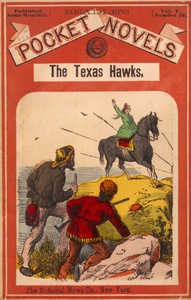
The Texas Hawks; or, The Strange Decoy — Context and Discussion
(0 User reviews)
391
Project Gutenberg
2021
Not confirmed
Dime novels; Texas -- Fiction; Brigands and robbers -- Fiction; Kiowa Indians -- Fiction
Readers of public-domain and historical texts
Project Gutenberg digital edition
en
Edition facts
Words
38,693
Reading time
169 min
Text sections
5
The source record for The Texas Hawks; or, The Strange Decoy — Context and Discussion measures this digital text at 38,693 words, 2 hr 49 min estimated reading time, and 5 detected text sections.
The text analysis averages about 14.6 words per sentence, while the detected sections provide another way to judge how the source is divided.
Project Gutenberg metadata also associates the work with “Dime novels,” connecting these edition facts with the source record’s subject description.
Source:
Project Gutenberg record #66248
In this 1872 dime novel, a hunting party's campfire dispute over a 'strange rider' sets off a chain of abduction and pursuit. Badger contrasts careless ease with sudden violence, using precise physical details—hoof-print chips, unbarred doors, a mastiff's corpse—to ground the melodrama in tangible clues.
Read the complete public-domain text at its original source.
Read on Project GutenbergThe Texas Hawks opens not with a chase but with a debate: two hunters by a campfire argue whether a rumored "strange rider" is a hoax. One speaker is "careless and slightly scoffing," the other "low and earnest." This vocal contrast sets the pattern for a story built on opposed tones—leisure and peril, domestic calm and violent disruption.
Badger lingers on the bivouac's details: half-picked bones, sweat-wet horses, frost-touched leaves forming a "gayly-tinted arch." The scene is almost too picturesque, a deliberate calm before the storm. When the abduction comes, it is signaled by small, concrete signs—an unbarred door, a missing horse, a dead mastiff—rather than grand omens. The novel's tension lies in how ordinary objects become evidence of betrayal.
Voices in Opposition
The opening dialogue establishes a structural habit: Badger pairs contrasting voices to dramatize uncertainty. The scoffing hunter dismisses the strange rider as "sheer nonsense—nothing but a hoax"; his companion insists "there is something in it." This back-and-forth recurs in later confrontations. When Archibald Hawksley discovers his daughter missing, his wife's grief-stricken cry—"Oh! Fannie—my child, my poor child!"—is met with his cold command: "Peace, Esther." He shifts from despair to grim efficiency, swearing to have the abductor's "heart's blood." The novel repeatedly sets emotional outburst against controlled action, letting the reader feel the strain between feeling and duty.
Even the abductor, Mark Haley, speaks in a "hissed" tone that contrasts with the settler's blunt rage. Badger uses these vocal cues to map character without interior monologue: what a person says, and how they say it, becomes their motive.
Clues in the Dust
Badger invests extraordinary care in physical evidence. When Hawksley takes the abductor's trail, he dismounts to examine each hoof-print: "Large hoofs, shod in front; a triangular chip broken from the inside edge of the off hind foot." This forensic detail—specific enough to identify a single horse—grounds the melodrama in a detective-like procedure. The novel treats tracking as a skill, not magic: Hawksley leaves "plenty of signs" for his neighbors to follow, and the reader is given the same clues.
Earlier, the discovery of the missing girl is built from mundane absences: the door unbarred, the stranger's horse gone, the mastiff's "stiff and mangled body." Badger does not describe the abduction itself; he shows only its aftermath. The effect is to make the reader a co-investigator, piecing together what happened from broken details. This method gives the dime novel a surprising texture of realism within its formulaic frame.
The Settler's Double Blow
Archibald Hawksley faces not one loss but two: his "only grown son" has already disappeared before the story opens, and now his daughter Fannie is taken. Badger uses this cumulative grief to motivate action rather than despair. The narrator notes that "this second blow, following so closely upon the disappearance of his only grown son, instead of crushing him to the earth, seemed to call forth all his energies." The settler becomes a man remade by crisis, his composure "unnatural" and feverish.
This pattern—a character hardened by sequential loss—is typical of the dime novel's frontier ethos, but Badger gives it a specific edge. Hawksley's wife, Esther, is left behind to dispatch children for help, her terror "momentarily stilled" by her husband's stern commands. The division of labor (man tracks, woman organizes) is clear, but the emotional cost is registered in small gestures: the mother's repeated cry "Fannie—my child," the father's "groan of heartfelt despair" before he steels himself. The novel treats grief as a fuel, not a stop.
Readers attentive to physical detail will find Badger's tracking sequences as rewarding as his shootouts. The novel rewards a slow eye: note how often a door, a footprint, or a broken branch carries more weight than a speech. The Texas Hawks is a story told through objects left behind—a chip in a hoof, an unbarred latch, a dead dog—and the men who read them. Approach it as a puzzle as much as a chase.
There’s something about that old dime novel’s quiet before the storm—the way a locked door matters more than any shout—that reminds me of reading Williwaw years later, where weather itself does the same patient, patient work. Both leave you holding your breath without quite knowing why. That’s just how some stories stay with you. Williwaw: A Novel — Edition Insights feels like a friend remembering, too.
There are no reviews for this eBook.
There are no comments for this eBook.
Reader reflection
What was your reading experience?
Capture what you thought, learned, and would like to remember.
Your progress
0
/
10
2
Was reading this book enjoyable?
3
Is this a title you would suggest to others?
4
What was the reading difficulty like?
5
How did the pace of the book feel?
6
Would this book work well in a reading group?
7
Is this a title worth rereading?
8
How valuable was this book for your own interests?
9
What changed or sharpened your thinking?
10