1

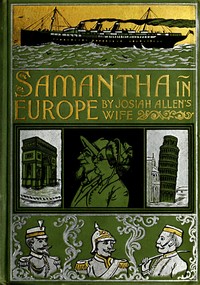
Samantha in Europe — A Reader’s Guide
(0 User reviews)
1544
Project Gutenberg
2021
Not confirmed
Voyages and travels -- Fiction; Americans -- Europe -- Fiction; United States -- Social conditions -- 1865-1918 -- Fiction; Europe -- Description and travel -- Fiction
Readers of public-domain and historical texts
Project Gutenberg digital edition
en
Edition facts
Words
153,322
Reading time
667 min
Text sections
48
Before opening Samantha in Europe — A Reader’s Guide, the edition data offers a quick orientation: 153,322 words, 11 hr 7 min estimated reading time, and 48 detected text sections.
The text analysis averages about 21.6 words per sentence, while the detected sections provide another way to judge how the source is divided.
Project Gutenberg metadata also associates the work with “Voyages and travels -- Fiction,” connecting these edition facts with the source record’s subject description.
Source:
Project Gutenberg record #66972
Marietta Holley's Samantha in Europe follows the sharp-tongued Samantha and her husband Josiah on a tour abroad, blending domestic humor with pointed social commentary. Through dialect-rich dialogue and vivid descriptions of sights like the Warwick vase, Holley contrasts American and European customs while threading temperance advocacy and critiques of inequality into the travelogue.
Read the complete public-domain text at its original source.
Read on Project GutenbergMarietta Holley’s Samantha in Europe opens not with a ship’s departure but with a kitchen-table quarrel. Josiah, hungry and skeptical, dismisses his wife’s writing as “weak” because it is “writ by a woman,” while Samantha calmly fries chicken and retorts that she would “hate to sadden the world” by stopping. This domestic prologue sets the pattern for the entire travel narrative: Samantha’s observations of European landmarks are continually interrupted by Josiah’s complaints, her moralizing, and the couple’s running debate about gender, duty, and taste. The preface alone establishes the book’s distinctive voice—colloquial, ironic, and unapologetically opinionated.
A Voice That Refuses to Be Polished
Holley writes Samantha’s narration in a thick rural dialect—“sez,” “hain’t,” “wuz,” “mebby”—that marks her as an outsider to the refined European settings she describes. This linguistic choice does more than create folksy charm; it becomes a tool of critique. When Samantha gazes at the Warwick vase, she shifts from aesthetic appreciation to a temperance sermon, linking the carved vine leaves to “that sharp spear that Mr. Bacchus brandishes.” Josiah’s exasperated plea—“Keep on! I believe you’d keep up your dum temperance talk if you wuz on the way to the scaffold”—underscores the friction between Samantha’s moral earnestness and Josiah’s desire for peace. The dialect allows Holley to embed serious arguments about drink, hypocrisy, and history within what might otherwise be a conventional sightseeing account.
Sightseeing as Moral Theater
The excerpts show that Samantha rarely lets a monument pass without commentary. At the Warwick vase, she speculates about its original users—“How come it sunk in the bottom of the lake?”—and invents a story of a drinker so disgusted by revelry that he threw the vase away. This is not idle fancy; it is a deliberate reframing of a classical artifact through a temperance lens. Similarly, the hospital founded by Robert Dudley prompts a curt dismissal: “Sech likely deeds as this couldn’t cover up his black performances.” Samantha’s judgments are swift and moral, treating history as a ledger of virtue and vice. Josiah, by contrast, wants only a drawbridge to keep unwanted visitors away—a fantasy of domestic retreat that Samantha rejects as impractical. Their exchanges turn every landmark into a debate about how to live.
The Unseen Weight of Home
Despite the European setting, the book’s emotional center remains the Allen household. The dedication addresses “the weary traveller who yearns to see under strange skies the light of the old home fire,” and the preface ends with Samantha preparing supper while Josiah grumbles. Even abroad, the couple’s arguments circle back to domestic concerns: Josiah’s hunger, Samantha’s cooking, the cost of things. When Josiah proposes a moat and drawbridge for their house, Samantha’s reply—“how could I face ’em the next Sunday in meetin’?”—reveals that her real compass is community reputation, not foreign wonders. The travelogue thus becomes a sustained tension between the pull of adventure and the gravitational force of home, with Samantha always measuring the strange against the familiar.
Readers should listen for the gaps between what Samantha says and what Holley implies. The dialect is not a limitation but a weapon; Josiah’s complaints are not mere comic relief but a counterpoint that sharpens Samantha’s arguments. Pay attention to how often a description of a castle or church slides into a sermon on drink, charity, or women’s work. The book rewards those who read the travelogue as a sustained performance of moral inquiry disguised as a vacation diary.
Flipping through Samantha in Europe, I paused at her dry remarks on foreign grandeur—how it often masks plain discomfort. It reminded me, oddly, of the frontier writings in Wetzel, the Scout; or, The Captives of the Wilderness — Reading Companion, where the wilderness itself is another kind of lavish, unforgiving landscape. Different worlds, yet both ask what we truly carry when the scenery changes.
There are no reviews for this eBook.
There are no comments for this eBook.
Reader reflection
What was your reading experience?
Capture what you thought, learned, and would like to remember.
Your progress
0
/
10
2
How much did you enjoy the reading experience?
3
Is this a title you would suggest to others?
4
What was the reading difficulty like?
5
Is this a title worth rereading?
6
Did the story or argument move comfortably?
7
Could you apply anything you learned?
8
How clear did the writing feel?
9
What did this book teach you most?
10