1

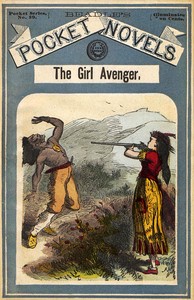
The Girl Avenger; or, The Beautiful Terror of the Maumee — Story, Setting & Ideas
(0 User reviews)
761
Project Gutenberg
2022
Not confirmed
Adventure stories; Frontier and pioneer life -- Fiction; Dime novels; Ohio -- Fiction
Readers of public-domain and historical texts
Project Gutenberg digital edition
en
Edition facts
Words
37,885
Reading time
165 min
Text sections
21
Before opening The Girl Avenger; or, The Beautiful Terror of the Maumee — Story, Setting & Ideas, the edition data offers a quick orientation: 37,885 words, 2 hr 45 min estimated reading time, and 21 detected text sections.
The text analysis averages about 19.2 words per sentence, while the detected sections provide another way to judge how the source is divided.
Project Gutenberg metadata also associates the work with “Adventure stories,” connecting these edition facts with the source record’s subject description.
Source:
Project Gutenberg record #68016
An editorial note on T. C. Harbaugh's 1872 dime novel, focusing on how the opening, middle, and later excerpts guide a first reading of this frontier adventure set in 1794 along the Maumee River.
Read the complete public-domain text at its original source.
Read on Project GutenbergThe novel opens with a stag hunt on the Maumee in August 1794, immediately establishing a pattern of sudden violence: an Indian shoots the stag, then is himself shot by an unseen assailant. The prose is brisk, relying on stock phrases like "the red tide of life" and "the whip-like crack of a rifle." The narrator identifies the shooter only as a "young she-wolf"—a nickname that foreshadows the title character's ferocity. This opening scene, with its swift reversal of hunter and hunted, sets the tone for a narrative where no character is safe and allegiances shift without warning.
The Opening: A World of Sudden Violence
The first chapter introduces the setting and a key motif: the natural world as both refuge and trap. The stag's cautious approach to water, the Indian's hidden rifle among the pansies, and the "almost human cry" of the dying animal all emphasize the precariousness of life. The shooter, later revealed to be Effie St. Pierre, is described as a "young she-wolf"—a term that blends human and animal, hinting at her role as an avenger. The prose relies on sensory details (smoke, crack of rifle, warm blood) to create immediacy, but the narrator remains omniscient, occasionally addressing the reader directly. This opening primes the reader for a story where action is swift and moral lines are blurred.
The Middle: Captivity and Confrontation
In the cave scene, the narrative shifts to a confined space where multiple characters converge. Effie St. Pierre is braiding her hair while listening to Major Rudolph Runnion's "twice-told passion." The dialogue reveals that Runnion is a British officer wounded by a trader, and that a "red-coat at the fort" offers a bounty for him. The Ottawa chief Wacomet observes them, planning to take Effie, the skins, rifles, and gold. The scene builds tension through Wacomet's silent observation and Effie's sudden detection of him. Her swift action—firing a double-barreled pistol—mirrors the opening's sudden violence. The description of Wacomet's wound ("a frightful wound in the cheek") and his recovery underscores the physical toll of frontier conflict. This section shows how the novel uses confined spaces and multiple perspectives to heighten suspense.
The Later Excerpt: Language and Loyalty
Later in the text, Wacomet is described as having "frequent companionship with the whites" and being "to a great extent, a master of the English language." This detail complicates the portrayal of Native characters, suggesting a degree of cultural contact and adaptation. The narrative also reveals that Effie has "three lovers—two white, the third red," though the excerpt does not specify her feelings. The phrase "the minion of an imbecile king" (referring to King George III) injects a political note, aligning the novel with American frontier ideology. The prose continues to favor action over introspection: Effie's shriek, the tomahawk blow, and Wacomet's hissed "Wacomet's squaw at last!" drive the plot forward. Readers should note how the novel balances melodramatic dialogue with bursts of physical conflict.
Structure and Pacing: A Dime Novel's Rhythm
With 21 text sections and a total word count of 37,885, the novel moves quickly. Each chapter typically ends on a cliffhanger—the stag's death, the cave shot, Wacomet's capture of Effie. The narrative alternates between outdoor action (hunts, chases) and indoor confrontations (caves, forts). The use of multiple character perspectives (Effie, Runnion, Wacomet) allows the reader to see events from different sides, but the omniscient narrator always controls the flow. The prose is efficient, relying on familiar dime-novel conventions: exaggerated emotions, physical descriptions, and moral contrasts. First-time readers should expect a fast-paced story where character motivations are often stated outright, and where the setting—the Maumee River valley—serves as both a picturesque backdrop and a site of constant danger.
This novel rewards attention to its opening scenes, which establish the rhythm of violence and reversal that defines the narrative. The excerpts suggest that Effie St. Pierre is less a fully developed character than a force of nature—the "Beautiful Terror" of the title. Readers should watch for how the novel uses animal imagery (she-wolf, stag, serpent) to blur the line between human and wild. The historical setting of 1794, during the Northwest Indian War, provides a backdrop for conflicts that are personal as well as political. Approach the text as a period artifact of dime-novel storytelling, where action and atmosphere matter more than psychological depth.
Reading about that 1794 frontier terror, I remembered crouching in my grandfather’s barn with a flashlight, the Maumee’s mud and menace feeling as real as the hay dust. It reminded me of the quiet dread in Williwaw, where weather itself becomes the antagonist. That same shiver of smallness against something vast. Perhaps that’s what draws me back to Williwaw: A Novel — Edition Insights—not adventure, but the hush before it breaks.
There are no reviews for this eBook.
There are no comments for this eBook.
Reader reflection
Record your reading impressions
A brief reflection can help important ideas stay with you longer.
Your progress
0
/
10
2
Did this book hold your interest?
3
Is this a title you would suggest to others?
4
How demanding did the text feel?
5
What was the strongest part of the book?
6
Did this book create an emotional response?
7
Did the book give you something worth debating?
8
Was the book what you thought it would be?
9
What is the main idea you are taking away?
10